answer.
Ask question
Login Signup
Ask question
All categories
  • English
  • Mathematics
  • Social Studies
  • Business
  • History
  • Health
  • Geography
  • Biology
  • Physics
  • Chemistry
  • Computers and Technology
  • Arts
  • World Languages
  • Spanish
  • French
  • German
  • Advanced Placement (AP)
  • SAT
  • Medicine
  • Law
  • Engineering
Vaselesa [24]
2 years ago
15

Learning Goal:

Physics
1 answer:
skelet666 [1.2K]2 years ago
5 0

Answer:

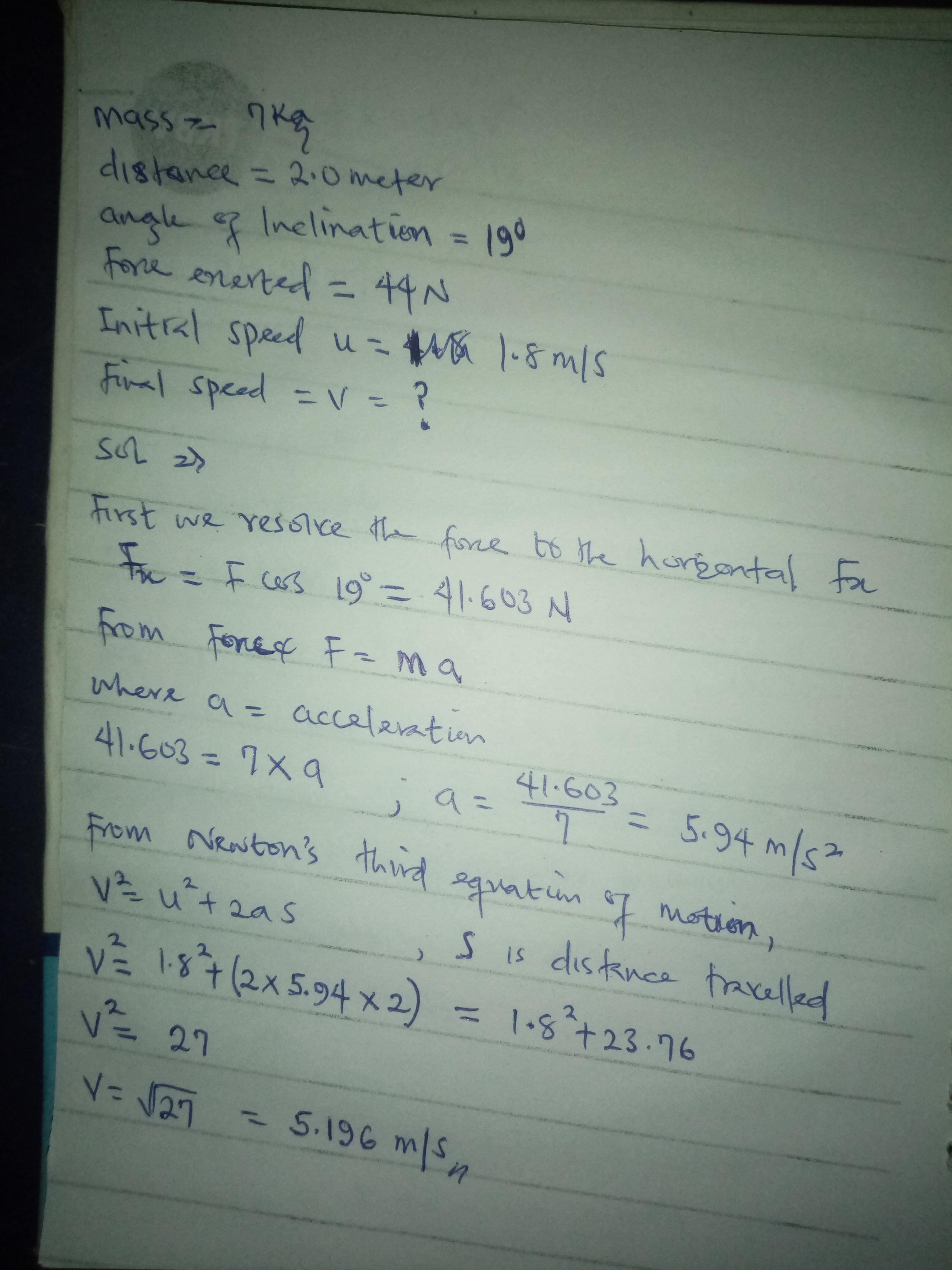
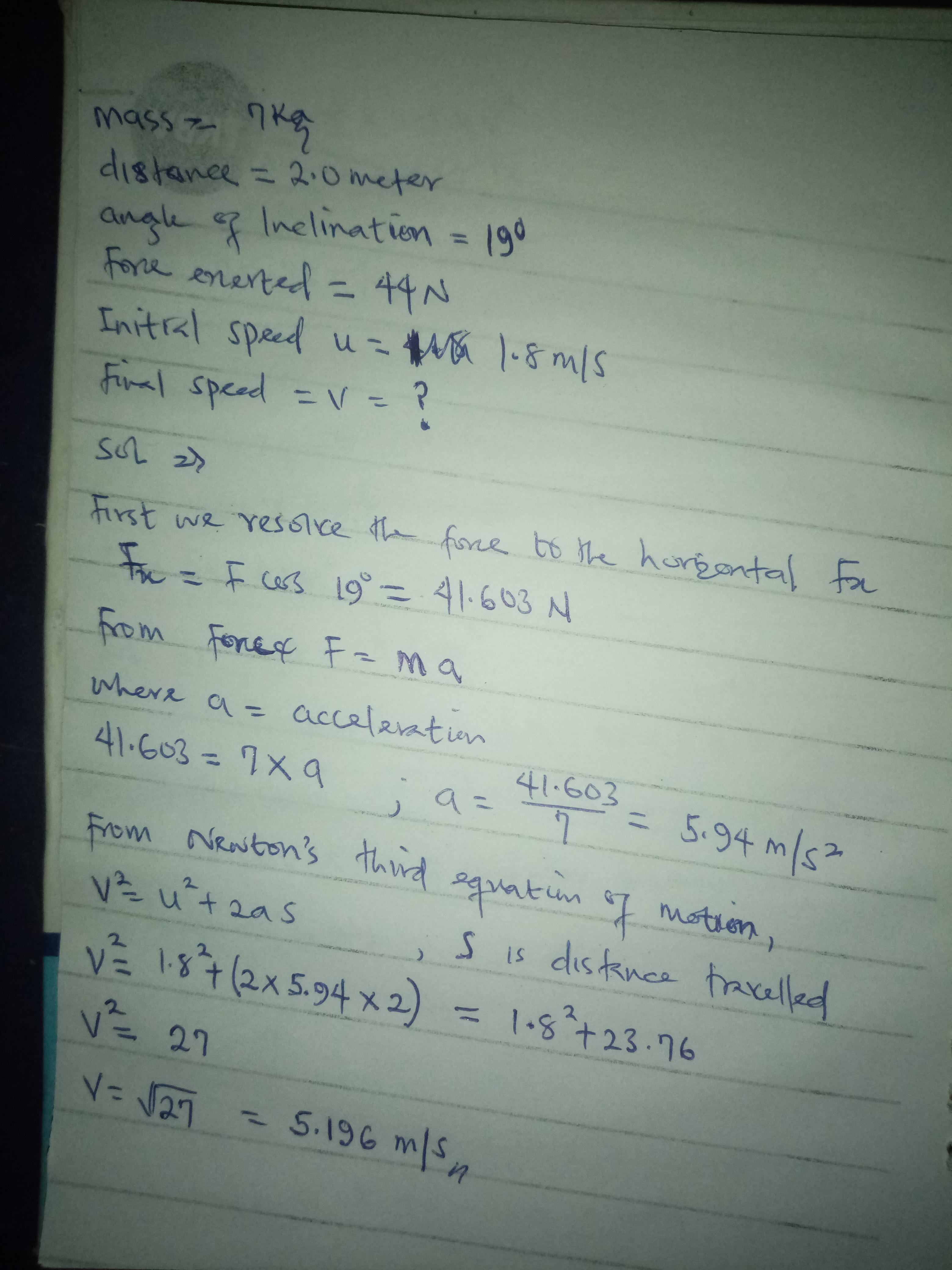
Velocity up the ramp is 5.196m/s

Explanation:

Detailed explanation and calculation is shown in the image below

You might be interested in
The following times are given using metric prefixes on the base SI unit of time: the second. Rewrite them in scientific notation
Leno4ka [110]

Answer: a=9.8*10^-10s

b=9.8*10^-13s

c=1.7*10^-8s

d=5.57*10^-4s

Explanation:

a) given 980 ps

Expected answer is 980 * 10^-12

Therefore, 980ps = 9.8*10^-10s

b) given 980 fs

Expected answer is 980 * 10^-15

Therefore, 980fs = 9.8*10^-13s

c) given 17 ns

Expected answer is 17 * 10^-9

Therefore, 17ns = 1.7*10^-8s

d) given 577 μs

Expected answer is 577 * 10^-6

Therefore, 577μs = 5.57*10^-4s

a=9.8*10^-10s

b=9.8*10^-13s

c=1.7*10^-8s

d=5.57*10^-4s

8 0
2 years ago
Read 2 more answers
If you pull a resistant puppy with its leash in a horizontal direction, it takes 80 N to get it going. You can then keep it movi
netineya [11]

Answer:

The coefficient of static friction between the puppy and the floor is 0.7273.

Explanation:

The horizontal force applied to move the puppy from a steady state has to be greater than the force of static friction, after it is moving the force needs to be equal to be greater than the force of dynamic friction in order to maintain its movement. The force of static friction is given by:

F_s = \mu_s*N

Where F_s is the static friction force, \mu_s is the coefficient of static friction and N is the normal force. Since there's no angle on the flor the normal force is equal to the weight of the puppy, therefore, N = 110\text{ N}, to make the puppy moving we need to use a force of 80 N, therefore, F_s = 80 \text{ N}, so we can solve for the coefficient as shown below:

80 = \mu_s*110\\\mu_s = \frac{80}{110} = 0.7273\\

The coefficient of static friction between the puppy and the floor is 0.7273.

5 0
2 years ago
A slender rod is 80.0 cm long and has mass 0.370 kg . A small 0.0200-kg sphere is welded to one end of the rod, and a small 0.05
nataly862011 [7]

Answer:

1.10 m/s

Explanation:

Linear speed is given by

v=r\omega

Kinetic energy is given by

KE=0.5I\omega^{2}

Potential energy

PE= mgh

From the law of conservation of energy, KE=PE hence

0.5I\omega^{2}=mgh where m is mass, I is moment of inertia, \omega is angular velocity, g is acceleration due to gravity and h is height

Substituting m2-m1 for m and 0.5l for h, \frac {2v}{L} for \omega we obtain

0.5I(\frac {2v}{L})^{2}=0.5Lg(m2-m1)

(\frac {2v}{L})^{2}=\frac {gl(m2-m1)}{I} and making v the subject

v^{2}=\frac {gl^{3}(m2-m1)}{4I}

v=\sqrt {\frac {gl^{3}(m2-m1)}{4I}}

For the rod, moment of inertia I=\frac {ML^{2}}{12} and for sphere I=MR^{2} hence substituting 0.5L for R then I=M(0.5L)^{2}

For the sphere on the left hand side, moment of inertia I

I=m1(0.5L)^{2} while for the sphere on right hand side, I=m2(0.5L)^{2}

The total moment of inertia is therefore given by adding

I=\frac {ML^{2}}{12}+ m1(0.5L)^{2}+ m2(0.5L)^{2}=\frac {L^{2}(M+3m1+3m2)}{12}

Substituting \frac {L^{2}(M+3m1+3m2)}{12} for I in the equation v=\sqrt {\frac {gL^{3}(m2-m1)}{4I}}

Then we obtain

v=\sqrt {\frac {gL^{3}(m2-m1)}{4(\frac {L^{2}(M+3m1+3m2)}{12})}}=\sqrt {\frac {3gL^{3}(m2-m1)}{L^{2}(M+3m1+3m2)}}

This is the expression of linear speed. Substituting values given we get

v=\sqrt {\frac {3*9.81*0.8^{3}(0.05-0.02)}{0.8^{2}(0.39+3(0.02)+3(0.05))}} \approx 1.08 m/s

8 0
2 years ago
which has a greater kinetic energy, a bowling ball that has a mass of 5kg travelling at 6m/s, or a ship that has a mass of 12000
AVprozaik [17]

Answer:bowling ball has greater kinetic energy

Explanation:

Kinetic energy of bowling ball:

mass=m=5kg

Velocity=v=6m/s

Kinetic energy =ke

Ke=0.5 x m x v x v

Ke=0.5 x 5 x 6 x 6

Ke=90J

Kinetic energy of ship:

mass=m=120000kg

velocity=v=0.02m/s

Ke=0.5 x m x v x v

Ke=0.5 x 120000 x 0.02 x 0.02

Ke=24J

6 0
2 years ago
If you add 700 kJ of heat to 700 g of water at 70 degrees C, how much water is left in the container? The latent heat of vaporiz
makkiz [27]

Answer:A

Explanation:Find attached picture file for details
3 0
2 years ago
Other questions:
  • Which of the following ways is usable energy lost?
    14·2 answers
  • A passenger jet flies from one airport to another 1,273 miles away in 2.2 h. find its average speed.
    14·2 answers
  • The number that is used to show the value of one currency compared to another is called the __________. A. trade rate B. currenc
    6·1 answer
  • Why are experiments often performed in laboratories?
    7·1 answer
  • 50 POINTS! A Boy throws a ball horizontally a distance of 22m downrange from the top of a tower that is 20.0m tall. What is his
    7·1 answer
  • The oscillating current in an electrical circuit is as follows, where I is measured in amperes and t is measured in seconds. I =
    15·1 answer
  • in a race, Usain Bolt accelerates at 1.99m/s^2 for the first 60.0m, then decelerates at -0.266m/s^2 for the final 40.0m. what wa
    13·1 answer
  • Wire A has the same length and twice the radius of wire B. Both wires are made of the same material and carry the same current.
    8·1 answer
  • You are riding a rollercoaster going around a vertical loop, on the inside of the loop. If the loop has a radius of 30 meters, h
    14·2 answers
  • Four kilograms of carbon monoxide (CO) is contained in a rigid tank with a volume of 1 m^3. The tank is fitted with a paddle whe
    11·1 answer
Add answer
Login
Not registered? Fast signup
Signup
Login Signup
Ask question!