answer.
Ask question
Login Signup
Ask question
All categories
  • English
  • Mathematics
  • Social Studies
  • Business
  • History
  • Health
  • Geography
  • Biology
  • Physics
  • Chemistry
  • Computers and Technology
  • Arts
  • World Languages
  • Spanish
  • French
  • German
  • Advanced Placement (AP)
  • SAT
  • Medicine
  • Law
  • Engineering
Kay [80]
2 years ago
4

The sound tube experiment was performed in gas Carbon Dioxide at temperature 20 deg. C. The students partnering on the bench obt

ained for the slope of the straight line fitting of the experimental points the value 365.0. Compare the speed of sound following from that slope to the calculated speed of sound from the gas properties? For CO2, Cp/Cv = 1.289, and the mass of one mol CO2 is 0.044 kg. The sound tube length is 0.367 m. The additional necessary datum is given in the text.

Physics
1 answer:
marta [7]2 years ago
7 0

Answer:

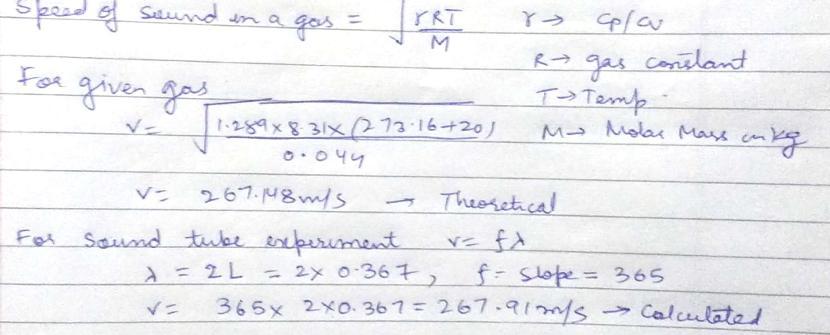
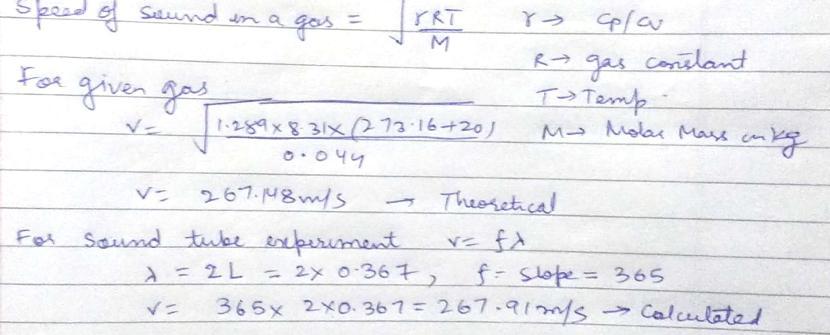
The speed of sound theoretically is 267.148 m/s which is clearly less than slope calculated speed 365.0 m/s

Explanation:

check the attached picture

You might be interested in
Steam at 700 bar and 600 oC is withdrawn from a steam line and adiabatically expanded to 10 bar at a rate of 2 kg/min. What is t
Setler79 [48]

Answer:

Final temperature of the steam = 304.29 K = 31.14°C

Rate Entropy generation of the process should be 0 because no heat is transferred into or out of the system. And ΔS = Q/T = 0 J/K.

But 0.01 J/k.s was obtained though, which is approximately 0.

Explanation:

For an adiabatic system, the Pressure and temperature are related thus

P¹⁻ʸ Tʸ = constant

where γ = ratio of specific heats. For steam, γ = 1.33

P₁¹⁻ʸ T₁ʸ = P₂¹⁻ʸ T₂ʸ

P₁ = 700 bar

P₂ = 10 bar

T₁ = 600°C = 873.15 K

T₂ = ?

(700⁻⁰•³³)(873.15¹•³³) = (10⁻⁰•³³)(T₂¹•³³)

T₂ = 304.29 K = 31.14°C

b) Rate Entropy generation of the process should be 0 because no heat is transferred into or out of the system. And ΔS = Q/T

To prove this

Entropy of the process

dQ - dW = dU

dQ = dU + dW

dU = mCv dT

dW = PdV

dQ = TdS

TdS = mCv dT + PdV

dS = (mCv dT/T) + (PdV/T) =

PV = mRT; P/T = mR/V

dS = (mCv dT/T) + (mRdV/V)

On integrating, we obtain

ΔS = mCv In (T₂/T₁) + mR In (V₂/V₁)

To obtain V₁ and V₂, we use PV = mRT

V/m = specific volume

Pv = RT

R for steam = 461.52 J/kg.K

For V₁

P = 700 bar = 700 × 10⁵ Pa, T = 873.15 K

v₁ = (461.52 × 873.15)/(700 × 10⁵) = 0.00570 m³/kg

For V₂

P = 10 bar = 10 × 10⁵ Pa, T = 304.29 K

v₂ = (461.52 × 304.29)/(10 × 10⁵) = 0.143 m³/kg

ΔS = mCv In (T₂/T₁) + mR In (V₂/V₁)

m = 2 kg/min = 0.0333 kg/s, Cv = 1410.8 J/kg.K

ΔS = [0.03333 × 1410.8 × In (304.29/873.15)] + (0.03333 × 461.52 × In (0.143/0.00570)

ΔS = - 49.56 + 49.57 = 0.01 J/K.s ≈ 0 J/K.s
3 0
2 years ago
There have been several proposed atomic models during the last 150 years. Which model best illustrates the Bohr model. This mode
Eva8 [605]
<span>Despite the Quantum Mechanical Model treating the electron mathematically as a wave rather than fixed patterns, the Quantum Mechanical model best illustrates the Bohr model because both models of the atom assign specific energies to an electron.</span>
3 0
2 years ago
Read 2 more answers
Identify the false statement: Select one:
svet-max [94.6K]

Answer:

D) Synthesizers have always had a well-established presence in standard ensembles

Explanation:

As synthesizers are electronic music instruments that can create the sounds of many different musical instruments, they have been seen as a threat to many musicians since their invention.

8 0
2 years ago
Read 2 more answers
A tank contains 100 gal of water and 50 oz of salt.water containing a salt concentration of 1 4 (1 1 2 sin t) oz/gal flows into
Alchen [17]

Answer:

Explanation:

Heres the possible full question and solution:

A tank contains 100 gal of water and 50 oz of salt. Water containing a salt concentration of ¼ (1 + ½ sin t) oz/gal flows ito the tank at a rate of 2 gal/min, and the mixture in the tank flows out at the same rate.

a. Find the amount of salt in the tank at any time.

b. Plot the solution for a time period long enough so that you see the ultimate behavior of the graph.

c. The long-time behavior of the solution is an oscillation about a certain constant level. What is this level? What is the amplitude of the oscillation?

solution

a)

Consider the tank contains 100gal of water and 50 oz of salt

Assume that the amount of salt in the tank at time t is Q(t).

Then, the rate of change of salt in the tank is given by \frac{dQ}{dt}.

Here, \frac{dQ}{dt}=rate of liquid flowing in the tank - rate of liquid flowing out.

Therefore,

Rate_{in} =2gal/min \times \frac{1}{4} (1+ \frac{1}{2}sin t)oz/gal\\\\\\ \frac{1}{2} (1+ \frac{1}{2}sin t)oz/min\\\\\\Rate_{out}=2gal/min \times\frac{Q}{100}oz/gal\\\\\frac{Q}{50}oz/min

Therefore,

\frac{dQ}{dt} can be evaluated as shown below:

\frac{dQ}{dt}=\frac{1}{2}(1+\frac{1}{2}\sin t)-\frac{Q}{50}\\\\\\\frac{dQ}{dt}+\frac{1}{50}Q=\frac{1}{2}+\frac{1}{4}\sin t

The above differential equation is in standard form:

\frac{dy}{dt}+Py=G

Here, P=\frac{1}{50},G=\frac{1}{2}+\frac{1}{4}\sin t

The integrating factor is as follows:

\mu(t)=e^{\int {P}dt}\\\mu(t)=e^{\int {\frac{1}{50}}dt}\\\mu(t)=e^{\frac{t}{50}}

Thus, the integrating factor is  \mu(t)=e^{\frac{t}{50}}

Therefore, the general solution is as follows:

y\mu(t)=\int {\mu (t)G}dt\\\\Qe^{\frac{t}{50}}=\int {e^{\frac{t}{50}}(\frac{1}{2}+\frac{1}{4}\sin t) dt}\\\\Qe^{\frac{t}{50}}=\frac{1}{2}\int {e^{\frac{t}{50}}dt + \frac{1}{4}\int {\sin t {e^{\frac{t}{50}}} dt}\\\\\Qe^{\frac{t}{50}}=25 {e^{\frac{t}{50}} + \frac{1}{4}\int {\sin t {e^{\frac{t}{50}}} dt}+C...(1)

Here, C is arbitrary constant of integration.

Solve \int {\sin te^{\frac{t}{50}}} dt}

Here u = e^{\frac{t}{50}} and v =\sin t.

Substitute u , v in the below formula:

\int{u,v}dt=u\int{v}dt-\int\frac{du}{dt}\int{v}dt\dot dt\\\\\int {e^{\frac{t}{50}}\sin t}dt=-e^{\frac{t}{50}}\cos t + \frac{1}{50}\int{e^{\frac{t}{50}}\cos t}dt...(2)

Now, take u = e^{\frac{t}{50}}, v =\sin t

Therefore, \int{e^{\frac{t}{50}}\cos t} dt=\int {e^{\frac{t}{50}}\sin t}dt - \frac{1}{50}\int{e^{\frac{t}{50}}\sin t}dt...(3)

Use (3) in equation(2)

\int {e^{\frac{t}{50}}\sin t}dt=-e^{\frac{t}{50}}\cos t + \frac{e^{\frac{t}{50}}}{50}\sin t - \frac{1}{2500}\int{e^{\frac{t}{50}}\sin t}dt\\\\\frac{2501}{2500}\int{e^{\frac{t}{50}}\sin t}dt={e^{\frac{t}{50}}\cos t}+\frac{e^{\frac{t}{50}}}{50}\sin t\\\\\int{e^{\frac{t}{50}}\sin t}dt=\frac{2500}{2501}{e^{\frac{t}{50}}\cos t}+\frac{50}{2501}e^{\frac{t}{50}}\sin t...(4)

Use (4) in equation(l) .

Qe^{\frac{t}{50}}=25 e^{\frac{t}{50}} - \frac{625}{2501}e^{\frac{t}{50}}\cos t +\frac{25}{5002}e^{\frac{t}{50}}\sin t+C

Apply the initial conditions t =0, Q = 50.

50=25-\frac{625}{2501}+c\\\\c=\frac{63150}{2501}

So, Qe^{\frac{t}{50}}=25 e^{\frac{t}{50}} - \frac{625}{2501}e^{\frac{t}{50}}\cos t +\frac{25}{5002}e^{\frac{t}{50}}\sin t+\frac{63150}{2501}

Therefore, the amount of salt in the tank at any time is as follows:

Qe^{\frac{t}{50}}=25 e^{\frac{t}{50}} - \frac{625}{2501}e^{\frac{t}{50}}\cos t +\frac{25}{5002}e^{\frac{t}{50}}\sin t+\frac{63150}{2501}e^{\frac{-t}{50}}

b)

sketch the solution curve as shown in attachment as graph 1:

CHECK COMMENT FOR C

3 0
2 years ago
What is the minimum amount of energy required to completely melt a 7.25-kg lead brick which has a starting temperature of 18.0 °
Delvig [45]

Answer: c. 4.56 × 10⁵ J

Explanation:

Given that

mass of lead brick, m= 7.25kg

Temperature T1 =  18.0 °C

Temperature T2 = 328 °C

specific heat capacity of lead, c = 128 J/(kg∙C°)

latent heat of fusion Lfusion =23,200 J/kg

Amount of energy Q =?

Using the formulae

Amount of energy ,Q =mc ( T2-T1)+ mLfusion

7.25kg x 128 J/(kg∙C°) x (328-18°C) + 7.25kg x 23200 J/kg

=455880J

=4.56 x 10^5 J

5 0
2 years ago
Other questions:
  • If E1 = 13.0 V and E2 = 5.0 V , calculate the current I2 flowing in emf source E2.
    8·1 answer
  • What is the resultant velocity vector when you add your swimming velocity and the current velocity? give the x and y components
    15·2 answers
  • A 25-turn circular coil of wire has diameter 1.00 m. It is placed with its axis along the direction of the Earth’s magnetic fiel
    10·1 answer
  • A +5.0-μC point charge is placed at the 0 cm mark of a meter stick and a -4.0-μC charge is placed at the 50 cm mark. What is the
    13·1 answer
  • Peregrine falcons are known for their maneuvering ability. In a tight circular turn, a falcon can attain a centripetal accelerat
    13·1 answer
  • In a 1.25-T magnetic field directed vertically upward, a particle having a charge of magnitude 8.50μC and initially moving north
    12·1 answer
  • a) Suppose that the current in the solenoid is I(t). Within the solenoid, but far from its ends, what is the magnetic field B(t)
    12·1 answer
  • A 1500 kg car enters a section of curved road in the horizontal plane and slows down at a uniform rate from a speed of 100 km/h
    13·1 answer
  • A lion and a pig participate in a race over a 2.20 km long course. The lion travels at a speed of 18.0 m/s and the pig can do 2.
    15·1 answer
  • 2) A man squeezes a pin between his thumb and finger, as shown in Fig. 6.1.
    14·1 answer
Add answer
Login
Not registered? Fast signup
Signup
Login Signup
Ask question!