answer.
Ask question
Login Signup
Ask question
All categories
  • English
  • Mathematics
  • Social Studies
  • Business
  • History
  • Health
  • Geography
  • Biology
  • Physics
  • Chemistry
  • Computers and Technology
  • Arts
  • World Languages
  • Spanish
  • French
  • German
  • Advanced Placement (AP)
  • SAT
  • Medicine
  • Law
  • Engineering
Burka [1]
2 years ago
11

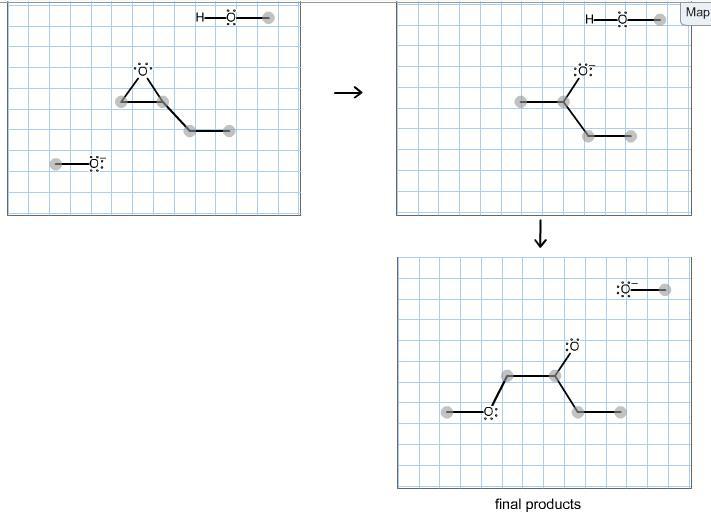
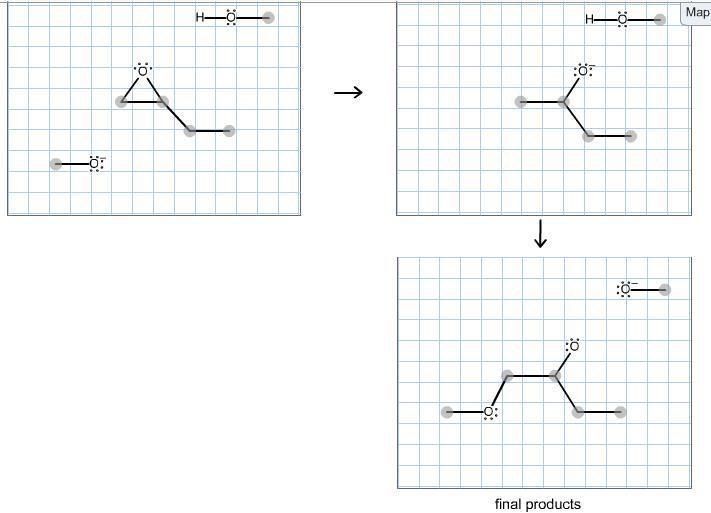
Complete the mechanism for the base-catalyzed opening of the epoxide below by adding any missing atoms, bonds, charges, nonbondi

ng electron pairs, and curved arrows.

Chemistry
1 answer:
worty [1.4K]2 years ago
3 0

Complete Question:

check the first image for complete part of the question

Answer and Explanation:

Epoxide is a three membered ring made up of two carbon atoms and one oxygen atom. Epoxides are cyclic ethers. Due to its ring size, it is highly strained and very reactive. Epoxide ring opening takes place with respect to addition of acid and base.

Ring opening of epoxide with acid:  

In the presence of base, the nucleophile attacks the epoxide ring at more substituted site and inverse stereochemistry takes place.(check file 2 attached)

Ring opening of epoxide with base:  

The backside attack of nucleophile takes place in less substituted site and then it undergoes protonation to form a product.

(check file 2 attached)

You might be interested in
Why couldn't you substitute 3m H2SO4 for concentrated HNO3 when oxidizing copper?
schepotkina [342]

This question seems to be an essay question from experiment. Different solution of oxidizing agent will have different strength.  Sulfuric acid or H2SO4 is weaker oxidizing agent when compared to nitric acid (HNO3). In this case, if you subtitute the H2SO4 you wouldn't be able to get the same result for the experiment.


5 0
2 years ago
Read 2 more answers
Describe how you would prepare exactly 100 mL of 0.109 M picolinate buffer, pH 5.61. Possible starting materials are pure picoli
Pepsi [2]

Answer:

1.342g of picolinic acid and 6.743mL of 1.0M NaOH diluting the mixture to 100.0mL

Explanation:

<em>The pKa of the picolinic acid is 5.4.</em>

Using Henderson-Hasselbalch formula for picolinic-picolinate buffer:

pH = pKa + log [Picolinate] / [Picolinic]

<em>Where [] could be taken as moles of each species</em>

<em />

5.61 = 5.4 + log [Picolinate] / [Picolinic]

0.21 = log [Picolinate] / [Picolinic]

1.62181 = [Picolinate] / [Picolinic] <em>(1)</em>

<em></em>

Now, both picolinate and picolinic acid will be:

0.100L * (0.109mol / L) =

0.0109 moles = [Picolinate] + [Picolinic] <em>(2)</em>

<em></em>

First, as we will start with picolinic acid, we need add:

0.0109 moles picolinic acid * (123.10g/mol) = 1.342g of picolinic acid

Now, replacing (2) in (1):

1.62181 = 0.0109 moles - [Picolinic] / [Picolinic]

1.62181 [Picolinic] = 0.0109 moles - [Picolinic]

2.62181 [Picolinic] = 0.0109 moles

[Picolinic] = 4.157x10⁻³ moles

And:

[Picolinate] = 0.0109 - 4.157x10⁻³ moles =

<h3>6.743x10⁻³ moles</h3><h3 />

To obtain these moles of picolinate ion we need to make the reaction of the picolinic acid with NaOH:

Picolinic acid + NaOH → Picolinate + Water

<em>That means to obtain 6.743x10⁻³ moles of picolinate ion we need to add 6.743x10⁻³ moles of NaOH</em>

<em />

6.743x10⁻³ moles of NaOH that is 1.0M are, in mL:

6.743x10⁻³ moles * (1L / 1mol) = 6.743x10⁻³L * 1000 =

<h3>6.743mL of the 1.0M NaOH must be added</h3><h3 />

Thus, we obtain the desire moles of picolinate and picolinic acid to obtain the buffer we want, the last step is:

<h3>Dilute the mixture to 100mL, the volume we need to prepare</h3>

3 0
2 years ago
Perform the following calculations and give your answer with the correct number of significant figures:
Arte-miy333 [17]
When multiplying numbers, the term with the least significant digits gives how many significant digits will be in the answer. 2.995 has the least with 4 "sig figs", so the answer will have 4 significant digits as well:

2.995/0.16685 = <span>17.9502547198
</span>                           ↑↑  ↑<span>↑
                        4 sig figs

So the answer is 17.95.</span>
3 0
2 years ago
If one starts with pure NO2(g) at a pressure of 0.500 atm, the total pressure inside the reaction vessel when 2NO2(g) 2NO(g) + O
natulia [17]

Answer:

The partial pressure of NO2  = 0.152 atm

Explanation:

Step 1: Data given

Pressure NO2 = 0.500 atm

Total pressure at equilibrium = 0.674 atm

Step 2: The balanced equation

2NO2(g) → 2NO(g) + O2(g)

Step 3: The initial pressure

pNO2 = 0.500 atm

pNO = 0 atm

p O2 = 0 atm

Step 4: Calculate pressure at the equilibrium

For 2 moles NO2 we'll have 2 moles NO and 1 mol O2

pNO2 = 0.500 - 2x atm

pNO =2x atm

pO2 = xatm

The total pressure = p(total) = p(NO2) + p(NO) + p(O2)

p(total) = (0.500 - 2x) + 2x + x= 0.674 atm

0.500 + x = 0.674 atm

x = 0.174 atm

This means the partial pressure of NO2 = 0.500 - 2*0.174 = 0.152 atm

6 0
2 years ago
A sealed, insulated calorimeter contains water at 310 K. The surrounding air temperature is 298 K, and the water inside the calo
serious [3.7K]
D is the answer, I believe.

An isolated system is one that allows neither heat or matter to enter or exit, and since the liquid remained the same temperature, one can conclude that neither energy nor matter is passing through.
7 0
2 years ago
Read 2 more answers
Other questions:
  • That's just the tip of the iceberg" is a popular expression you may have heard. It means that what you can see is only a small p
    5·2 answers
  • What mass of ammonium thiocyanate (nh4scn) must be used if it is to react completely with 5.7 g barium hydroxide octahydrate?
    12·1 answer
  • A pan containing 30 grams of water was allowed to cool from a temperature of 90.0 °C. If the amount of heat released is 1,500 jo
    6·2 answers
  • the air pressure was 101.3 kPa, but the weatherman said it was 1001.3 kPa. What is the percentage error​
    15·1 answer
  • What is the name of the following ionic compound?: MoAs
    9·1 answer
  • For a hydrogen atom, which electronic transition would result in the emission of a photon with the highest energy?
    11·1 answer
  • For this question, the "entropy term" refers to "-TΔS". Addition reactions are generally favorable at low temperatures because _
    6·1 answer
  • Draw the three structures of the aldehydes with molecular formula C5H10O that contain a branched chain.
    6·1 answer
  • After a reaction, a new compound contains 0.73 g Mg and 0.28 g N. What is the empirical formula of this compound?
    12·1 answer
  • Reaction A has a high activation energy, whereas reacton B has a low activation energy. Which of the statements about reaction A
    12·1 answer
Add answer
Login
Not registered? Fast signup
Signup
Login Signup
Ask question!