answer.
Ask question
Login Signup
Ask question
All categories
  • English
  • Mathematics
  • Social Studies
  • Business
  • History
  • Health
  • Geography
  • Biology
  • Physics
  • Chemistry
  • Computers and Technology
  • Arts
  • World Languages
  • Spanish
  • French
  • German
  • Advanced Placement (AP)
  • SAT
  • Medicine
  • Law
  • Engineering
irina1246 [14]
2 years ago
13

Tritium 3 1H decays to 3 2He by beta emission. Find the energy released in the process. Answer in units of keV.

Chemistry
1 answer:
-Dominant- [34]2 years ago
7 0

Answer:

The energy released in the decay process = 18.63 keV

Explanation:

To solve this question, we have to calculate the binding energy of each isotope and then take the difference.

The mass of Tritium = 3.016049 amu.

So,the binding energy of Tritium =  3.016049 *931.494 MeV

= 2809.43155 MeV.

The mass of Helium 3 = 3.016029 amu.

So, the binding energy of Helium 3 = 3.016029 * 931.494 MeV

= 2809.41292 MeV.

The difference between the binding energy of Tritium and the binding energy of Helium is: 32809.43155 - 2809.412 = 0.01863 MeV

1 MeV = 1000keV.

Thus, 0.01863 MeV = 0.01863*1000keV = 18.63 keV.

So, the energy released in the decay process = 18.63 keV.

You might be interested in
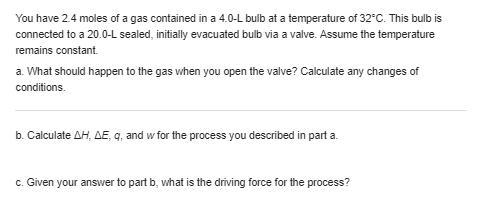
Consider 2.4 moles of a gas contained in a 4.0 L bulb at a constant temperature of 32°C. This bulb is connected to an evacuated
Luden [163]

Complete Question

The complete question is shown on the first uploaded image

Answer

a

As the valve is opened , the gas will flow into the empty container until the both containers have the same pressure

b

\Delta H = 0\ , \Delta E = 0 , q= 0 , w= 0

c

The driving force for this process is the increase in entropy this is because the movement of the internal energy of the gas into a larger volume, what this does is that it increases the amount of disorder(entropy).

Explanation

In order to obtain the parameter in the part B of the question we are first obtain the initial pressure, using the ideal gas equation  

                      P = \frac{nRT}{V}

                     P = \frac{(2.4mol)(0.0821\frac{1 atm}{K \cdot \ mol} )}{4.0L}

                         P =15 \ atm

The next thing is to obtain the new pressure of the gas , using boyle's law

              P_1V_1 = P_2V_2

                  P_2 = \frac{P_1 V_1}{V_2}

                  P_2 = \frac{(15 \ atm)(4.0L)}{24.0 L}

                  P_2 = 2.5 \ atm    

Since the this process is isothermal , the change in heat is equal to zero

                      i.e  q = 0 J

  The workdone to move  the gas to the other container is zero because the  the pressure at this second container is zero due to the fact that it is a vacuum

    i.e  w = -P_{external} \Delta V

              =-(0 \ atm) (24.0 - 4.0L)

              = 0L \cdot atm

  Since the change in heat is zero and the workdone is zero then the change in internal energy is equal to 0

     This is because the change in internal energy is equal to a summation of change in heat and the workdone

                i.e \Delta E = q + w

                            = 0J

Generally the change in enthalpy is mathematically represented as

                \Delta H = n C_p \Delta T

Since the temperature is zero this means that the change in temperature is zero , substituting this value for change in temperature into the equation for  change in enthalpy

           \Delta H = n C_p (0)

                   = 0J


7 0
2 years ago
Which isolated gaseous atom has a total of five electrons occupying spherically shaped orbitals?
Andre45 [30]
Let's find the electron configuration of each atom


Atom      atomic number                electron configuration

Bo            5                                    1s2 2s2 2p
F              9                                    1s2 2s2 2p5 
Na          11                                    1s2 s2 2p6 3s
K            19                                    1s2 2s2 2p6 3s2 3p6 4s      


The spherically shaped orbitals are the s orbitals.


You can se in the table that I wrote above that sodium has 2 electrons at 1s, 2 electrons at 2s and 1 electron at 3s orbitals, that is a total of five electrons at s (spherically shaped orbtials).


So the answer is the option A) sodium.
3 0
2 years ago
Sodium thiosulfate (Na2S2O3), photographer’s
vova2212 [387]

3Na2S2O3 + AgBr ------>Na5[Ag(S2O3) 3] +NaBr

from equation 3 mol 1 mol

given x mol 0.10 mol


x= (3*0.10)/1=0.30 mol Na2S2O3


Answer: 0.30 mol Na2S2O3

3 0
2 years ago
Read 2 more answers
How many hydrogen bonds can CH2O make to water
VladimirAG [237]
Hydrogen bonds are not like covalent bonds. They are nowhere near as strong and you can't think of them in terms of a definite number like a valence. Polar molecules interact with each other and hydrogen bonds are an example of this where the interaction is especially strong. In your example you could represent it like this: 

<span>H2C=O---------H-OH </span>

<span>But you should remember that the H2O molecule will be exchanging constantly with others in the solvation shell of the formaldehyde molecule and these in turn will be exchanging with other H2O molecules in the bulk solution. </span>

<span>Formaldehyde in aqueous solution is in equilibrium with its hydrate. </span>

<span>H2C=O + H2O <-----------------> H2C(OH)2</span>
5 0
2 years ago
Which postulate of Dalton's theory is consistent with the following observation concerning the weights of reactants and products
hram777 [196]

<u>Answer:</u> This illustrates law of conservation of mass.

<u>Explanation:</u>

Dalton's theory is based on mainly two laws which are law of conservation of mass and law of constant proportion.

Law of conservation of mass states that mass can neither be created nor be destroyed but it can only be transformed from one form to another form.

This also means that total mass on the reactant side must be equal to the total mass on the product side.

The chemical equation for the decomposition of calcium carbonate follows:

CaCO_3\rightarrow CaO+CO_2

We are given:

Mass of calcium carbonate = 100 grams

Mass of calcium oxide = 56 grams

Mass of carbon dioxide = 44 grams

Total mass on reactant side = 100  g

Total mass on product side = 56 + 44 = 100 g

As, the total mass on reactant side is equal to the total mass on product side.

Thus, this illustrates law of conservation of mass.

6 0
2 years ago
Other questions:
  • How does vegetation slow and prevent sediment loss?
    8·1 answer
  • Which of the pairs of molecular structures shown below depict enantiomers (enantiomeric forms) of the same molecule?
    11·1 answer
  • A "shielding gas" mixture of argon and carbon dioxide is sometimes used in welding to improve the strength of the weld. if a gas
    12·2 answers
  • From the options provided for each element below, choose the properties that it may have based on its location in the periodic t
    10·2 answers
  • Identify the type of solid from the description. Select from the following choices: metallic solid, network solid, molecular sol
    5·1 answer
  • A car uses 12.5 L of gasoline to travel a distance of 275 km. Convert this into units of miles per gallon (mi/gal).
    14·1 answer
  • Classify each of these soluble solutes as a strong electrolyte, a weak electrolyte, or a nonelectrolyte. Solutes Formula Hydroch
    5·2 answers
  • Hitesh wants to learn swimming. He brought swimming costumes and a cap. What kind of material should these be made of and why?
    11·1 answer
  • 3. Scott and James work at a grocery store. After the grocery store closed, they were playing a game with a shopping cart and Sc
    6·1 answer
  • the actual yield of a certain reaction is 38.0 g while the theoretical yield is 50.0 g calculate the percent yield
    8·1 answer
Add answer
Login
Not registered? Fast signup
Signup
Login Signup
Ask question!