answer.
Ask question
Login Signup
Ask question
All categories
  • English
  • Mathematics
  • Social Studies
  • Business
  • History
  • Health
  • Geography
  • Biology
  • Physics
  • Chemistry
  • Computers and Technology
  • Arts
  • World Languages
  • Spanish
  • French
  • German
  • Advanced Placement (AP)
  • SAT
  • Medicine
  • Law
  • Engineering
Darina [25.2K]
2 years ago
6

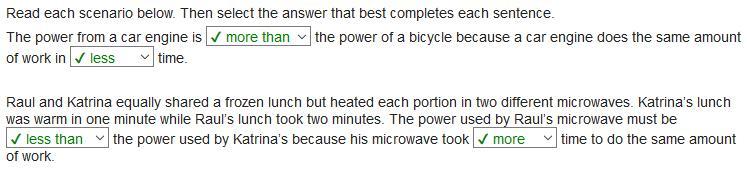
Read each scenario below. Then select the answer that best completes each sentence.

Physics
2 answers:
mixas84 [53]2 years ago
8 0

Answer:

Car engine

1. More than

2. Less

Raul microwave

1. Less than

2. More

Explanation:

just answered the question

Pavel [41]2 years ago
7 0

Answer:

The power used by raul's microwave must be the power used by katrina's because his microwave took time to do the same amount of work.

Explanation:

The power from a car engine is the power of a bicycle because a car engine does the same amount of work in time. raul and katrina equally shared a frozen lunch but heated each portion in two different microwaves. katrina's lunch was warm in one minute while raul's lunch took two minutes. the power used by raul's microwave must be the power used by katrina's because his microwave took time to do the same amount of work.

You might be interested in
Calculate the current through a 10.0-m long 22-gauge nichrome wire with a radius of 0.321 mm if it is connected across a 12.0-V
Kipish [7]

Answer:

Therefore,

Current through Nichrome wire is 0.3879 Ampere.

Explanation:

Given:

Length = l = 10 meter

Radius = r = 0.321\ mm =0.321\times 10^{-3}\ meter

Resistivity=\rho=1.00\times 10^{-6}\ ohm\ meter

V = 12 Volt

To Find:

Current, I =?

Solution:

Resistance for 0.0-m long 22-gauge nichrome wire with a radius of 0.321 mm if it is connected across a 12.0-V battery given as

R=\dfrac{\rho\times l}{A}

Where,

R = Resistance

l = length

A = Area of cross section = πr²

\rho=Resistivity=1.00\times 10^{-6}\ ohm\ meter

Substituting the values we get

R=\dfrac{1\times 10^{-6}\times 10}{3.14\times (0.321\times 10^{-3})^{2}}

R=\dfrac{1\times 10^{-5}}{3.23\times 10^{-7}}

R=\dfrac{1\times 10^{2}}{3.23}

R=30.95\ ohm

Now by Ohm's Law,

V= I\times R

Substituting the values we get

I=\dfrac{V}{R}=\dfrac{12}{30.95}=0.3876\ Ampere

Therefore,

Current through Nichrome wire is 0.3879 Ampere.

4 0
2 years ago
Jade and her roommate Jari commute to work each morning, traveling west on I-10. One morning Jade left for work at 6:45 A.M., bu
Veronika [31]

Answer:

Jari

Explanation:

The question requires to know who is traveling faster. This is done by comparing the gradients. The steeper the slope (high gradient), the faster the speed and vice versa.

From Jari's line, the starting point is (0, 0) and another point is (6, 7)

The gradient being change in y to change in x

Change in y=7-0=7

Change in x=6-0=6

Slope is 7/6

For Jade, first point is (0, 10) then another point is (6, 16)

Change in y=16-10=6

Change in x=6-0=6

Slope is 6/6=1

Clearly, 7/6 is greater than 6/6 or 1 hence Jari is faster than Jade

3 0
2 years ago
Richard needs to fly from san diego to halifax, nova scotia and back in order to give an important talk about mathematics. on th
kondor19780726 [428]

When plane is going towards Halifax the speed of wind is in the direction of fly

so overall the net speed of the plane will increase

while when he is on the way back the air is opposite to flight so net speed will decrease

now the total time of the journey is 13 hours

out of this 2 hours he spent in mathematics talk

so total time of the fly is 13 - 2 = 11 hours

now we have formula to find the time to travel to Halinex

t_1 = \frac{d}{v + 50}

time taken to reach back

t_2 = \frac{d}{v - 50}

now we have total time

T = t_1 + t_2

11 = \frac{d}{v - 50} + \frac{d}{v + 50}

here d= 3000 miles

11 = \frac{3000}{v - 50} + \frac{3000}{v + 50}

3.67 * 10^{-3} = \frac{2v}{v^2 - 2500}

v^2 - 2500 = 545.45v

solving above quadratic equation we will have

v = 550 mph

so speed of plane will be 550 mph

3 0
2 years ago
Read 2 more answers
Suppose your friend claims to have discovered a mysterious force in nature that acts on all particles in some region of space. H
kirill [66]

Answer:

             U = 1 / r²

Explanation:

In this exercise they do not ask for potential energy giving the expression of force, since these two quantities are related


         F = - dU / dr

this derivative is a gradient, that is, a directional derivative, so we must have

          dU = - F. dr

the esxresion for strength is

         F = B / r³

let's replace

          ∫ dU = - ∫ B / r³  dr

in this case the force and the displacement are parallel, therefore the scalar product is reduced to the algebraic product

let's evaluate the integrals

            U - Uo = -B (- / 2r² + 1 / 2r₀²)

To complete the calculation we must fix the energy at a point, in general the most common choice is to make the potential energy zero (Uo = 0) for when the distance is infinite (r = ∞)

             U = B / 2r²

we substitute the value of B = 2

             U = 1 / r²

5 0
2 years ago
Consider an object with s=12cm that produces an image with s′=15cm. Note that whenever you are working with a physical object, t
Leni [432]

A. 6.67 cm

The focal length of the lens can be found by using the lens equation:

\frac{1}{f}=\frac{1}{s}+\frac{1}{s'}

where we have

f = focal length

s = 12 cm is the distance of the object from the lens

s' = 15 cm is the distance of the image from the lens

Solving the equation for f, we find

\frac{1}{f}=\frac{1}{12 cm}+\frac{1}{15 cm}=0.15 cm^{-1}\\f=\frac{1}{0.15 cm^{-1}}=6.67 cm

B. Converging

According to sign convention for lenses, we have:

- Converging (convex) lenses have focal length with positive sign

- Diverging (concave) lenses have focal length with negative sign

In this case, the focal length of the lens is positive, so the lens is a converging lens.

C. -1.25

The magnification of the lens is given by

M=-\frac{s'}{s}

where

s' = 15 cm is the distance of the image from the lens

s = 12 cm is the distance of the object from the lens

Substituting into the equation, we find

M=-\frac{15 cm}{12 cm}=-1.25

D. Real and inverted

The magnification equation can be also rewritten as

M=\frac{y'}{y}

where

y' is the size of the image

y is the size of the object

Re-arranging it, we have

y'=My

Since in this case M is negative, it means that y' has opposite sign compared to y: this means that the image is inverted.

Also, the sign of s' tells us if the image is real of virtual. In fact:

- s' is positive: image is real

- s' is negative: image is virtual

In this case, s' is positive, so the image is real.

E. Virtual

In this case, the magnification is 5/9, so we have

M=\frac{5}{9}=-\frac{s'}{s}

which can be rewritten as

s'=-M s = -\frac{5}{9}s

which means that s' has opposite sign than s: therefore, the image is virtual.

F. 12.0 cm

From the magnification equation, we can write

s'=-Ms

and then we can substitute it into the lens equation:

\frac{1}{f}=\frac{1}{s}+\frac{1}{s'}\\\frac{1}{f}=\frac{1}{s}+\frac{1}{-Ms}

and we can solve for s:

\frac{1}{f}=\frac{M-1}{Ms}\\f=\frac{Ms}{M-1}\\s=\frac{f(M-1)}{M}=\frac{(-15 cm)(\frac{5}{9}-1}{\frac{5}{9}}=12.0 cm

G. -6.67 cm

Now the image distance can be directly found by using again the magnification equation:

s'=-Ms=-\frac{5}{9}(12.0 cm)=-6.67 cm

And the sign of s' (negative) also tells us that the image is virtual.

H. -24.0 cm

In this case, the image is twice as tall as the object, so the magnification is

M = 2

and the distance of the image from the lens is

s' = -24 cm

The problem is asking us for the image distance: however, this is already given by the problem,

s' = -24 cm

so, this is the answer. And the fact that its sign is negative tells us that the image is virtual.
3 0
2 years ago
Other questions:
  • What size force does the femur exerts on the kneecap if the tendons are oriented as in the figure and the tension in each tendon
    15·1 answer
  • Using the superposition method, calculate the current through R5 in Figure 8-71
    14·1 answer
  • A dog is chasing a cat towards a tree. The cat has a 10-yard lead and runs at 6 yards per second. The dog runs at a speed of 8 y
    15·1 answer
  • It takes Venus 225 days to orbit the sun. If the Earth-sun distance is 1.5 × 10^11 m, what
    7·1 answer
  • A 0.2-kg steel ball is dropped straight down onto a hard, horizontal floor and bounces straight up. The ball's speed just before
    5·2 answers
  • During the 440, a runner changes his speed as he comes out of the curve onto the home stretch from 18 ft/sec to 38 ft/sec over a
    5·1 answer
  • A laser emits two wavelengths (λ1 = 420 nm; λ2 = 630 nm). When these two wavelengths strike a grating with 450 lines/mm, they pr
    13·1 answer
  • A 3-kg skateboard is rolling down the sidewalk at 4 m/s when it collides with a 1-kg skateboard that was initially at rest. If t
    14·2 answers
  • Elias serves a volleyball at a velocity of 16 m/s. The mass of the volleyball is 0.27 kg. What is the height of the volleyball a
    14·1 answer
  • A projectile of mass 0.2 kg and an initial velocity of 50 m/s collides with the end of a blade attached to a turbine. The rotati
    5·1 answer
Add answer
Login
Not registered? Fast signup
Signup
Login Signup
Ask question!
