answer.
Ask question
Login Signup
Ask question
All categories
  • English
  • Mathematics
  • Social Studies
  • Business
  • History
  • Health
  • Geography
  • Biology
  • Physics
  • Chemistry
  • Computers and Technology
  • Arts
  • World Languages
  • Spanish
  • French
  • German
  • Advanced Placement (AP)
  • SAT
  • Medicine
  • Law
  • Engineering
zloy xaker [14]
2 years ago
8

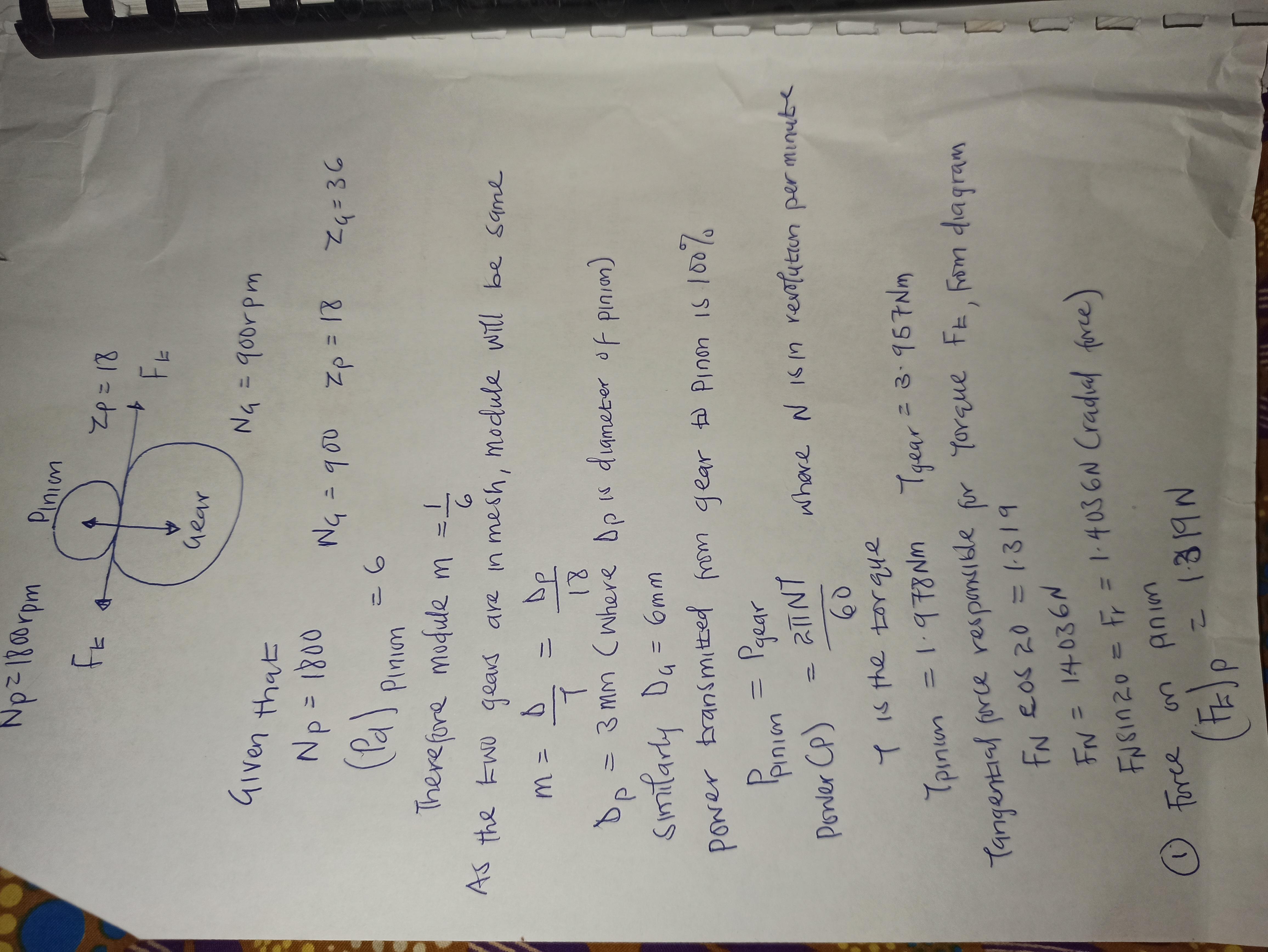
15.27 An 18-tooth pinion with a diametral pitch of 6 rotates 1800 rpm and drives a 36-tooth gear at 900 rpm in a gear speed redu

cer. The pinion and gear with 20 ° full-depth involute teeth are keyed to shafts that are simply supported by bearings. The bearings on each shaft are 2.0 in. from the gear center. If the gears transmit 0.5 hp, what are the forces on the pinion, gear, and shafts?

Engineering
1 answer:
Triss [41]2 years ago
7 0

Answer:

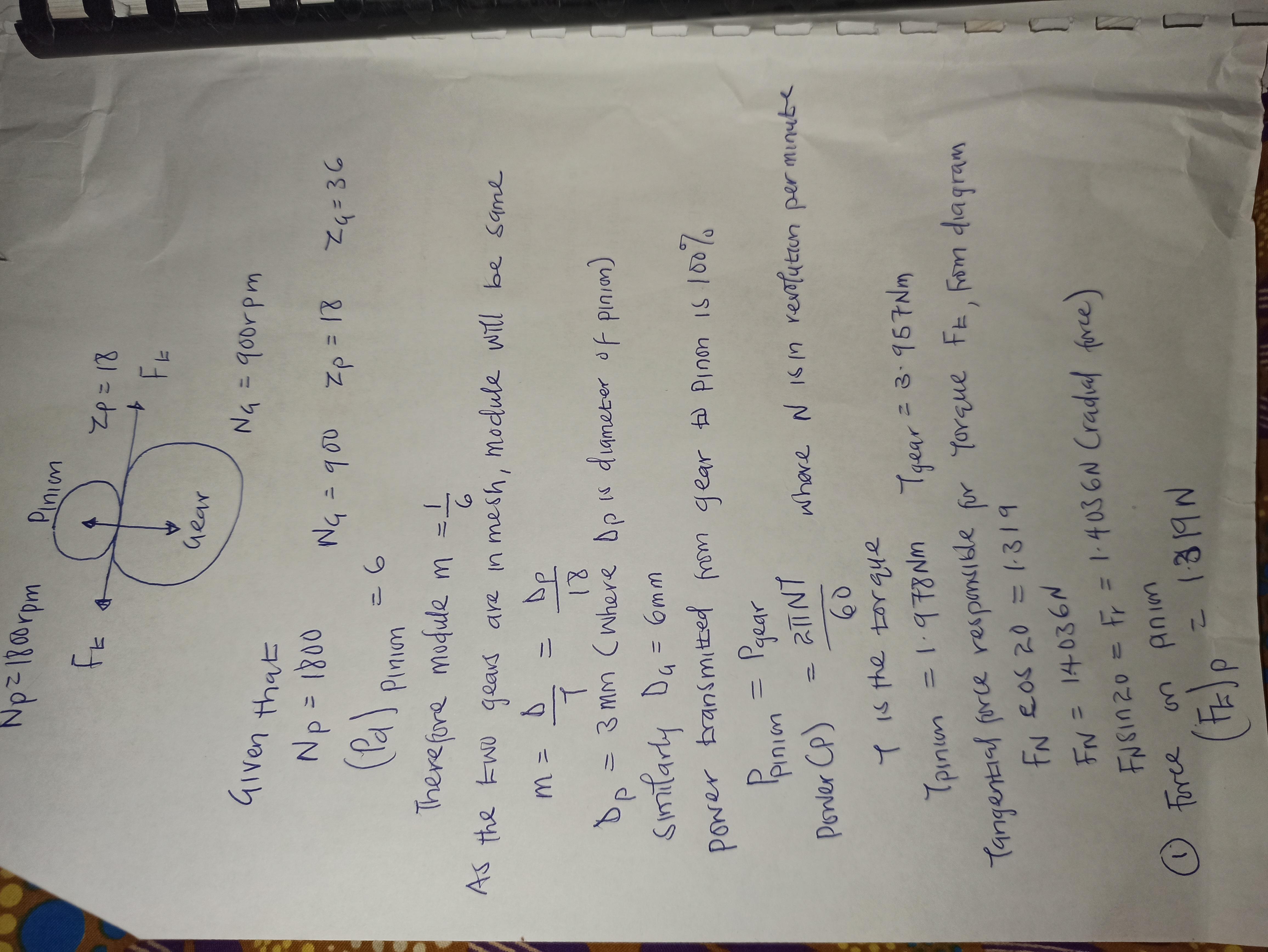
Force on pinion= 1.4036N

Force on gear = 1.4036N(opposite in direction to force on pinion)

Force on shaft=0.48N

Explanation

Check attachment

You might be interested in
Derive the probability that a receptor is occupied by a ligand using a model that treats the L ligands in solution as distinguis
love history [14]

that is the same thing as you are not going through this week or something

7 0
2 years ago
1. Consider a city of 10 square kilometers. A macro cellular system design divides the city up into square cells of 1 square kil
kakasveta [241]

Answer:

a) n = 1000\,users, b)\Delta t_{min} = \frac{1}{30}\,h, \Delta t_{max} = \frac{\sqrt{2} }{30}\,h, \Delta t_{mean} = \frac{1 + \sqrt{2} }{60}\,h, c) n = 10000000\,users, \Delta t_{min} = \frac{1}{3000}\,h, \Delta t_{max} = \frac{\sqrt{2} }{3000}\,h, \Delta t_{mean} = \frac{1 + \sqrt{2} }{6000}\,h

Explanation:

a) The total number of users that can be accomodated in the system is:

n = \frac{10\,km^{2}}{1\,\frac{km^{2}}{cell} }\cdot (100\,\frac{users}{cell} )

n = 1000\,users

b) The length of the side of each cell is:

l = \sqrt{1\,km^{2}}

l = 1\,km

Minimum time for traversing a cell is:

\Delta t_{min} = \frac{l}{v}

\Delta t_{min} = \frac{1\,km}{30\,\frac{km}{h} }

\Delta t_{min} = \frac{1}{30}\,h

The maximum time for traversing a cell is:

\Delta t_{max} = \frac{\sqrt{2}\cdot l }{v}

\Delta t_{max} = \frac{\sqrt{2} }{30}\,h

The approximate time is giving by the average of minimum and maximum times:

\Delta t_{mean} = \frac{1+\sqrt{2} }{2}\cdot\frac{l}{v}

\Delta t_{mean} = \frac{1 + \sqrt{2} }{60}\,h

c) The total number of users that can be accomodated in the system is:

n = \frac{10\times 10^{6}\,m^{2}}{100\,m^{2}}\cdot (100\,\frac{users}{cell} )

n = 10000000\,users

The length of each side of the cell is:

l = \sqrt{100\,m^{2}}

l = 10\,m

Minimum time for traversing a cell is:

\Delta t_{min} = \frac{l}{v}

\Delta t_{min} = \frac{0.01\,km}{30\,\frac{km}{h} }

\Delta t_{min} = \frac{1}{3000}\,h

The maximum time for traversing a cell is:

\Delta t_{max} = \frac{\sqrt{2}\cdot l }{v}

\Delta t_{max} = \frac{\sqrt{2} }{3000}\,h

The approximate time is giving by the average of minimum and maximum times:

\Delta t_{mean} = \frac{1+\sqrt{2} }{2}\cdot\frac{l}{v}

\Delta t_{mean} = \frac{1 + \sqrt{2} }{6000}\,h

8 0
2 years ago
Same rule: If both players spend the same number of coins, player 2 gains 1 coin. Off-by-one rule: If the players do not spend t
Galina-37 [17]

Answer:

Check the explanation

Explanation:

1 -

public int getPlayer2Move(int round)

{

  int result = 0;


  //If round is divided by 3

  if(round%3 == 0) {

      result= 3;

  }

  //if round is not divided by 3 and is divided by 2

  else if(round%3 != 0 && round%2 == 0) {

      result = 2;

  }

  //if round is not divided by 3 or 2

  else {

      result = 1;

  }


  return result;

}

2-

public void playGame()

{


  //Initializing player 1 coins

  int player1Coins = startingCoins;


  //Initializing player 2 coins

  int player2Coins = startingCoins;


  for ( int round = 1 ; round <= maxRounds ; round++) {


      //if the player 1 or player 2 coins are less than 3

      if(player1Coins < 3 || player2Coins < 3) {

          break;

      }


      //The number of coins player 1 spends

      int player1Spends = getPlayer1Move();


      //The number of coins player 2 spends

      int player2Spends = getPlayer2Move(round);


      //Remaining coins of player 1

      player1Coins -= player1Spends;


      //Remaining coins of player 2

      player2Coins -= player2Spends;


      //If player 2 spends the same number of coins as player 2 spends

      if ( player1Spends == player2Spends) {

          player2Coins += 1;

          continue;

      }


      //positive difference between the number of coins spent by the two players

      int difference = Math.abs(player1Spends - player2Spends) ;


      //if difference is 1

      if( difference == 1) {

          player2Coins += 1;

          continue;

      }


      //If difference is 2

      if(difference == 2) {

          player1Coins += 2;

          continue;

      }


  }


  // At the end of the game

  //If player 1 coins is equal to player two coins

  if(player1Coins == player2Coins) {

      System.out.println("tie game");

  }

  //If player 1 coins are greater than player 2 coins

  else if(player1Coins > player2Coins) {

      System.out.println("player 1 wins");

  }

  //If player 2 coins is grater than player 2 coins

  else if(player1Coins < player2Coins) {

      System.out.println("player 2 wins");

  }

}
3 0
2 years ago
A certain working substance receives 100 Btu reversibly as heat at a temperature of 1000℉ from an energy source at 3600°R. Refer
Valentin [98]

Answer:

Explanation:

t1 = 1000 F = 1460 R

t0 = 80 F = 540 R

T2 = 3600 R

The working substance has an available energy in reference to the 80F source of:

B1 = Q1 * (1 - T0 / T1)

B1 = 100 * (1 - 540 / 1460) = 63 BTU

The available energy of the heat from the heat wource at 3600 R is

B2 = Q1 * (1 - T0 / T2)

B2 = 100 * (1 - 540 / 3600) = 85 BTU

The reduction of available energy between the source and the 1460 R temperature is:

B3 = B2 - B1 = 85 - 63 = 22 BTU

6 0
2 years ago
The outer surface of an engine is situated in a place where oil leakage can occur. When leaked oil comes in contact with ahot su
VladimirAG [237]

Answer:

TBC thickness of 4 mm is insufficient to prevent fire hazard

Explanation:

Given:

- Temperature of hot-fluid inner surface T_i = 333°C

- The convection coefficient hot-fluid h_i = 7 W/m^2K

- The thermal conductivity of engine cover k_1 = 14 W/mK

- The thickness of engine cover L_1 = 0.01 m

- The thermal conductivity of TBC layer k_2 = 1.1 W/mK  ... (Typing error)

- The thickness of TBC layer L_2 = 0.004 m

- Temperature of ambient air outer surface T_o = 69°C

- The convection coefficient ambient air h_o = 7 W/m^2K

Find:

Would a TBC layer of 4 mm thickness be sufficient to keep the engine cover surface below autoignition temperature of 200°C to prevent fire hazard?

Solution:

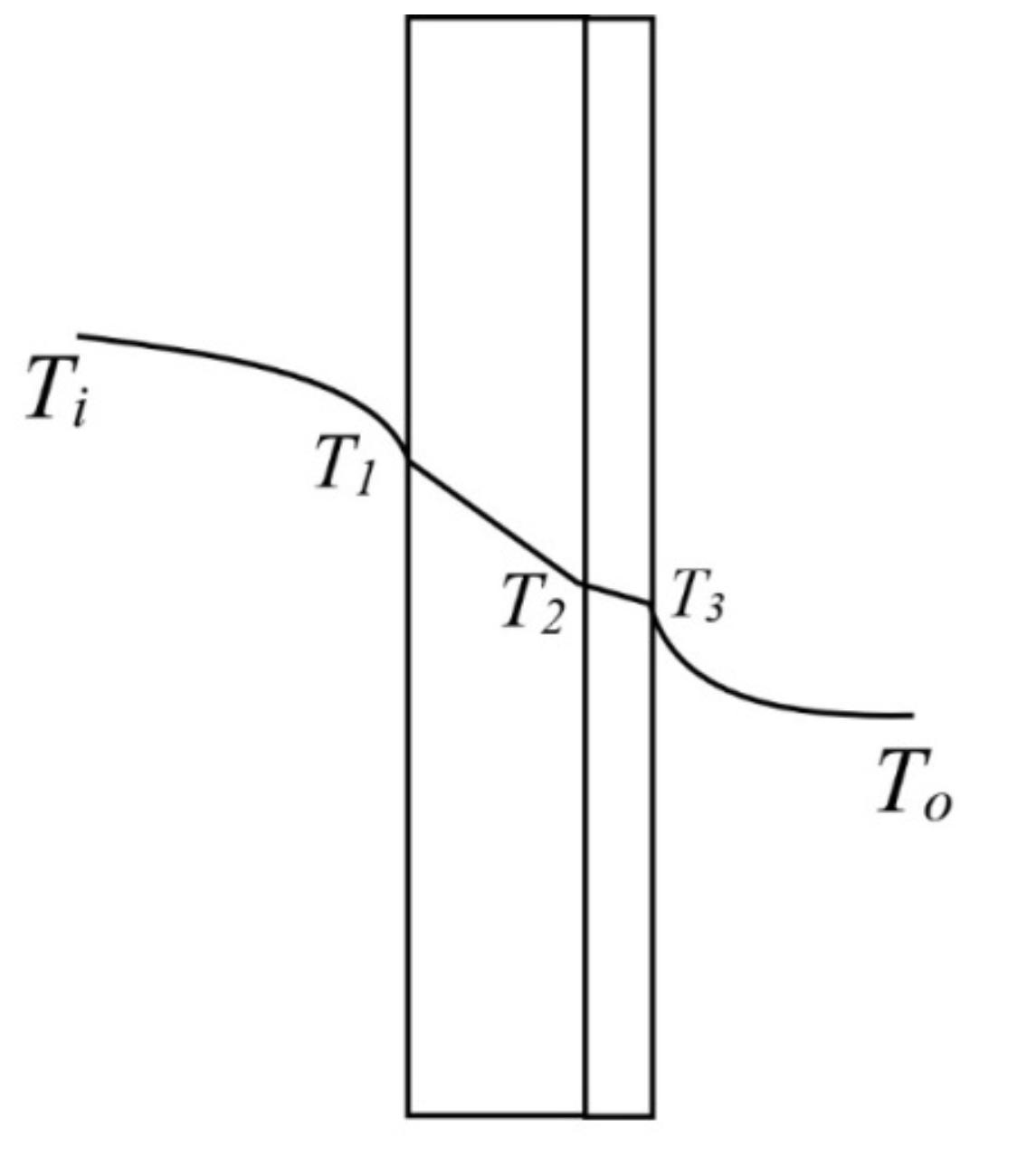
- We will use thermal circuit analogy for the 1-D problem and steady state conduction with no heat generation in the cover or TBC layer.

 The temperature at each medium interface and the Thermal resistance for each medium is given in the attachment schematic and circuit analogy.

 - We will calculate the total heat flux for the entire system q:

                       q = ( T_i - T_o ) / R_total

- R_total is the equivalent thermal resistance of the entire circuit. Since all resistances are in series we have:

                       R_total = 1 / h_i + L_1 / k_1 + L_2 / k_2 + 1 / h_o

- Plug in the values and compute:

                       R_total = 1 / 7 + 0.01 / 14 + 0.004 / 1.1 + 1 / 7

                       R_total = 0.2900649351 T-m^2 / W

- Calculate the Total heat flux q:

                       q = ( 333 - 69 ) / 0.2900649351

                       q = 910.141 W / m^2

- Just like the total current in a circuit remains same, the total heat flux remains same. We will use the total heat flux q to calculate the temperature of outer engine surface T_2 as follows:

                      q = ( T_i - T_2 ) / R_i2

Where,

                      R_i2 = 1 / h_i + L_1 / k_1

                      R_i2 = 1 / 7 + 0.01 / 14 = 0.14357 T-m^2 / W

Hence,

                      ( T_i - T_2 ) = q*R_i2

                        T_2 = T_i - q*R_i2

Plug the values in:

                        T_2 = 333 - 910.141*0.14357

                        T_2 = 202.33°C

- The outer surface of the engine cover has a temperature above T_ignition = 200°C. Hence, the TBC thickness of 4 mm is insufficient to prevent fire hazard

3 0
2 years ago
Other questions:
  • Steam enters a turbine operating at steady state at 1 MPa, 200 °C and exits at 40 °C with a quality of 83%. Stray heat transfer
    9·1 answer
  • Define a) Principal Plane b) Principal Stress c) anelasticity d) yield point e) ultimate tensile stress f) hardness g) toughness
    5·1 answer
  • The wall of drying oven is constructed by sandwiching insulation material of thermal conductivity k = 0.05 W/m°K between thin me
    8·1 answer
  • 13–27. The conveyor belt is moving downward at 4 m&gt;s. If the coefficient of static friction between the conveyor and the 15-k
    11·1 answer
  • g The function below takes a single string parameter: sentence. Complete the function to return everything but the middle 10 cha
    15·1 answer
  • The in situ moist unit weight of a soil is 17.3 kN/m3 and the moisture content is 16%. The specific gravity of soil solids is 2.
    12·1 answer
  • A 50-kg iron block and 20-kg copper block, both initially at 80 oC, are dropped into a large lake at 15 oC. Thermal equilibrium
    12·1 answer
  • A sample of normally consolidated clay was subjected to a CU triaxial compression test that was carried out until the specimen f
    6·1 answer
  • The total floor area of a building, including below-grade space but excluding unenclosed areas, measured from the exterior of th
    8·1 answer
  • Air ows steadily in a thermally insulated pipe with a constant diameter of 6.35 cm, and an average friction factor of 0.005. At
    5·1 answer
Add answer
Login
Not registered? Fast signup
Signup
Login Signup
Ask question!