answer.
Ask question
Login Signup
Ask question
All categories
  • English
  • Mathematics
  • Social Studies
  • Business
  • History
  • Health
  • Geography
  • Biology
  • Physics
  • Chemistry
  • Computers and Technology
  • Arts
  • World Languages
  • Spanish
  • French
  • German
  • Advanced Placement (AP)
  • SAT
  • Medicine
  • Law
  • Engineering
nordsb [41]
2 years ago
3

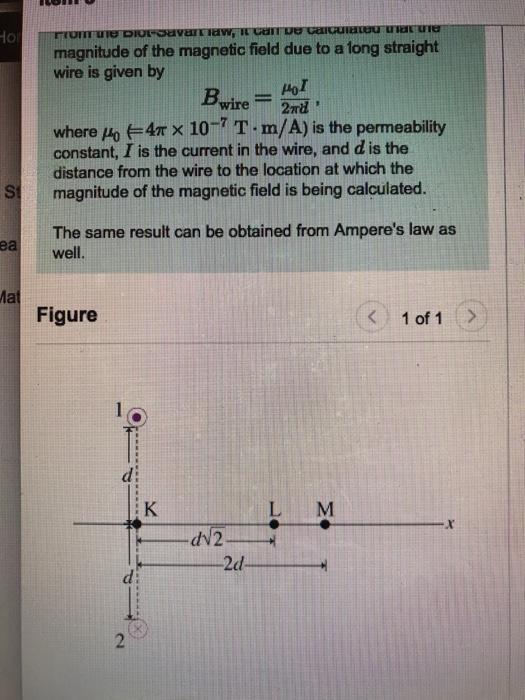
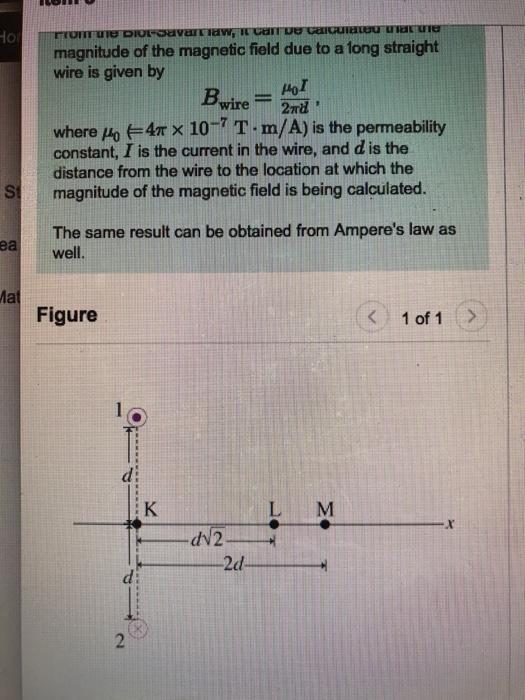
To understand how to use the principle of superposition in conjunction with the Biot-Savart (or Ampere's) law. From the Biot-Sav

art law, it can be calculated that the magnitude of the magnetic field due to a long straight wire is given by Bwire=μ0I2πd , where μ0 (=4π×10−7T⋅m/A) is the permeability constant, I is the current in the wire, and d is the distance from the wire to the location at which the magnitude of the magnetic field is being calculated. The same result can be obtained from Ampere's law as well.

Physics
1 answer:
iren [92.7K]2 years ago
3 0

Note: The Question Continues as

...Point L is located a distance d\sqrt{2}  from the midpoint between the two wires. Find the magnitude of the net magnetic field BL created by pint L by both wires.

Express your answer in terms of I, d and appropriate constants.

2- The Figure is attached in the attachment.

Answer:

Find the attachment for complete solution

You might be interested in
Assume your eye has an aperture diameter of 3.00 mm at night when bright headlights are pointed at it. 1) At what distance can y
krek1111 [17]

Answer:

The distance is 6259.31 meters.

Explanation:

We shall use the Reyligh criterion to solve the problem

For diffraction due to circular aperture we have

Assuming that human eye is circular we have

\frac{x}{D}=\frac{1.22\lambda }{d}

\therefore D=\frac{xd}{1.22\lambda }

Applying the given values we have

D=\frac{1.40\times 3\times 10^{-3}}{1.22\times 550\times 10^{-9}}\\\\\therefore D=6259.31m\\D=6.26km

3 0
2 years ago
Read 2 more answers
A weightlifter lifts a 13.0-kg barbel from the ground an moves it a distance of 1.3 meters. What is the work se does on the barb
marta [7]

The work done on the barbell is -165.62 Nm.

Explanation:

Work done on any object is the measure of force required to move that object from one position to another. So it is determined by the product of force acting on the object with the displacement of the object.

In the present problem, the displacement of the object on acting of force is given as 1.3 m. And the weight of the object which is a barbel is given as 13 kg. As the work is to lift the object from the ground, so the acceleration due to gravity will be acting on the object. In other words, the force applied on the object to lift it should be in opposite direction to the acting of acceleration due to gravity.

Thus, Force = - Mass * Acceleration due to gravity = - 13 * 9.8 =-127.4 N

Now, the force is -127.4 N and the displacement is 1.3 m.

So, Work done = F*d

Work done = -127.4* 1.3 = -165.62 Nm

So, the work done on the barbell is -165.62 Nm.

6 0
2 years ago
4 A wheel starts from rest and has an angular acceleration of 4.0 rad/s2. When it has made 10 rev determine its angular velocity
Slav-nsk [51]

Answer:

w_f= 22.41rad/s

Explanation:

First, we know that:

a = 4 rad/s^2

S = 10 rev = 62.83 rad

Now we know that:

w_f^2-w_i^2=2aS

where w_f is the final angular velocity, w_i the initial angular velocity, a is the angular aceleration and S the radians.

Replacing, we get:

w_f^2-(0)^2=2(4)(62.83)

Finally, solving for w_f:

w_f= 22.41rad/s

8 0
2 years ago
A professor's office door is 0.89 m wide, 2.0 m high, and 4.0 cm thick; has a mass of 25 kg ; and pivots on frictionless hinges.
taurus [48]
In order to answer this question ... strange as it may seem ...
we only need one of those measurements that you gave us
that describe the door.

The door is hanging on frictionless hinges, and there's a torque
being applied to it that's trying to close it.  All we need to do is apply
an equal torque in the opposite direction, and the door doesn't move.

Obviously, in order for our force to have the most effect, we want
to hold the door at the outer edge, farthest from the hinges.  That
distance from the hinges is the width of the door ... 0.89 m.

We need to come up with 4.9 N-m of torque,
applied against the mechanical door-closer.

Torque is (force) x (distance from the hinge).

                                    4.9 N-m  =  (force) x (0.89 m) 

Divide each side by 0.89m:    Force = (4.9 N-m) / (0.89 m)

                                                             =  5.506 N .
7 0
2 years ago
The two hot-air balloons in the drawing are 48.2m and 61.0 m above the ground.A person in the left balloon observes that the rig
mafiozo [28]

Answer:

The horizontal distance x between the two balloons is 54.15 m

Explanation:

The diagram described as obtained online is presented in the image attached to this solution.

Let the horizontal distance between the two balloons be x

Difference in height (vertical distance) between the two balloons = 61 - 48.2 = 12.8 m

Using trigonometric relations, it is evident that

Tan 13.3° = 12.8/x

x = 12.8/tan 13.3° = 12.8/0.2364 = 54.15 m
4 0
2 years ago
Other questions:
  • In which scenario is an animal doing work? Check all that apply.
    15·2 answers
  • Venn diagrams are used for comparing and contrasting topics. The overlapping sections show characteristics that the topics have
    15·2 answers
  • The formula s = 16t2 gives the distance an object falls due to gravity, where s is the distance in feet and t is the time in sec
    5·1 answer
  • A 9V battery is directly connected to each of 3 LED bulbs. Select the statement that accurately describes this circuit. A) A dir
    5·2 answers
  • Two balls of unequal mass are hung from two springs that are not identical. The springs stretch the same distance as the two sys
    12·1 answer
  • -A coconut falls out of a tree 12.0 m above the ground and hits a bystander 3.00 m tall on the top of the head. It bounces back
    11·1 answer
  • Calculate the energy in the form of heat (in kJ) required to change 75.0 g of liquid water at 27.0 °C to ice at –20.0 °C. Assume
    15·1 answer
  • You live on a planet far from ours. "Based on extensive communication with a physicist on earth", you have determined that all l
    6·1 answer
  • The period of an ocean wave is 5 seconds. What is the wave's frequency?
    15·1 answer
  • A solar-powered car has a kinetic energy of 110250 J. Its mass is 180 kg. Work out how fast the car is travelling.
    9·2 answers
Add answer
Login
Not registered? Fast signup
Signup
Login Signup
Ask question!