answer.
Ask question
Login Signup
Ask question
All categories
  • English
  • Mathematics
  • Social Studies
  • Business
  • History
  • Health
  • Geography
  • Biology
  • Physics
  • Chemistry
  • Computers and Technology
  • Arts
  • World Languages
  • Spanish
  • French
  • German
  • Advanced Placement (AP)
  • SAT
  • Medicine
  • Law
  • Engineering
expeople1 [14]
2 years ago
3

The original fluid mosaic model stated that membrane proteins move freely in the plane of the lipid bilayer via lateral diffusio

n "like protein icebergs in a sea of lipids." Since its initial description in 1927, the fluid mosaic model has been refined.
Complete the statements that describe some of the refinements of the fluid mosaic model as it relates to protein mobility.
Choose the answer that best completes each sentence:
Membrane (lipid) rafts, Vesicles, Cytoskeletal elements, Protein-protein interactions, Bilayer leaflets.
1) ______ may form a locally rigid, non-lipid matrix surrounded by the fluid lipid matrix.
2) ______, membrane domains rich in sphingolipids and cholesterol, are regions with reduced lipid and protein mobility.
3) ______ can be attached to proteins or can "fence in" proteins, reducing protein mobility.
Chemistry
1 answer:
jenyasd209 [6]2 years ago
7 0

Answer:

1. Protein-protein interactions

2. Lipid rafts

3. Cytoskeletal elements

Explanation:

The fluid mosaic model was proposed by the Singer and Nicolson in 1972 which stated that the membrane is a mosaic of the lipids, carbohydrates and the proteins.

The fluid mosaic model has been revised many times which are:

1. Protein-protein interactions: the proteins present in the lipid bilayer can easily float in the lipid layer, can be found integrated into the layer and exist on the outside of the layer. These proteins can form a bond with each other which are rigid and are non-lipid matrix.

2. Lipid rafts: the structure formed in the bilayer which is rich in cholesterol and the sphingolipids. These regions have a reduced amount of lipids and reduced protein mobility.

3. Cytoskeletal elements: are attached to the proteins and act as a fence in proteins which reduces the mobility of the proteins.

You might be interested in
recheck Fusion reactions power the in space. Humans currently use fusion in , but researchers are seeking more applications.
quester [9]

One: looks to be correct for both answers. Certainly the first one is. The second depends on your other choices. But military use is one.

Two: is correct. Pd has (in this case) an atomic mass of 114 and its number is 46

Three: Even with my slop numbers, 4.98  is the answer (although I get 4.99 but again, my numbers are pretty sloppy).

Four: Slop numbers say 78.3, but 78 is the right answer.

Five: Slop numbers agree with Al2S3. I think that's D

They are all correct. Very Fine Work.

4 0
2 years ago
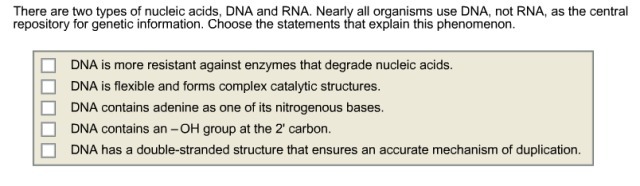
There are two types of nucleic acids, dna and rna. nearly all organisms use dna, not rna, as the central repository for genetic
Leya [2.2K]
Found the choices. Pls see attachment. 

The statements that explains this phenomenon are:
1) DNA contains adenine as one of its nitrogenous bases.
2) DNA has a double-stranded structure that ensures an accurate mechanism of duplication.

6 0
2 years ago
When monomers combine to form a condensation polymer, another product is also formed. typically, this product is _____. methanol
shtirl [24]
Water is the answer!
4 0
2 years ago
Read 2 more answers
A sample of fluorine gas is confined in a 5.0-L container at 0.432 atm and 37 °C. How many moles of gas are in this sample?
Ahat [919]

Answer:

About 0.08486 moles

Explanation:

PV=nRT, when P is the pressure in atmospheres, V is the volume in liters, n is the number of moles, R is the universal gas constant, and T is the temperature in Kelvin.

0.432 \cdot 5= n \cdot 0.0821 \cdot 310

n\approx 0.08486 moles

Hope this helps!

7 0
2 years ago
The compound AX2 decomposes according to the equation, 2 AX2(g) => 2 AX(g) + X2(g). In one experiment, AX2 was measured at va
Karolina [17]

Answer:

0.0011 mol/L.s

Explanation:

The average rate of disappearing of the reagent is the variation of the concentration of it divided by the time that this variation is being measured. The reaction rate, is proportional to the coefficient of the substance, so, for a generic reaction:

aA + bB --> cC + dD

rate = -(1/a)Δ[A]/Δt = -(1/b)Δ[B]/Δt = (1/c)Δ[C]/Δdt = (1/d)Δ[D]/dt

The minus sign is because of the reagent is desapering, so:

rate = -(1/2)*(0.0209 - 0.0300)/(10 - 6)

rate = 0.0011 mol/L.s

8 0
2 years ago
Other questions:
  • Write the empirical formula of at least four binary ionic compounds that could be formed from the following ions:
    11·2 answers
  • The mass of a solid copper penny is 3.46 g. how many copper atoms are in the penny?
    9·2 answers
  • Al(s)+hcl(aq) → alcl3(aq)+h2(g). assume you have plenty of hcl and 6.0 mol of al. how many moles of h2 are formed?
    7·1 answer
  • What is the molar mass of 1-butene if 5.38 × 10¹⁶ molecules of 1-butene weigh 5.00 μg?
    13·1 answer
  • Which of the following best describes a chain reaction? Select one: a. Neutrons from splitting atoms continue to split other ato
    15·1 answer
  • Suppose a layer of oil is on the top of a beaker of water. Water in many oils is slightly soluble, so its concentration is so lo
    8·1 answer
  • A reaction produces a gas, which is collected in a glass cylinder. When a glowing splint is placed inside the container, it burn
    15·1 answer
  • Identify from the following list of molecules and ions which behave as Lewis acids: CO2, NH3, BCl3, Fe3+. (A) CO2 and NH3 (B) NH
    5·1 answer
  • Which statements describe lattice energy?
    7·1 answer
  • One of the most common causes of inaccurate melting point ranges is rapid heating of the compound. Under these circumstances, ho
    6·1 answer
Add answer
Login
Not registered? Fast signup
Signup
Login Signup
Ask question!