answer.
Ask question
Login Signup
Ask question
All categories
  • English
  • Mathematics
  • Social Studies
  • Business
  • History
  • Health
  • Geography
  • Biology
  • Physics
  • Chemistry
  • Computers and Technology
  • Arts
  • World Languages
  • Spanish
  • French
  • German
  • Advanced Placement (AP)
  • SAT
  • Medicine
  • Law
  • Engineering
Temka [501]
2 years ago
10

What is the transmitted intensity of light if an additional polarizer is added perpendicular to the first polarizer in the setup

described in Question 3

Physics
1 answer:
Fantom [35]2 years ago
5 0

Answer:

3) Transmitted intensity of light if unpolarized light passes through a single polarizing filter = 40 W/m²

- Transmitted intensity of light if an additional polarizer is added perpendicular to the first polarizer in the setup described = 7.5 W/m²

Explanation:

Complete Question

3) What is the transmitted intensity of light if unpolarized light passes through a single polarizing filter and the initial intensity is 80 W/m²?

- What is the transmitted intensity of light if an additional polarizer is added perpendicular to the first polarizer in the setup described in Question 3 (the setup)? Show all work in your answer.

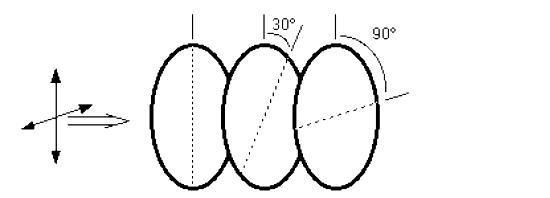
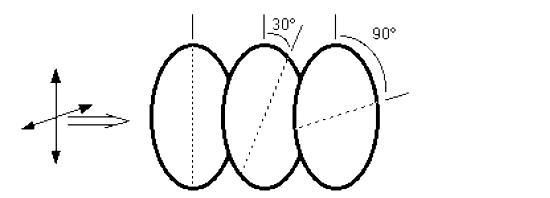
The image of this setup attached to this question as obtained from online is attached to this solution.

Solution

3) When unpolarized light passes through a single polarizer, the intensity of the light is cut in half.

Hence, if the initial intensity of unpolarized light is I₀ = 80 W/m²

The intensity of the light rays thay pass through the first single polarizer = I₁ = (I₀/2) = (80/2) = 40 W/m²

- According to Malus' law, the intensity of transmitted light through a polarizer is related to the intensity of the incident light and the angle at which the polarizer is placed with respect to the major axis of the polarizer before the current polarizer of concern.

I₂ = I₁ cos² θ

where

I₂ = intensity of light that passes through the second polarizer = ?

I₁ = Intensity of light from the first polarizer that is incident upon the second polarizer = 40 W/m²

θ = angle between the major axis of the first and second polarizer = 30°

I₂ = 40 (cos² 30°) = 40 (0.8660)² = 30 W/m²

In the same vein, the intensity of light that passes through the third/additional polarizer is related to the intensity of light that passes through the second polarizer and is incident upon this third/additional polarizer through

I₃ = I₂ cos² θ

I₃ = intensity of light that passes through the third/additional polarizer = ?

I₂ = Intensity of light from the second polarizer that is incident upon the third/additional polarizer = 30 W/m²

θ = angle between the major axis of the second and third/additional polarizer = 60° (although, it is 90° with respect to the first polarizer, it is the angle it makes with the major axis of the second polarizer, 60°, that matters)

I₃ = 30 (cos² 60°) = 30 (0.5)² = 7.5 W/m²

Hope this Helps!!!
You might be interested in
A moving sidewalk has a velocity of 1.7m/s north. if a man walks 1.1m/s, how long does it take him to travel 15m north in relati
alexira [117]
I think the answer will be a
3 0
2 years ago
Discuss how the hardness or softness of the landing surface is related to the time required to stop the egg
monitta

Answer

To understand this concept it is necessary to understand Newton's Second Law

According to Newtons Second law applied force is equal to rate of change of momentum of a body.

Mathematically,

F=\frac{dp}{dt}

here, \frac{dp}{dt} is rate of change of momentum with respect to time

It means If two eggs fall from same height,one on softer surface and other on hard surface that time the momentum of both eggs will remain equal at both the surfaces. But, impact time will be different. On hard surface egg will stop almost instantly so impact time will be small and hence the force on egg will be large therefore the egg will breakup.

On the other hand on the soft surface like a cotton, egg will not stop instantly but it will slow down for a few seconds and then stop due to which the time of impact will increase. Therefore the force on egg will be less and it won't break up.


3 0
2 years ago
A 6.0-μF capacitor charged to 50 V and a 4.0-μF capacitor charged to 34 V are connected to each other, with the two positive pla
ch4aika [34]

Answer:

5702.88 J or 5.7mJ

Explanation:

Given that :

C 1 = 6.0-μF

C 2 = 4.0-μF

V 1 = 50V

V 2 = 34V

Note that : Q = CV

Q 1 = C1 * V1

Q 1 = 50×6 = 300μC

Q 2 = 34×4 = 136μC

Parallel connection = C 1 + C 2

= 6+4 = 10μC

V = Qt/C

Where Qt = Q1+Q2

V = Q1+Q2/C

V = 300+136/10

V = 437/10

V = 43.6volts

Uc1 = 1/2×C1V^2

= 1/2 × 6μF × 43.6^2

= 1/2 × 6μF × 1900.96

= 3μF × 1900.96volts

= 5702.88J

= 5702.88J/1000

= 5.7mJ

4 0
2 years ago
For this problem, imagine that you are on a ship that is oscillating up and down on a rough sea. Assume for simplicity that this
ikadub [295]

Answer:

no idea

Explanation:

7 0
2 years ago
A satellite, orbiting the earth at the equator at an altitude of 400 km, has an antenna that can be modeled as a 1.76-m-long rod
ivann1987 [24]

Answer:

The inducerd emf is 1.08 V

Solution:

As per the question:

Altitude of the satellite, H = 400 km

Length of the antenna, l = 1.76 m

Magnetic field, B = 8.0\times 10^{- 5}\ T

Now,

When a conducting rod moves in a uniform magnetic field linearly with velocity, v, then the potential difference due to its motion is given by:

e = - l(vec{v}\times \vec{B})

Here, velocity v is perpendicular to the rod

Thus

e = lvB           (1)

For the orbital velocity of the satellite at an altitude, H:

v = \sqrt{\frac{Gm_{E}}{R_{E}} + H}

where

G = Gravitational constant

m_{e} = 5.972\times 10^{24}\ kg = mass of earth

R_{E} = 6371\ km = radius of earth

v = \sqrt{\frac{6.67\times 10^{- 11}\times 5.972\times 10^{24}}{6371\times 1000 + 400\times 1000} = 7670.018\ m/s

Using this value value in eqn (1):

e = 1.76\times 7670.018\times 8.0\times 10^{- 5} = 1.08\ V

5 0
2 years ago
Other questions:
  • Which pair of sentences is describing the same velocity? A car is parked. A car is moving in circles. A bus drives 40 miles per
    9·2 answers
  • if one sprinter runs the 400.0 m in 58 seconds and another can run the same distance in 60.0 seconds, by how much distance will
    11·2 answers
  • Just after a motorcycle rides off the end of a ramp and launches into the air, its engine is turning counterclockwise at 8325 re
    8·2 answers
  • Electric field lines always begin at _______ charges (or at infinity) and end at _______ charges (or at infinity). One could als
    5·1 answer
  • A person shooting at a target from a distance of 450 metres finds that the sound of the bullet hitting the target comes 1 / 2 se
    5·1 answer
  • Paula is studying two different animals. Both animals are classified within the same genus, but they are different species. Base
    14·2 answers
  • At time t=0 a proton is a distance of 0.360 m from a very large insulating sheet of charge and is moving parallel to the sheet w
    7·1 answer
  • the steel bed of a suspension bridge is 200m long at 20 C. If the extremes of temperature to which it might be exposed are -30 C
    9·1 answer
  • When a 0.058 kg tennis ball is served, it accelerates from rest to a speed of 45.0 m/s. The impact with the racket gives the bal
    14·1 answer
  • The drawing shows three identical springs hanging from the ceiling. Nothing is attached to the first spring, whereas a 4.50-N bl
    6·1 answer
Add answer
Login
Not registered? Fast signup
Signup
Login Signup
Ask question!