answer.
Ask question
Login Signup
Ask question
All categories
  • English
  • Mathematics
  • Social Studies
  • Business
  • History
  • Health
  • Geography
  • Biology
  • Physics
  • Chemistry
  • Computers and Technology
  • Arts
  • World Languages
  • Spanish
  • French
  • German
  • Advanced Placement (AP)
  • SAT
  • Medicine
  • Law
  • Engineering
Leviafan [203]
2 years ago
8

8. How did the measured angular magnification of the telescope compare with the theoretical prediction?

Physics
1 answer:
Genrish500 [490]2 years ago
3 0

Complete Question

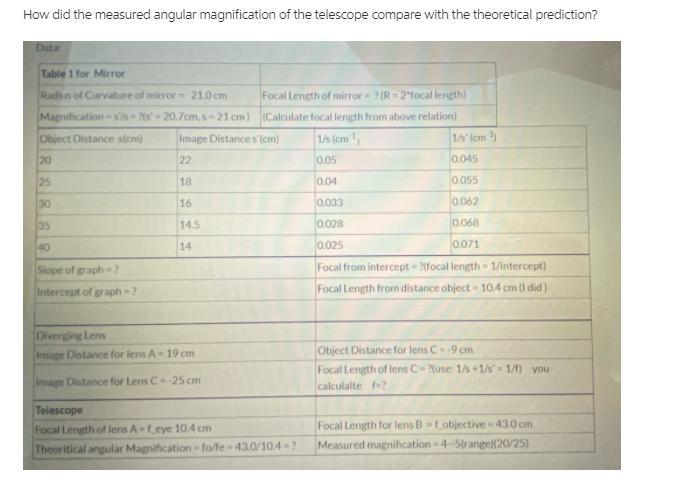
The complete question is shown on the first uploaded image  

Answer:

The theoretical angular magnification lies within the angular magnification range

Explanation:

From the question we are told that

   The  focal length of  B  is  f_{objective } =  43.0 \ cm

    The focal length of  A  is   f_{eye} =  10.4 \  cm

The  theoretical angular  magnification is mathematically represented as

           m = \frac{f_{objective }}{f_{eye}}  =  \frac{43.0}{10.4}

            m = \frac{f_{objective }}{f_{eye}}  =  4.175

Form the question the measured angular magnification ranges from 4 -5

So from the value calculated and the value given we can deduce that the theoretical angular  magnification lies within the angular magnification range

You might be interested in
Which statements describe vectors? Check all that apply. -Vectors have magnitude only. -Vectors have direction only. -Vectors ha
Natali [406]

Answer:

Vectors have both magnitude and direction

Explanation:

Vectors show how strong the force in because the bigger the arrow, the stronger the force.  Also, it obviously shows direction because its an arrow.

6 0
2 years ago
Read 2 more answers
If a 3-kg rabbit's leg muscles act as imperfectly elastic springs, how much energy will they hold if the rabbit lands from a hei
DiKsa [7]

Answer;

- 15 J

Explanation;

-Potential energy is defined as mechanical energy, stored energy, or energy caused by its position.

-For the gravitational force the formula is P.E. = mgh, where m is the mass in kilograms, g is the acceleration due to gravity (9.8 m /s² at the surface of the earth) and h is the height in meters.

Potential energy of the rabbit at the peak of its height is

PE = (3)(10)(0.5) = 15 J

(around 14.7 but because energy is lost, it is less than that)

3 0
2 years ago
Read 2 more answers
A block of mass m1 = 3.5 kg moves with velocity v1 = 6.3 m/s on a frictionless surface. it collides with block of mass m2 = 1.7
maxonik [38]
First, let's find the speed v_i of the two blocks m1 and m2 sticked together after the collision.
We can use the conservation of momentum to solve this part. Initially, block 2 is stationary, so only block 1 has momentum different from zero, and it is:
p_i = m_1 v_1
After the collision, the two blocks stick together and so now they have mass m_1 +m_2 and they are moving with speed v_i:
p_f = (m_1 + m_2)v_i
For conservation of momentum
p_i=p_f
So we can write
m_1 v_1 = (m_1 +m_2)v_i
From which we find
v_i =  \frac{m_1 v_1}{m_1+m_2}= \frac{(3.5 kg)(6.3 m/s)}{3.5 kg+1.7 kg}=4.2 m/s

The two blocks enter the rough path with this velocity, then they are decelerated because of the frictional force \mu (m_1+m_2)g. The work done by the frictional force to stop the two blocks is
\mu (m_1+m_2)g  d
where d is the distance covered by the two blocks before stopping.
The initial kinetic energy of the two blocks together, just before entering the rough path, is
\frac{1}{2} (m_1+m_2)v_i^2
When the two blocks stop, all this kinetic energy is lost, because their velocity becomes zero; for the work-energy theorem, the loss in kinetic energy must be equal to the work done by the frictional force:
\frac{1}{2} (m_1+m_2)v_i^2 =\mu (m_1+m_2)g  d
From which we can find the value of the coefficient of kinetic friction:
\mu =  \frac{v_i^2}{2gd}= \frac{(4.2 m/s)^2}{2(9.81 m/s^2)(1.85 m)}=0.49
3 0
2 years ago
Differences between Pressure and upthrust​
Angelina_Jolie [31]

Answer:

Pressure is equal to the ratio of thrust to the area in contact. Upthrust is a force exerted by the fluids on an object placed in the fluid . Upthrust acts in upward direction.

4 0
2 years ago
A 0.200-kg mass attached to the end of a spring causes it to stretch 5.0 cm. If another 0.200-kg mass is added to the spring, th
ziro4ka [17]

Answer:

A: 4 times as much

B: 200 N/m

C: 5000 N

D: 84,8 J

Explanation:

A.

In the first question, we have to caculate the constant of the spring with this equation:

m*g=k*x

Getting the k:

k=\frac{m*g}{x} =\frac{0,2[kg]*9,81[\frac{m}{s^{2} } ]}{0,05[m]} =39,24[\frac{N}{m}]

Then we can calculate how much the spring stretch whith the another mass of 0,2kg:

x=\frac{m*g}{k} =\frac{0,4[kg]*9,81[\frac{m}{s^{2} } ]}{39,24[\frac{N}{m}]} =0,1[m]\\

The energy of a spring:

E=\frac{1}{2}*k*x^{2}

For the first case:

E=\frac{1}{2} *39,24[\frac{N}{m}]*(0,05[m])^{2} =0,049 [J]

For the second case:

E=\frac{1}{2} *39,24[\frac{N}{m}]*(0,1[m])^{2} =0,0196 [J]

If you take the relation E2/E1 = 4.

B.

We have the next facts:

x=0,005 m

E = 0,0025 J

Using the energy equation for a spring:

E=\frac{1}{2}*k*x^{2}⇒k=\frac{E*2}{x^{2} } =\frac{0,0025[J]*2}{(0,005[m])^{2} } =200[\frac{N}{m} ]

C.

The potential energy of the diver will be equal to the kinetic energy in the moment befover hitting the watter.

E=W*h=500[N]*10[m]=5000[J]

Watch out the units in this case, the 500 N reffer to the weighs of the diver almost relative to the earth, thats equal to m*g.

D.

The work is equal to the force acting in the direction of the motion. so we have to do the diference beetwen angles to obtain the effective angle where the force is acting: 47-15=32 degree.

The force acting in the direction of the ramp will be the projection of the force in the ramp, equal to F*cos(32). The work will be:

W=F*d=F*cos(32)*d=10N*cos(32)*10m=84,8J

7 0
2 years ago
Other questions:
  • A car starts from rest and accelerates along a straight line path in one minute. It finally attains a velocity of 40 meters/seco
    6·1 answer
  • read the excerpt below and answer the question. "no roving foot shall crush thee here, no busy hand provoke a tear." what type o
    12·1 answer
  • Macy always thought there were only a few hair colors: blond, brown, and black. However, when she actually began looking around,
    12·2 answers
  • Roads often have to be repaved because they crack over time. Sometimes this cracking is due to the fact that the roads (as well
    7·1 answer
  • An overhang hollow shaft carries a 900 mm diameter pulley, whose centre is 250 mm from the centre of the nearest bearing. The we
    10·1 answer
  • At a fixed depth within a fluid at rest, the pressure pushing upward is
    10·1 answer
  • A gold wire that is 1.8 mm in diameter and 15 cm long carries a current of 260 mA. How many electrons per second pass a given cr
    14·1 answer
  • Lizette works in her school’s vegetable garden. Every Tuesday, she pulls weeds for 15 minutes. Weeding seems like a never-ending
    15·2 answers
  • What is the mass of a student who weighs 618 Newton?
    13·1 answer
  • The average standard rectangular building brick has a mass of 3.10 kg and dimensions of 225 m x 112 m x 75 m. The gravitational
    8·1 answer
Add answer
Login
Not registered? Fast signup
Signup
Login Signup
Ask question!