answer.
Ask question
Login Signup
Ask question
All categories
  • English
  • Mathematics
  • Social Studies
  • Business
  • History
  • Health
  • Geography
  • Biology
  • Physics
  • Chemistry
  • Computers and Technology
  • Arts
  • World Languages
  • Spanish
  • French
  • German
  • Advanced Placement (AP)
  • SAT
  • Medicine
  • Law
  • Engineering
Ivanshal [37]
2 years ago
13

Yesinia read that certain perfume ingredients, called esters, would agitate bees. Because perfume formulas are secret, she decid

ed to determine whether the unknown Ester X was present in four different perfumes by observing the bees’ behavior. She placed a saucer containing 10 mL of the first perfume 3 meters from the beehive. She recorded the time required for the bees to emerge and made observations on their behavior. After a 30-minute recover period, she tested the second, third and four perfumes. All experiments were conducted on the same day when the weather conditions were similar, that is, air temperature and wind. What was the hypothesis? What would be the control group? What is the experimental group? What was deliberately changed? What responded to the change?
Chemistry
1 answer:
RUDIKE [14]2 years ago
6 0

Answer:

Hypothesis: IF the perfumes contained Ester "X", THEN the bees would be agitated

Control group: The control group would be the group of bees that did not receive any perfume treatment

Experimental group: Bees that were exposed to the different perfumes

Independent variable: The type of perfumes

Dependent variable: the behavior of the bees

Explanation:

An hypothesis is a testable explanation or suggested solution to a problem that is subject to testing (for proving or disproving) via experimentation. The hypothesis of this experiment will be: IF the perfumes contained Ester "X", THEN the bees would be agitated

The control group of an experiment is the group that does not receive the experimental treatment or the group whose independent variable is not changed. In this case, there is no stated control group but control group of this particular experiment could be the BEES THAT WERE NOT EXPOSED TO ANY PERFUME.

The experimental group, as opposed to the control group, is the group that receives experimental treatment. In this case, it is the group of bees that were exposed to the different types of perfumes.

In an experiment, the variable that is deliberately changed by the experimenter is called the independent variable. The independent variable in this question is the TYPE OF PERFUME given to the bees.

The variable that responds to the changes made to the independent variable is called the dependent variable. The dependent variable, which is the measured variable, is THE BEHAVIOR OF THE BEES.

You might be interested in
A certain gas is present in a 12.0 L cylinder at 4.0 atm pressure. If the pressure is increased to 8.0 atm the volume of the gas
diamong [38]
There are 3 parts in this question:
1) To find the initial Boyle's constant k_{i}
2) To find the final Boyle's constant k_{f}
3) To verify whether gas is obeying Boyle's law or not

Given data:
The initial volume of the cylinder(in litres) = V_{i} = 12.0 L
The initial pressure(in atmospheric pressure) = P_{i} = 4.0 atm

The final pressure(in atmospheric pressure) = P_{f} = 8.0 atm
The final volume of the cylinder(in litres) = V_{f} = 6.0 L

First you need to know what Boyle's law is:
<span>Boyle's law states that the pressure of a given mass of an ideal gas is inversely proportional to its volume at a constant temperature.
</span>
The Mathematical form of Boyle's law is:
P =  \frac{k}{V}

Where,
P = Pressure
V = Volume of the gas
k = Boyle's constant

Now let's solve aforementioned parts one by one:
1. 
The initial volume of the cylinder(in litres) = V_{i} = 12.0 L
The initial pressure(in atmospheric pressure) = P_{i} = 4.0 atm
The Boyle's constant = k_{i} = ?

According to the Boyle's law,

P_{i} = \frac{k_{i}}{V_{i}}

=> k_{i} =  P_{i}V_{i}
Plug-in the values in the above equation, you would get:
k_{i} = 4.0 * 12.0 = 48

Ans-1) k_{i} = 48

2.
The final pressure(in atmospheric pressure) = P_{f} = 8.0 atm
The final volume of the cylinder(in litres) = V_{f} = 6.0 L
The Boyle's constant = k_{f} = ?

According to the Boyle's law,

P_{f} = \frac{k_{f}}{V_{f}}

=> k_{f} =  P_{f}V_{f}
Plug-in the values in the above equation, you would get:
k_{f} = 8.0 * 6.0 = 48

Ans-2) k_{f} = 48

3.
In order to verify Boyle's law, the initial Boyle's constant should be EQUAL to the final Boyle's constant, meaning:

k_{i} = k_{f}

Since,
k_{i} = 48
k_{f} = 48

Therefore,
48=48.

Ans-3) Hence proved: The gas IS obeying the Boyle's law.

-i

4 0
3 years ago
Read 2 more answers
Assume the following substances are soluble in water.
solmaris [256]

Ammonium carbonate will form 3 moles of ions.

Methyl alcohol will form 0 moles of ions.

Methane will form 0 moles of ions.

Aluminum sulfite will form 3 moles of ions.

Hydrobromic acid will form 2 moles of ions.

Explanation:

One mole of ammonium carbonate will form 3 moles of ions when dissolved in water.

(NH₄)₂CO₃ (s) + H₂O (l) → 2 NH₄⁺ (aq) + CO₃²⁻ (aq) + H₂O (l)

One mole of methyl alcohol will form 0 moles of ions when dissolved in water.

(actually it form ions because of its acidic behavior but they are at the order of 10⁻⁷ moles, however in the framework of this question we may say that there are none)

One mole of methane will form 0 moles of ions when dissolved in water.

Methane does not react with water (in normal conditions) so will not form ions.

One mole of aluminum sulfite will form 3 moles of ions when dissolved in water.

Al₂SO₃ (s) + H₂O (l) → 2 Al₃⁺ (aq) + SO₃²⁻ (aq) + H₂O (l)

One mole of hydrobromic acid will form 2 moles of ions when dissolved in water.

HBr (l) +  H₂O (l) → Br⁻ (aq) + H₃O⁺ (aq)

Learn more about:

solvation of ions

brainly.com/question/5384053

#learnwithBrainly

8 0
2 years ago
When metals combine with nonmetals, the metallic atoms tend to 1. lose electrons and become positive ions 2. lose electrons and
Vika [28.1K]
The correct answer is 1. Lose electrons and become positive ions.


I hope my answer was beneficial to you! c:
5 0
2 years ago
Read 2 more answers
If 75.0% of the isotopes of an element have a mass of 35.0 amu and 25.0% of the isotopes have a mass of 37.0amu what is the atom
Norma-Jean [14]
 <span>Calculating average atomic mass is exactly like calculating a weighted average. Perform the following calculation: 

(mass1)(percentage1) + (mass2)(percentage2) = average atomic mass 

(35.0)(0.75) + (37.0)(0.25) = average atomic mass 

Make sure your percentages are in decimal form for this calculation. 

One of the other answers given is correct, though the explanation is lacking a bit. Two of the answers can be eliminated immediately: 35.0 amu and 37.0 amu cannot be the average. If the mixture of isotopes was 50% and 50%, then 36.0 amu would be correct; however, the mixture is 75/25. This leaves only one possible answer choice.</span>
8 0
2 years ago
Read 2 more answers
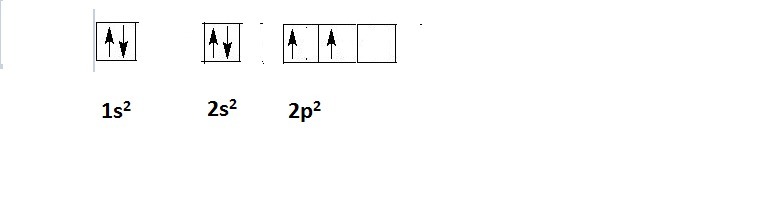
In which orbitals would the valence electrons for carbon <br> c. be placed?
katrin2010 [14]

Answer: 2s and 2p

Explanation: Carbon is an element with atomic number of 6 and thus contains 6 electrons. The electrons are filled in order of increasing energies and follows Afbau's rule.The electrons are singly filled first in each orbital having same spin, then only pairing occurs. This rule was known as Hund's Rule.

The valence electrons are the electrons which are present in last shell. Thus valence electrons are 4, two in s and 2 in p orbitals.

C: 6:1s^22s^22p_x^12p_y^1


8 0
2 years ago
Read 2 more answers
Other questions:
  • In which of these situations would light slow down?
    14·2 answers
  • A beam of light passes though a liquid in a test tube without scattering. Which type of mixture is most likely in the test tube?
    13·2 answers
  • What mass of ammonium thiocyanate (nh4scn) must be used if it is to react completely with 5.7 g barium hydroxide octahydrate?
    12·1 answer
  • The equilibrium constant for the gas-phase isomerization of borneol (c10h17oh) to isoborneol at 503 k is 0.106. a mixture consis
    12·1 answer
  • Part a write an equation for the formation of nh3(g) from its elements in its standard states. express your answer as a chemical
    11·2 answers
  • If one mole of a substance has a mass of 56.0 g, what is the mass of 11 nanomoles of the substance? Express your answer in nanog
    13·1 answer
  • Pb(OH)2 + _HCI → __ H2O + _<br>PbCl2​
    6·1 answer
  • A sample of soil from a newly discovered cave is analyzed by a team of explorers. They find an element that is a good conductor
    9·1 answer
  • Which of the following species is a molecular element?1. neon 2. carbon dioxide3. chlorine 4. sodium 5. none of the above
    6·1 answer
  • Sugar is made up of clear, colorless crystals that dissolve easily in water, but the crystals and their solution do not conduct
    10·2 answers
Add answer
Login
Not registered? Fast signup
Signup
Login Signup
Ask question!