answer.
Ask question
Login Signup
Ask question
All categories
  • English
  • Mathematics
  • Social Studies
  • Business
  • History
  • Health
  • Geography
  • Biology
  • Physics
  • Chemistry
  • Computers and Technology
  • Arts
  • World Languages
  • Spanish
  • French
  • German
  • Advanced Placement (AP)
  • SAT
  • Medicine
  • Law
  • Engineering
Levart [38]
2 years ago
10

1. Which two groups of elements in the periodic table are the most reactive?(1 point) A) alkali metals and halogens B) alkaline

earth metals and halogens C)halogens and noble gases D)noble gases and alkali metals 2. Use the periodic table to answer the question. Which statement about nitrogen (N) and phosphorus (P) is correct? (1 point) A)They have the same number of valence electrons. B)They have the same number of electron shells. C)They are both classified as halogens. D)They are both inert. 3. Which property do transition metals have in common?(1 point) A)They usually have low densities. B)They are usually very soft. C)They are usually very reactive. D)They usually have high melting points. 4. Neon and argon are both in Group 18 of the periodic table. Which property do they most likely share?(1 point) A)low or no reactivity B)silver color C)strong odor D)metallic texture 5. A scientist studies an element that has seven electrons in its outer shell, is fairly toxic, and is highly reactive. To which group of the periodic table does this element belong?(1 point) A) 17 B) 1 C) 18 D) 2 PLEASEE HELP I NEED IT DONE BY TMR
Chemistry
1 answer:
tatyana61 [14]2 years ago
4 0

Answer:

Explanation:

1) alkali metals and halogens as alkalis have 1 electron they need to get rid of in order to gain a full outer shell of electrons and the halogens have to gain 1 electron.

2) they have the same number of electrons on the outer shells

3)they usually have high melting points

4) low or no reactivity

5) group 7

You might be interested in
Which diatomic molecule is formed when the two atoms share six electrons
Leviafan [203]

The diatomic molecule that is formed when two atoms share six electrons is N2.

The atomic number of nitrogen is 7 and its electronic configuration is 2,5. This implies that, nitrogen has 5 electrons in its outermost shell. To attain the octet structure, it needs 3 electrons more. To form a diatomic molecule, two nitrogen atoms come together and each donate three electrons, which are equally shared between the two, thus, each ends up having 8 electrons in its outermost shell.

3 0
2 years ago
Read 2 more answers
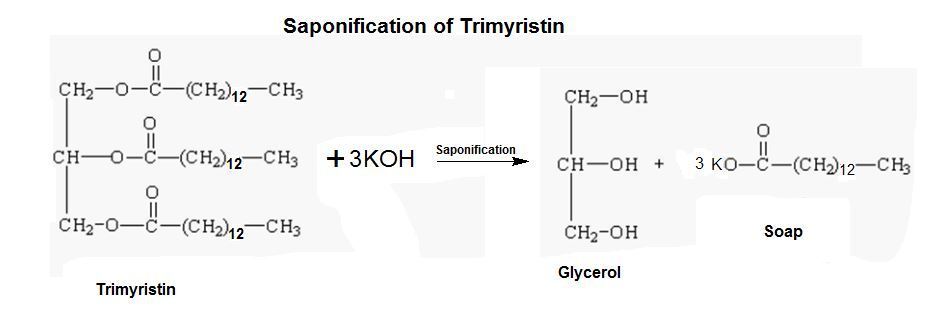
Draw the condensed structural formula in the equation for the saponification of trimyristin with koh
Ludmilka [50]

Explanation: Saponification reaction is a reaction in which hydrolysis of fats takes place under basic conditions giving glycerol and a salt of corresponding fatty acid.

We are given a Fatty acid called as Trimyristin.

Its reaction with KOH leads to the formation of soap and is given by the equation:

Trimyristin+3 KOH\rightarrow Glycerol+Soap

C_{45}H_{86}O_6+3KOH\rightarrow C_3H_5(OH)_3+3CH_3(CH_2)_{12}CO_2K

The condensed structural formula for the equation is given in the image attached.

4 0
2 years ago
Read 2 more answers
A solution contains cr3+ ions. the addition of 0.063 l of 1.50 m naf solution was needed to completely precipitate the chromium
steposvetlana [31]

Cr{3+} + 3 NaF → CrF3 + 3 Na{+} <span>

First calculate the total mols of NaF. 

(0.063 L) x (1.50 mol/L NaF) = 0.0945 mol NaF total </span>


Using stoichiometric ratio:

<span>0.0945 mol NaF * (1 mol Cr3+ / 3 mol NaF) * (51.9961 g Cr3+/mol) = 1.6379 g Cr3+</span>
6 0
2 years ago
How and why do ionic bonds form? Check all of the boxes that apply. Ionic bonds form between metal atoms and other metal atoms.
sammy [17]

2 Ionic bonds form between metal atoms and nonmetal atoms.

4 The less electronegative atoms transfers one or more electrons to the more electronegative atom.

5 The metal atom forms a cation and the nonmetal atom forms an anion.

7 The attraction between ions with an opposite charge forms an ionic bond.


8 0
2 years ago
Read 2 more answers
The volume of a gas is 36.0 ml at 10.0°c and 4.50 atm. at what temperature (°c) will the gas have a pressure of 3.50 atm and a v
galben [10]
Using the combined gas law, where PV/T = constant, we first solve for PV/T for the initial conditions: (4.50 atm)(36.0 mL)/(10.0 + 273.15 K) = 0.57213.
Remember to use absolute temperature.
For the final conditions: (3.50 atm)(85.0 mL)/T = 297.5/T
Since these must equal, 0.57213 = 297.5/T
T = 519.98 K
Subtracting 273.15 gives 246.83 degC.

5 0
2 years ago
Other questions:
  • The group of molecules called nucleotides contain:
    13·1 answer
  • For the reaction A+2B→C under a given set of conditions, the initial rate is 0.100 M/s.What is Δ[B]/Δt under the same conditions
    13·2 answers
  • Express 601 kg as an integer
    11·2 answers
  • To neutralize 1.65g LiOH, how much .150 M HCl would be needed?
    6·1 answer
  • Why are chemical tests necessary to tell a dextrose solution from a saline solution?
    14·1 answer
  • An atom has four electrons in its valence shell. What types of covalent bonds is it capable of forming?
    5·1 answer
  • The bond enthalpy of the C―N bond in the amide group of proteins can be treated as an average of C―N (276 kJ/mol) and C═N (615 k
    14·1 answer
  • Which of the following best describes electrolytes
    10·1 answer
  • The density of honey is 1.42 g/mL. If you poured honey into a glass of water, would it sink to the bottom or float on top? Expla
    11·1 answer
  • When the following equation is balanced, the coefficients are __________. Al(NO3)3 + Na2S → Al2S3 + Na(NO3)
    11·1 answer
Add answer
Login
Not registered? Fast signup
Signup
Login Signup
Ask question!