answer.
Ask question
Login Signup
Ask question
All categories
  • English
  • Mathematics
  • Social Studies
  • Business
  • History
  • Health
  • Geography
  • Biology
  • Physics
  • Chemistry
  • Computers and Technology
  • Arts
  • World Languages
  • Spanish
  • French
  • German
  • Advanced Placement (AP)
  • SAT
  • Medicine
  • Law
  • Engineering
Mumz [18]
2 years ago
14

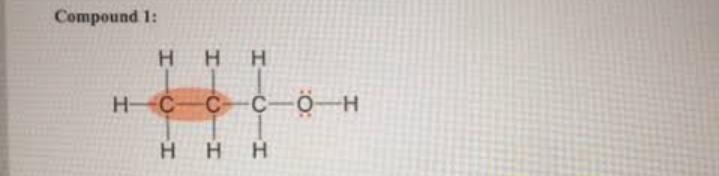
Describe each highlighted bond in terms of the overlap of atomic orbitals. (If the highlighted bond is not a pi bond, select the

blank option from the dropdown menu.) Compound 1: Molecular orbital type: _________ Atomic orbitals in the sigma bond: _________ Atomic orbitals in the pi bond: _________ Compound 2: Molecular orbital type: _________ Atomic orbitals in the sigma bond: _________ Atomic orbitals in the pi bond: _________

Chemistry
1 answer:
Anestetic [448]2 years ago
6 0

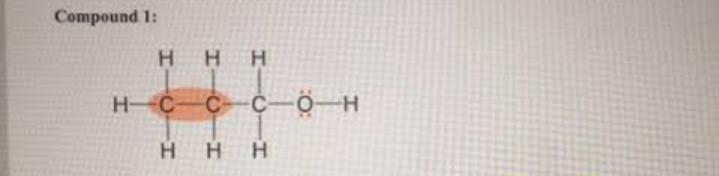
The image of the bonds are missing, so i have attached it.

Answer:

A) - Sigma bond

-Sp³ and Sp³

- None

B) - Sigma and pi bond

- Sp² of C and p of O

- p of C and P of O

Explanation:

A) For compound 1;

- the molecular orbital type is sigma bond due to the end-to-end overlapping.

- Atomic orbitals in the sigma bond will be Sp³ and Sp³

- Atomic orbitals in the pi bond would be nil because there is no pi bond.

B) For compound 2;

- the molecular orbital type is sigma and pi bond

-Atomic orbitals in the sigma bond would be Sp² of C and p of O

- The Atomic orbitals in the pi bond will be; p of C and p of O

You might be interested in
15. Using the information below, calculate ΔHf° for PbO(s)
Svet_ta [14]
ΔH(reaction) = ΔH(formation of products) - ΔH(formation of reactants) 
ΔH(reaction) = ( 1*ΔH(Pb(s)) + 1*ΔH(CO2(g)) ) - ( 1*ΔH(PbO(s)) + 1*ΔH(CO(g)) ) 
ΔH(reaction) = ( 0 + -393.5 ) - ( ΔH(PbO(s)) + -110.5 ) 
ΔH(reaction) = -283 - ΔH(PbO(s)) 
-131.4 = -283 -ΔH(PbO(s)) 
ΔH(PbO(s)) = -151.6 kJ

So, the best answer is A.
5 0
2 years ago
Read 2 more answers
A flask contains 0.180 mol of liquid bromine, br2. determine the number of bromine molecules present in the flask.
Reika [66]
<span>Avogadro's number represents the number of units in one mole of any substance. This has the value of 6.022 x 10^23 units / mole. This number can be used to convert the number of atoms or molecules into number of moles. We calculate as follows:

0.180 mol Br2 ( </span>6.022 x 10^23 molecules / mole ) = 1.084x10^23 molecules Br2
5 0
2 years ago
Read 2 more answers
recheck Fusion reactions power the in space. Humans currently use fusion in , but researchers are seeking more applications.
quester [9]

One: looks to be correct for both answers. Certainly the first one is. The second depends on your other choices. But military use is one.

Two: is correct. Pd has (in this case) an atomic mass of 114 and its number is 46

Three: Even with my slop numbers, 4.98  is the answer (although I get 4.99 but again, my numbers are pretty sloppy).

Four: Slop numbers say 78.3, but 78 is the right answer.

Five: Slop numbers agree with Al2S3. I think that's D

They are all correct. Very Fine Work.

4 0
2 years ago
How many grams of antifreeze C2H4(OH)2 would be required per 500 g of water to prevent the water from freezing at a temperature
Wewaii [24]

Answer:

333.7 g.

Explanation:

  • The depression in freezing point of water (ΔTf) due to adding a solute to it is given by: <em>ΔTf = Kf.m.</em>

Where, ΔTf is the depression in water freezing point (ΔTf = 20.0°C).

Kf is the molal freezing point depression constant of the solvent (Kf = 1.86 °C/m).

m is the molality of the solution.

<em>∴ m = ΔTf/Kf</em> = (20.0°C)/(1.86 °C/m) = <em>10.75 m.</em>

molaity (m) is the no. of moles of solute per kg of the solvent.

∵ m = (no. of moles of antifreeze C₂H₄(OH)₂)/(mass of water (kg))

∴ no. of moles of antifreeze C₂H₄(OH)₂ = (m)(mass of water (kg)) = (10.75 m)(0.5 kg) = 5.376 mol.

∵ no. of moles = mass/molar mass.

<em>∴ mass of antifreeze C₂H₄(OH)₂ = no. of moles x molar mass </em>= (5.376 mol)(62.07 g/mol) =<em> 333.7 g.</em>

5 0
2 years ago
If 34.7 g of AgNO₃ react with 28.6 g of H₂SO₄ according to this UNBALANCED equation below, how many grams of Ag₂SO₄ could be for
Luba_88 [7]

The  number  of grams   of Ag2SO4  that could be formed  is   31.8  grams


    <u><em> calculation</em></u>

Balanced   equation is  as below

2 AgNO3 (aq)  + H2SO4(aq)  →  Ag2SO4 (s)   +2 HNO3 (aq)


  • Find  the  moles  of  each reactant by use  of  mole= mass/molar mass  formula

that is  moles of  AgNO3= 34.7 g / 169.87  g/mol= 0.204 moles

             moles of  H2SO4 =  28.6  g/98  g/mol  =0.292  moles

  • use the  mole  ratio to determine the moles of  Ag2SO4

   that is;

  •    the mole ratio of  AgNo3 : Ag2SO4 is  2:1 therefore  the  moles of Ag2SO4=  0.204  x1/2=0.102 moles

  • The moles  ratio of H2SO4  : Ag2SO4  is  1:1  therefore  the moles of Ag2SO4 = 0.292  moles


  •      AgNO3  is the limiting reagent therefore  the moles of   Ag2SO4 = 0.102  moles

<h3>     finally  find  the mass  of Ag2SO4  by use of    mass=mole  x molar mass  formula</h3>

that  is  0.102   moles  x  311.8  g/mol= 31.8 grams

3 0
2 years ago
Other questions:
  • The molar mass of c3h8o2 (four significant figures) is ________.
    6·1 answer
  • What is the volume of 43.7 g of helium at stp?
    15·2 answers
  • What is the formal charge on the nitrogen in hydroxylamine, h2noh?
    8·1 answer
  • Type the correct answer in the box. Express the answer to three significant figures.
    8·1 answer
  • Victoria has a crate of vegetables that weighs 100 newtons. She exerts a force of 100 newtons to lift the crate with a pulley. W
    9·2 answers
  • Calculate the internal energy and enthalpy changes resulting if air changes from an initial |state of 5°C and 10bar, where its m
    11·1 answer
  • Ethyl butyrate, CH3CH2CH2CO2CH2CH3, is an artificial fruit flavor commonly used in the food industry for such flavors as orange
    14·1 answer
  • Study Example 8.1 on page 321. Then, calculate the molarity of a solution made by adding 5.51 g of CaCl2 to enough water to crea
    6·1 answer
  • Notice that the effective analytical connection for analysis of hypochlorite anion by the thiosulfate anion in this experiment i
    9·1 answer
  • The mass of radium-226 in a sample is found to have decreased from 45.00g to 5.625g in a period of 4800 years.From this informat
    13·1 answer
Add answer
Login
Not registered? Fast signup
Signup
Login Signup
Ask question!