answer.
Ask question
Login Signup
Ask question
All categories
  • English
  • Mathematics
  • Social Studies
  • Business
  • History
  • Health
  • Geography
  • Biology
  • Physics
  • Chemistry
  • Computers and Technology
  • Arts
  • World Languages
  • Spanish
  • French
  • German
  • Advanced Placement (AP)
  • SAT
  • Medicine
  • Law
  • Engineering
zaharov [31]
2 years ago
11

An object travels along a straight, horizontal surface with an initial speed of 2 ms. The position of the object as a function o

f time is given in the table. Which of the following graphs represents the object’s velocity as a function of time?

Physics
1 answer:
pashok25 [27]2 years ago
3 0

Answer:

The options are not provided, so i will answer in a general way.

We know that:

The movement is along a straight horizontal surface, then we have one-dimensional motion.

The speed is 2m/s

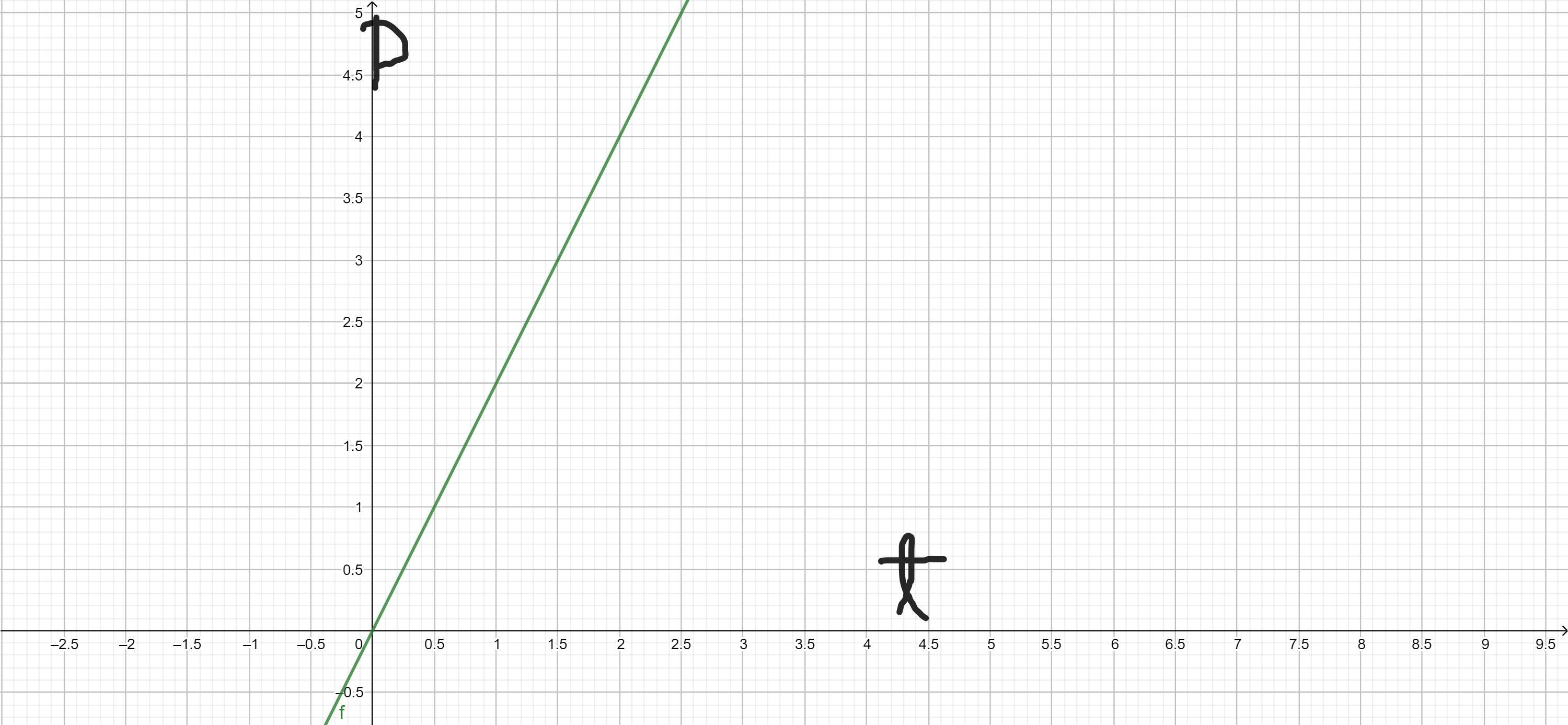
We want a graph of position vs time.

Now, remember the relation:

Distance = Speed*Time

Then we can write the position as a function of time as:

P(t) = 2m/s*t + P0

Where t is our variable, that represents time in seconds, and P0 is the position at time t = 0seconds, we can assume that this is zero.

Then the equation is:

P(t) = 2m/s*t

And the graph is something like:

You might be interested in
Suppose your friend claims to have discovered a mysterious force in nature that acts on all particles in some region of space. H
kirill [66]

Answer:

             U = 1 / r²

Explanation:

In this exercise they do not ask for potential energy giving the expression of force, since these two quantities are related


         F = - dU / dr

this derivative is a gradient, that is, a directional derivative, so we must have

          dU = - F. dr

the esxresion for strength is

         F = B / r³

let's replace

          ∫ dU = - ∫ B / r³  dr

in this case the force and the displacement are parallel, therefore the scalar product is reduced to the algebraic product

let's evaluate the integrals

            U - Uo = -B (- / 2r² + 1 / 2r₀²)

To complete the calculation we must fix the energy at a point, in general the most common choice is to make the potential energy zero (Uo = 0) for when the distance is infinite (r = ∞)

             U = B / 2r²

we substitute the value of B = 2

             U = 1 / r²

5 0
2 years ago
The late news reports the story of a shooting in the city. Investigators think that they have recovered the weapon and they run
Gemiola [76]

Answer:

50000 N

Explanation:

From the question given above, the following data were obtained:

Mass (m) of bullet = 0.050 kg

velocity (v) = 400 m/s

Distance (s) = 0.080 m

Force (F) =?

Next, we shall determine the acceleration of the bullet. This can be obtained as follow:

Initial velocity (u) = 0 m/s

Final velocity (v) = 400 m/s

Distance (s) = 0.080 m

Acceleration (a) =?

v² = u² + 2as

400² = 0 + (2 × a × 0.08)

160000 = 0 + 0.16a

160000 = 0.16a

Divide both side by 0.16

a = 160000 / 0.16

a = 1×10⁶ m/s²

Finally, we shall determine the force exerted by the bullet on the target. This can be obtained as follow:

Mass (m) of bullet = 0.050 kg

Acceleration (a) of bullet = 1×10⁶ m/s²

Force (F) =?

F = ma

F = 0.050 × 1×10⁶

F = 50000 N

Thus, the bullet exerted a force of 50000 N on the target.

7 0
2 years ago
Serena is a research student who has conducted an experiment on the discoloration of marble. Read about Serena’s experiment. The
sergij07 [2.7K]

The two flaws in her experiment’s design are

<span>- She introduced at least one confounding variable.</span> <span>- She tried to test multiple hypotheses at a time</span>

 In the above mentioned experiment she had to have four samples to prove four hypotheses, each one separately and not to mix two hypotheses in an alone sample, that what it brings as consequence is the confusion.

3 0
2 years ago
A 6.0-ohm resistor that obeys Ohm’s Law is connected to a source of variable potential difference. When the applied voltage is d
leva [86]

Is halved. A 6Ω resistor connected to a voltage source which voltage is decreased from 12V to 6V the current passing through the resistor is halved.

The key to solve this problem is applying Ohm's Law V = R I, clearing I from the equation, we obtain I = V/R. Then, the current is directly proportional to the voltage and inversely proportional to the resistance.

V = 12V and R = 6Ω

I = 12V/6Ω = 2A

V = 6V and R = 6Ω

V = 6V/6Ω = 1A

As we can see the current is halved if the voltage descreased from 12V to 6V

5 0
2 years ago
A. Why is the stratosphere considered a "stable" layer in the atmosphere?
vovangra [49]

Answer:

A. Stratosphere is said to be stable layer of the atmosphere when cool air sinks and warm air rises.Due to the fact that cool air has tendency to sink ,the air is not going fluctuating up and down in the stratosphere. This means that the air remains stationary or particles remains there for a very long duration.

B. If the lifted index is negative then the parcel temperature is warmer than the actual temperature. In addition, the parcel that is less warm than the surrounding will be less dense and will rise.

C. The water vapor come from different kinds of fronts; gust fronts from existing storms as their downdraft hits the surface, spreads and lifts air in front, upper air disturbances and surface heating by solar radiation making an unbalanced vertical profile .

D. the threshold used by storm chasers to assess if the dew point temperature is high enough to produce large thunderstorms is moisture ,the surface dew point needs to be 55 degrees fahrenheit or greater for a surface based thunderstorm to occur.

E. Wind shear is the change in wind direction or speed with height in an atmosphere.

Explanation:
7 0
2 years ago
Other questions:
  • Liz puts a 1 kg weight and a 10 kg on identical sleds. She then applies a 10N force to each sled. Which does not explain why the
    8·2 answers
  • Zamir and Talia raced through a maze. Zamir walked 2 m north, 2 m east, 4 m south, 2 m east, 4 m north, 2 m east, 3 m south, 4 m
    11·2 answers
  • A floating ice block is pushed through a displacement d = (14 m) i hat - (11 m) j along a straight embankment by rushing water,
    15·1 answer
  • It is initiated by the pressure gradient force. b. It blows from regions of high pressure to regions of low pressure. c. The dir
    14·1 answer
  • A ball is thrown upward from the top of a 25.0 m tall building. The ball’s initial speed is 12.0 m/sec. At the same instant, a p
    10·1 answer
  • A 5-kg can of paint is sitting on top of a 2-meter high step ladder. How much work did you do to move the can of paint to the to
    10·1 answer
  • You’re squeezing a springy rubber ball in your hand. If you push inward on it with a force of 1 N, it dents inward 2 mm. How far
    11·1 answer
  • Energy conservation with conservative forces: Two identical balls are thrown directly upward, ball A at speed v and ball B at sp
    7·1 answer
  • According to the nebular theory of solar system formation, what key difference in their early formation explains why the jovian
    13·1 answer
  • Unlike acceleration and velocity, speed does not need to specify
    7·1 answer
Add answer
Login
Not registered? Fast signup
Signup
Login Signup
Ask question!