answer.
Ask question
Login Signup
Ask question
All categories
  • English
  • Mathematics
  • Social Studies
  • Business
  • History
  • Health
  • Geography
  • Biology
  • Physics
  • Chemistry
  • Computers and Technology
  • Arts
  • World Languages
  • Spanish
  • French
  • German
  • Advanced Placement (AP)
  • SAT
  • Medicine
  • Law
  • Engineering
Eduardwww [97]
2 years ago
10

156 g sample of steel has a volume of 20.0 mL. What is the density of the steel sample? a g/cm3 Your answer should be rounded to

three significant figures. Do not include nits in your answer.​
Chemistry
2 answers:
Nimfa-mama [501]2 years ago
4 0

Answer:

The answer is

<h2>7.80</h2>

Explanation:

The density of a substance can be found by using the formula

density =  \frac{mass}{volume}  \\

From the question

mass of metal = 156 g

Since 1 mL = 1 cm³

20 mL = 20 cm³

volume = 20 cm³

It's density is

density =  \frac{156}{20}  =  \frac{39}{5}  \\

We have the final answer as

<h3>7.80 g/cm³ to 3 significant figures</h3>

Hope this helps you

ziro4ka [17]2 years ago
4 0

Answer:

7.8g/cm³

Explanation:

Formula is [ d = m/v ] where m = mass and v = volume.

We are given both "m" and "v" so we can solve for the density.

d = 156/20

d = 7.8

Best of Luck!

You might be interested in
Give the product for the reaction of 1-butene with methanol in the presence of acid. The mechanism is the same as the mechanism
Nuetrik [128]

Answer:

The final result is <u>2-methoxybutane. </u>

<u />

Explanation:

1-butene has a carbon-carbon double bound between C1 and C2.

When it will react with methanol, in the presence of an acid, the result will be an ether.

C4H8 + CH3OH → C5H12O

An acid-catalyzed ether synthesis from alkenes is limited by carbocation stability.

In the first step, the double bound will disappear. The C2 atom will be a C+ atom, this becaus it has only 3 bounds and not 4.

This C+ -atom will atract the O- atom to form an ether. The CH3 of methanol will bind on the C3 atom, this is the most stable position.

2-methoxybutane will be formed. It has a structural formula of C5H12O

1-methoxybutane will not be formed, because it's less stable.

1-butanol will be formed when water is added to 1-butene. The mechanism has the same principle but not the same product.

1-ethoxybutane and 2-ethoxybutane have a structural formula of C6H14O, this will not be the final result.

The final result is <u>2-methoxybutane. </u>

<u />

8 0
2 years ago
As Jesse's hybrid accelerates to pass a car on the highway, he notices that his gas mileage drops from 40 miles per gallon to 15
e-lub [12.9K]
The most likely explanation for this observation is C. his car has turned on more pistons to provide the extra energy needed to accelerate.

When cruising, hybrid cars are able to employ electrical energy to drive the car. Moreover, even if a vehicle is not a hybrid, a greater amount of fuel is consumed when one accelerates because the vehicle has to generate a force larger than the force of air resistance in order for it to accelerate. This increased demand of force reduces the vehicle's fuel economy.
7 0
2 years ago
Read 2 more answers
Avanti works in a bookstore. She has four books and is going to place them in two stacks. The diagram above shows the books befo
Feliz [49]

Answer:

Well they didn't transfer any energy when they weren’t touching and it did t produce any energy if it didn’t move. Since they are on top of each other they are causing momentum on each other creating kinetic energy

Explanation:

3 0
1 year ago
Which solution contains the largest number of moles of chloride ions?
elixir [45]
Molarity = number of moles of solute/liters of solution
number of moles of solute = molarity x liters of solution

Part (a): <span>30.00 ml of 0.100m Cacl2
number of moles of CaCl2 =  0.1 x 0.03 = 3x10^-3 moles
1 mole of CaCl2 contains 2 moles of chlorine, therefore 3x10^-3 moles of CaCl2 contains 6x10^-3 moles of chlorine

Part (b): </span><span>10.0 ml of 0.500m bacl2
number of moles of BaCl2 = 0.5 x 0.01 = 5x10^-3 moles
1 mole of BaCl2 contains 2 moles of chlorine, therefore 5x10^-3 moles of BaCl2 contains 10x10^-3 moles of chlorine

Part (c): </span><span>4.00 ml of 1.000m nacl
number of moles of NaCl = 1 x 0.004 = 0.004 moles
1 mole of NaCl contains 1 mole of chlorine, therefore 4x10^-3 moles of NaCl contains 4x10^-3 moles of chlorine

Part (d): </span><span>7.50 ml of 0.500m fecl3
number of moles of FeCl3 = 0.5 x 0.0075 = 3.75x10^-3 moles
1 mole of FeCl3 contains 3 moles of chlorine, therefore 3.75x10^-3 moles of FeCl3 contains 0.01125 moles of chlorine

Based on the above calculations, the correct answer is (d)</span>
5 0
2 years ago
Read 2 more answers
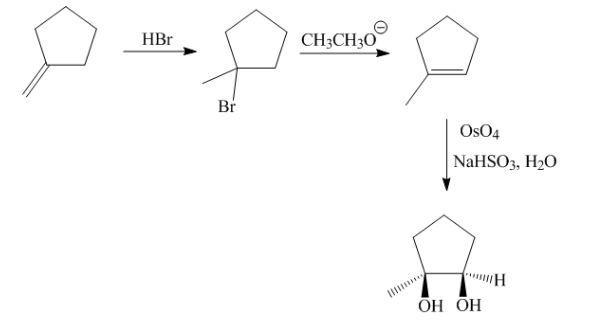
The target diol is synthesized in one step from 1-methylcyclopentene, but your lab partner exhausted the supply of that alkene.
andrezito [222]

Answer:

The reagents are CH_{3}CH_{3}O^{-},OsO_{4},NaHSO_{3}and H_{2}O.

Explanation:

1-Methylenecyclopentene is treated with HBr form 1-bromo-1-methylcyclopentane, which is treated with strong base ethoxide ion and forms 1-methylcyclopent-1-ene.

This alkene is treated with osmium tetraoxide in the presence of sodium bisulfite to form target product.

The chemical reaction is as follows.

4 0
2 years ago
Other questions:
  • Write one scientific question about the organism in the photo
    8·2 answers
  • The symbol for xenon (Xe) would be a part of the noble gas notation for the element antimony. cesium. radium. uranium.
    12·2 answers
  • Andrea is performing an experiment in which she needs to know when a strong acid is present. She is not sure which indicator to
    15·2 answers
  • Select the reagent(s) that would efficiently convert the starting material to the product for the following transformations (if
    11·1 answer
  • Hydrogen is unique among the elements because __________. 1. It has only one valence electron. 2. It is the only element that ca
    7·1 answer
  • Help please?
    9·2 answers
  • The diameter of an atom is approximately 1 × 10⁻¹⁰ m. What is the diameter in picometers?
    5·1 answer
  • What is the concentration of FeCl3 in a solution prepared by dissolving 10.0 g of FeCl3 in enough water to make 275 mL of soluti
    15·1 answer
  • A sample of krypton has a volume of 6.00 L, and the pressure is 0.960 atm. If the final temperature is 55.0°C, the final volume
    11·1 answer
  • A slug takes 4.25 minutes to travel 11.2 centimeters. What is the speed of the slug in minutes per second?
    10·1 answer
Add answer
Login
Not registered? Fast signup
Signup
Login Signup
Ask question!