answer.
Ask question
Login Signup
Ask question
All categories
  • English
  • Mathematics
  • Social Studies
  • Business
  • History
  • Health
  • Geography
  • Biology
  • Physics
  • Chemistry
  • Computers and Technology
  • Arts
  • World Languages
  • Spanish
  • French
  • German
  • Advanced Placement (AP)
  • SAT
  • Medicine
  • Law
  • Engineering
Aleks04 [339]
1 year ago
12

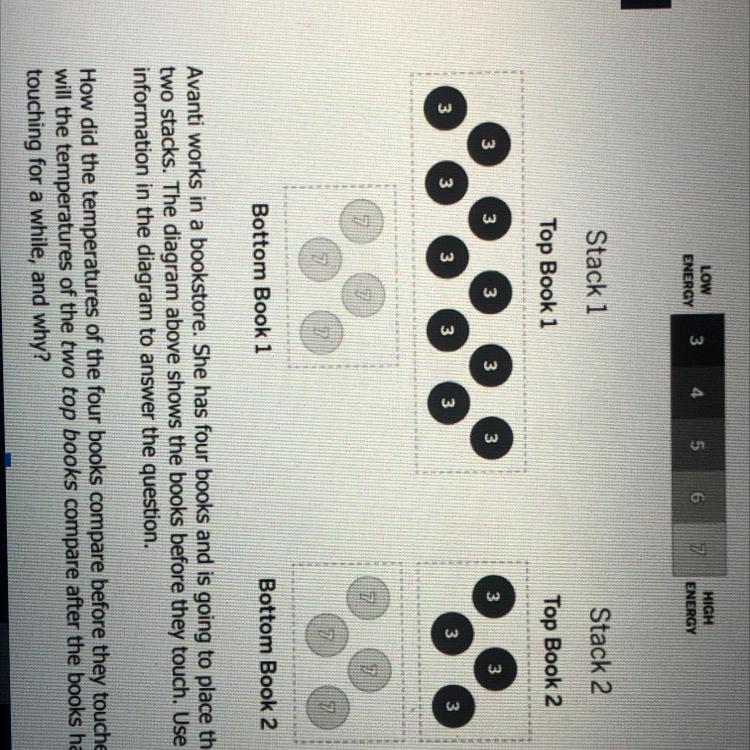
Avanti works in a bookstore. She has four books and is going to place them in two stacks. The diagram above shows the books befo

re they touch. Use the information in the diagram to answer the question. How did the temperatures of the four books compare before they touched? How will the temperatures of the two top books compare after the books have been touching for a while, and why?

Chemistry
1 answer:
Feliz [49]1 year ago
3 0

Answer:

Well they didn't transfer any energy when they weren’t touching and it did t produce any energy if it didn’t move. Since they are on top of each other they are causing momentum on each other creating kinetic energy

Explanation:

You might be interested in
The pressure inside of a sealed tube if you raise the temperature go ______..
Helen [10]

Answer:

The pressure will increase due ot expnasion of gasses in a closed sealed tube tube .

Explanation:

4 0
2 years ago
Read 2 more answers
In run 1, you mix 7.9 mL of the 43 g/L MO solution (MO molar mass is 327.33 g/mol), 3.13 mL of the 0.040 M SnCl2 in 2.0 M HCl so
blsea [12.9K]

Answer:

Concentration of H3O⁺  [H3O⁺] = 0.864 M

Explanation:

Given that:

The mass concentration of MO = 43 g/L

The volume of MO = 7.9 mL = 7.9 × 10⁻³ L

Recall that

The mass number of MO = Mass concentration of MO × Volume of MO

The mass number of MO = (43 g/L) * (7.9 × 10⁻³ L)

The mass number of MO =  0.3397 g

number of  moles of MO = (mass number of MO) / (molar mass of MO)

number of  moles of MO = (0.3397 g) / (327.33 g/mol)

moles of MO = 0.00104 mol

The total volume = 7.9 mL + 3.13 mL + 5.49 mL + 3.43 mL

The total volume = 19.95 mL = 19.95 × 10⁻³ L

Concentration of MO [MO} =(number of moles of MO) / (total volume)

[MO] = 0.00104 mol  /  19.95 × 10⁻³ L

[MO] = 5.2130 × 10⁻⁸ M

the number of moles of H3O⁺ = molarity of HCl in the solution × the volume of HCl in solution

the number of moles of H3O⁺ = [(2.0 M) * (3.13 mL)] + [(2.0 M) * (5.49 mL)]

the number of moles of H3O⁺ = 17.24 mmol

Concentration of H3O⁺  [H3O⁺] = (the number of moles of H3O⁺) / (total volume)

Concentration of H3O⁺  [H3O⁺] = (17.24 mmol) / (19.95 mL)

Concentration of H3O⁺  [H3O⁺] = 0.864 M

5 0
2 years ago
How many liters of oxygen gas can be produced at stp from the decomposition of 0.250 l of 3.00 m h2o2 in the reaction according
Wewaii [24]

the balanced chemical equation for the decomposition of H₂O₂ is as follows

2H₂O₂ ---> 2H₂O + O₂

stoichiometry of H₂O₂ to O₂ is 2:1

the number of moles of H₂O₂ decomposed is - 0.250 L x 3.00 mol/L = 0.75 mol

according to stoichiometry the number of O₂ moles is half the number of H₂O₂ moles decomposed

number of moles of O₂ - 0.75 mol / 2 = 0.375 mol

apply the ideal gas law equation to find the volume

PV = nRT

where P - standard pressure - 10⁵ Pa

V - volume

n - number of moles 0.375 mol

R - universal gas constant - 8.314 Jmol⁻¹K⁻¹

T - standard temperature - 273 K

substituting the values in the equation

10⁵ Pa x V = 0.375 mol x 8.314 Jmol⁻¹K⁻¹ x 273 K

V = 8.5 L

volume of O₂ gas is 8.5 L

6 0
2 years ago
A sample of an unknown substance has a mass of .158 kg if 2,510 J of heat is required to heat the substance from 32°C to 61°C wh
ziro4ka [17]

Answer: 0.548J/g°C

Explanation:

Q = s × m × DeltaT

Q = Heat (J)

S = Specific Heat Capacity

M = mass (g)

DeltaT = Change in temperature (°C)

0.158Kg x 1000 = 158g

2.510J = s x 158g x (61°C-32°C)

2.510J/(158g x 29°C) = s

S = 0.54779.... J/g°C

S = 0.548 J/g°C

7 0
2 years ago
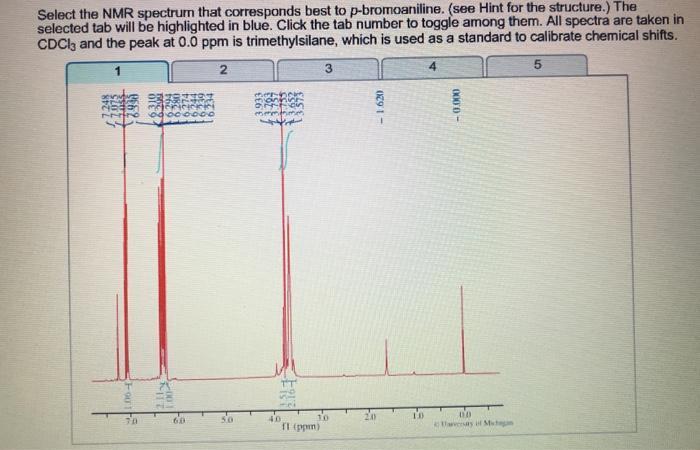
Select the NMR spectrum that corresponds best to p-bromoaniline. (see Hint for the structure.) The selected tab will be highligh
lana [24]

Answer:

The NMR spectrum that corresponds best to p-bromoaniline  is the one that is attached in the image below.

Explanation:

For the p-bromoaniline 3 types of hydrogen are observed. The first signal that appears at 3.7 ppm would be from the hydrogens of the NH2 group, the hydrogens in ortho position with respect to the NH2 group give a double at approximately 6.54 ppm, and finally the characteristic 7.21 ppm signal is observed for the hydrogens in meta position with with respect to the NH2 group.

7 0
2 years ago
Other questions:
  • White phosphorus, P4, is prepared by fusing
    12·1 answer
  • Explain why c6h5ch2ch2br is not formed during the radical bromination of c6h5ch2ch3. select the single best answer.
    8·1 answer
  • The table below provides some information about an unidentified element. Based on this information, the unidentified element is
    6·1 answer
  • When a 500. gram sample of water at 19.0oC absorbs 8.40 kiloJoules of heat, the temperature of the water will change to?
    11·1 answer
  • Match each decimal number to the correct scientific notation. 30,700 0.000307 0.00000307 3,070,000 3.07 × 10⁻⁶ arrowRight 3.07 ×
    12·2 answers
  • The following steps refer to various stages in transmission at a chemical synapse. 1. Neurotransmitter binds with receptors asso
    6·1 answer
  • Read the "Chemical Insights: Fireworks" essay within Ch 12 of the Zumdahl textbook. Which of the following substances produce br
    12·1 answer
  • The list below includes some of the properties of butane, a common fuel. Identify the chemical properties in the list. Check all
    14·1 answer
  • 7. If you fill a balloon with 5.2 moles of gas and it creates a balloon with a volume of 23.5 liters, how many moles are in a ba
    12·1 answer
  • In hypothetical element, two energy levels are separated by an energy of 282 kj/mol. what wavelength of light (in nm) is involve
    7·1 answer
Add answer
Login
Not registered? Fast signup
Signup
Login Signup
Ask question!