answer.
Ask question
Login Signup
Ask question
All categories
  • English
  • Mathematics
  • Social Studies
  • Business
  • History
  • Health
  • Geography
  • Biology
  • Physics
  • Chemistry
  • Computers and Technology
  • Arts
  • World Languages
  • Spanish
  • French
  • German
  • Advanced Placement (AP)
  • SAT
  • Medicine
  • Law
  • Engineering
Advocard [28]
2 years ago
15

Two students were doing an experiment which involved adding potassium sulfate powder to water. They added one teaspoon of potass

ium sulfate to the water and stirred it, and all the powder dissolved. They continued to do this until, after the fourth teaspoon, no more potassium sulfate would dissolve.
As more potassium sulfate dissolves in the water, the mixture becomes

a. more concentrated.
b. less concentrated.
c. dilute.
d. more cloudy.
Chemistry
1 answer:
lana [24]2 years ago
7 0

Answer:

less concentrated

Explanation:

because it will get dissociated into more ions

You might be interested in
Consider the dissolution of MnS in water (Ksp = 3.0 × 10⁻¹⁴). MnS(s) + H2O(l) Mn2+(aq) + HS–(aq) + OH–(aq) How is the solubility
Mademuasel [1]

Answer:

The solubility of MnS will decrease on addition of KOH solution.

Explanation:

As per the equation given:

MnS(s)+H_{2}O(l) -->Mn^{+2}(aq)+HS^{-}(aq)+OH^{-}(aq)

On dissolution of MnS in water it gives a basic solution as it gives hydroxide ions.

Now when the we are adding aqueous KOH solution, it will dissociate as:

KOH(aq)--->K^{+}(aq)+OH^{-}(aq)

Thus it will further furnish more hydroxide ion,

This will increase the concentration of hydroxide ions (present of product side), the system will try to decrease its concentration by shifting towards reactant side.

Thus the solubility of MnS will decrease on addition of KOH solution.

7 0
2 years ago
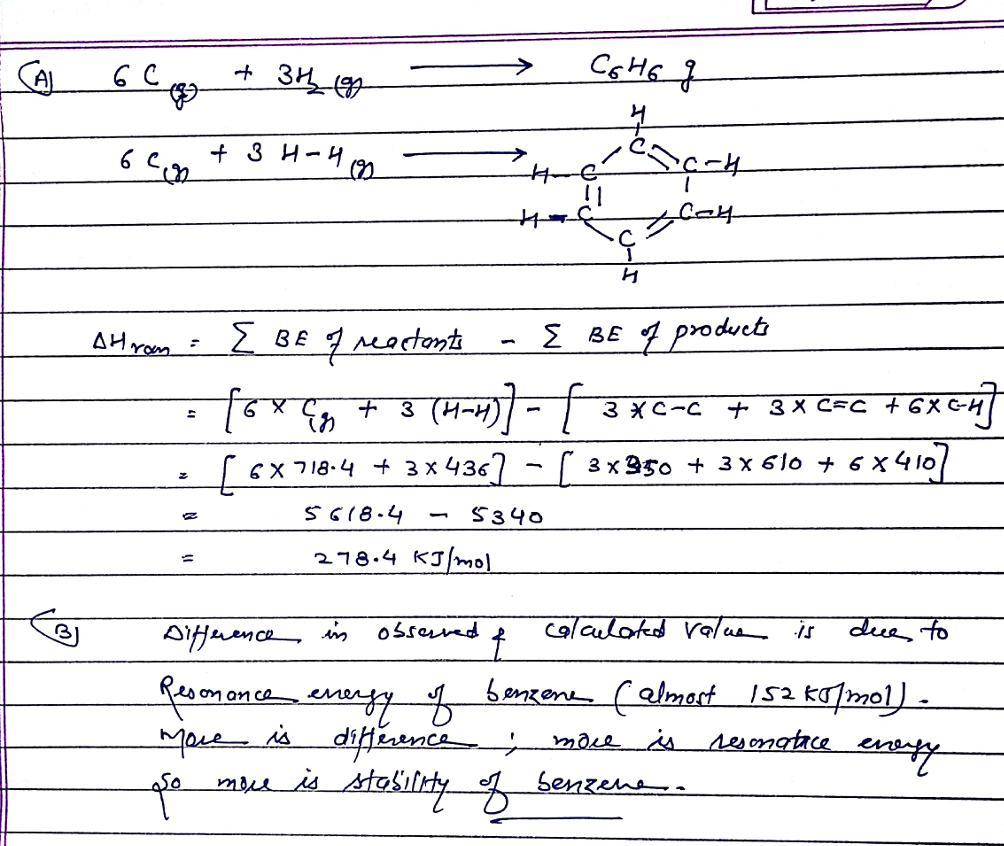
A. Use average bond energies together with the standard enthalpy of formation of C(g) (718.4 kJ/mol ) to estimate the standard e
Nana76 [90]

Answer:

a. 278.4kJ/mol

b. due to resonance, some energy are released

Explanation:

5 0
2 years ago
The first step in the Ostwald process for producing nitric acid is 4NH3(g) + 5O2(g) -> 4NO(g) + 6H2O(g). If the reaction of 1
aniked [119]

Answer: The percentage yield of the given reaction is 77.33%.

Explanation:

Moles is calculated by using the formula:

Moles=\frac{\text{Given mass}}{\text{Molar mass}}

  • Moles of Ammonia:

Given mass of ammonia = 150g

Molar mass of ammonia = 17 g/mol

Putting values in above equation, we get:

\text{Moles of ammonia}=\frac{150g}{17g/mol}=8.82moles

  • Moles of Oxygen

Given mass of oxygen = 150g

Molar mass of oxygen = 32 g/mol

Putting values in above equation, we get:

\text{Moles of oxygen}=\frac{150g}{32g/mol}=4.6875moles

For the given chemical equation:

4NH_3(g)+5O_2(g)\rightarrow 4NO(g)+6H_2O(g)

By Stoichiometry,

5 moles of oxygen reacts with 4 moles of ammonia.

So, 4.6875 moles of oxygen will react with = \frac{4}{5}\times 4.6875=3.75moles of ammonia

As, moles of ammonia required is less than the calculated moles. Hence, ammonia is present in excess and is termed as excess reagent.

Therefore, oxygen is considered as a limiting reagent because it limits the formation of products.

By Stoichiometry of the given reaction:

5 moles of oxygen gas produces 4 moles of nitric oxide

So, 4.6875 moles of oxygen gas will produce = \frac{4}{5}\times 4.6875=3.75moles of nitric oxide

Now, to calculate the theoretical amount of nitric oxide, we use equation 1:

Molar mass of nitric oxide = 30 g/mol

3.75mol=\frac{\text{Given mass}}{30g/mol}

Given mass of nitric oxide = 112.5 g

Now, to calculate the percentage yield, we use the formula:

\%\text{ yield}=\frac{\text{Experimental yield}}{\text{Theoretical yield}}\times 100

Experimental yield = 87 g

Theoretical yield = 112.5 g

Putting values in above equation, we get:

\%\text{ yield}=\frac{87}{112.5}\times 100=77.33\%

Hence, the percentage yield of the given reaction is 77.33%.

5 0
2 years ago
The chemical equation below shows the burning of magnesium (Mg) with oxygen (O2) to form magnesium oxide (MgO). 2Mg + O2 Right a
Nadusha1986 [10]

Answer:

64.0

Explanation:

2Mg+O2 ---> 2MgO

use dimentional analysis to find the amount of moles of O2 needed first

4.00molMg x 1.00mol O2/ 2.00 mol Mg=. 2.00 mol O2

using the coefficients you can see the mole ratio for O2:Mg the mole ratio is 1:2 which is why there is 1 mole on the top for 2 moles on the bottom. The Mg would cancel and multiply 4 by 1 then divide by 2, or multipy 4 by 1/2

Now that you have the moles of O2 you use the molar mass to find the grams in 2 moles of O2

2.00 mol O2 x 32.0g/1.00 mol = 64.0 g

multiply 2 by 32

4 0
2 years ago
A 25-ml sample of river water was titrated with 0.0010 m k2cr2o7 and required 8.3 ml to reach the end point. what is the chemica
arsen [322]

First let us calculate the moles of K2Cr2O7 that was supplied.

moles K2Cr2O7 = 0.0010 M * 0.0083 L = 8.3x10^-6 mol


From the chemical formula itself, we see that there are 7 O for every mole of K2Cr2O7 or 3.5 O2. Therefore:

moles O2 = 8.3x10^-6 mol K2Cr2O7 * (3.5 mol O2 / 1 mol K2Cr2O7)

moles O2 = 2.905x10^-5 mol O2


Calculating for the mass of O2 in mg:

mass O2 = 2.905x10^-5 mol O2 * (32 g / mol) * (1000 mg / g)

mass O2 = 0.9296 mg


Therefore the chemical oxygen demand (COD) is:

COD = 0.9296 mg / (0.025 L)

<span>COD = 37.184 mg/L</span>

7 0
2 years ago
Other questions:
  • A chemist has dissolved a certain substance in water. The chemist knows that more of the substance could be dissolved into the w
    13·2 answers
  • The population of rabbits in a forest is decreasing. Foxes in that region are now competing with each other for the limited numb
    12·2 answers
  • A 5.00 mL sample of H3PO4 solution of unknown concentration is titrated with a 0.1090 M NaOH solution. A volume of 7.12 mL of th
    5·1 answer
  • A substance is 89.2% carbon by mass. how much of the substance would be needed to recover 34.6 mol of pure carbon?
    8·2 answers
  • From the list below, which items describe beta decay? Check all that apply. APEX
    7·1 answer
  • Which statements about reducing sugars are true? D‑Glucose (an aldose) is a reducing sugar. The oxidation of a reducing sugar fo
    7·1 answer
  • When the reaction CO2(g) + H2(g) ⇄ H2O(g) + CO(g) is at equilibrium at 1800◦C, the equilibrium concentrations are found to be [C
    11·1 answer
  • A magnesium ion, Mg2+, with a charge of 3.2×10⁻¹⁹C and an oxide ion, O2−, with a charge of −3.2×10⁻¹⁹C, are separated by a dista
    6·1 answer
  • Robyn has been working on developing a new task to test the reaction time of athletes. As she begins to test athletes using her
    8·1 answer
  • Why is the atomic mass of iron, 55.845 amu, most similar to the mass of iron-56, yet less than 56 amu? The atomic mass is the si
    5·1 answer
Add answer
Login
Not registered? Fast signup
Signup
Login Signup
Ask question!