answer.
Ask question
Login Signup
Ask question
All categories
  • English
  • Mathematics
  • Social Studies
  • Business
  • History
  • Health
  • Geography
  • Biology
  • Physics
  • Chemistry
  • Computers and Technology
  • Arts
  • World Languages
  • Spanish
  • French
  • German
  • Advanced Placement (AP)
  • SAT
  • Medicine
  • Law
  • Engineering
mamaluj [8]
2 years ago
10

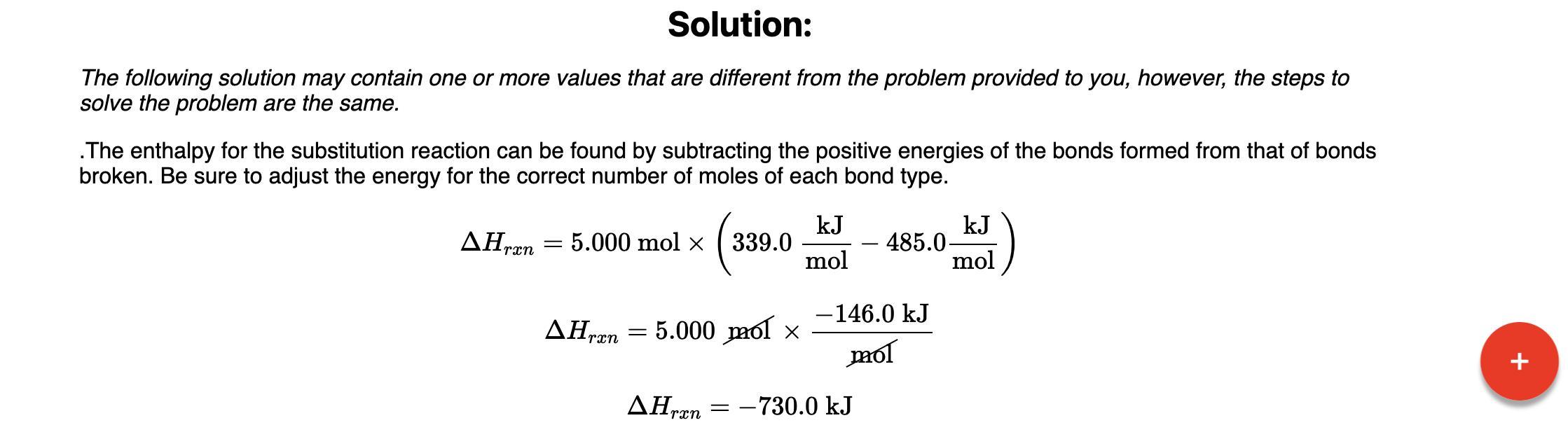
Sodium fluoroacetate (NaO₂C₂H₂F) is a common poison used in New Zealand to control invasive species, such as rats. It can be pre

pared by the substitution of a C-Cl bond in sodium chloroacetate (NaO₂C₂H₂Cl) for a C-F bond. What is the approximate enthalpy change for this substitution reaction on a 1.500 mole sample, based on the following bond energies?
C-Cl = 339.0 kJ/mol
C-F = 485.0 kJ/mol
Chemistry
1 answer:
NISA [10]2 years ago
7 0

Answer:

-219

Explanation:

1.5(339) - 1.5(485) = -219

You might be interested in
The standard molar heat of fusion of ice is 6020 j/mol. calculate q, w, and ∆e for melting 1.00 mol of ice at 0◦c and 1.00 atm p
zysi [14]

Answer :    q = 6020 J, w = -6020 J, Δe = 0

Solution : Given,

Molar heat of fusion of ice = 6020 J/mole

Number of moles = 1 mole

Pressure = 1 atm

Molar heat of fusion : It is defined as the amount of energy required to melt 1 mole of a substance at its melting point. There is no temperature change.

The relation between heat and molar heat of fusion is,

q=\Delta H_{fusion}(\frac{Mass}{\text{ Molar mass}})  (in terms of mass)

or, q=\Delta H_{fusion}\times Moles     (in terms of moles)

Now we have to calculate the value of q.

q=6020J/mole\times 1Mole=6020J

When temperature is constant then the system behaves isothermally and Δe is a temperature dependent variable.

So, the value of \Delta e=0

Now we have to calculate the value of w.

Formula used :    \Delta e=q+w

where, q is heat required, w is work done and \Delta e is internal energy.

Now put all the given values in above formula, we get

0=6020J+w

w = -6020 J

Therefore, q = 6020 J, w = -6020 J, Δe = 0

3 0
2 years ago
When a stable diatomic molecule spontaneously forms from its atoms, what are the signs of Delta H, Delta S, and Delta G? A. + +
Neko [114]
H will definitely be positive because a bond is always more stable than no bond surely if it is a sigma bond.
For G you can't really know because you don't know how much energy is provided by the bond and if it outways the loss in disorder.


The reaction will become more spontaneous with a lower temperature because H tells you the reaction is exotherm
3 0
2 years ago
A potential energy diagram is shown. A graph is plotted with Potential Energy in KJ on the y axis and Reaction Pathway on the x
ahrayia [7]

Answer:

35 KJ.

Explanation:

The activation energy is the minimum energy that must be overcome for a reaction to take place.

In the diagram given above, the activation energy lies between the energy of the reactants and that at the peak.

Thus we can calculate the activation energy as follow:

Energy of reactants = 30 KJ

Energy at the peak = 65 KJ

Activation energy =..?

Activation energy = Energy at the peak – Energy of reactants

Activation energy = 65 – 30

Activation energy = 35 KJ

Therefore, the activation energy of th reaction is 35 KJ

3 0
2 years ago
Hydrogen bonds are approximately _____% of the bond strength of covalent c-c or c-h bonds.
Lelu [443]
Hydrogen bonds are approximately 5% of the bond strength of covalent C-C or C-H bonds.
Hydrogen bonds strength in water is approximately 20 kJ/mol, strenght of carbon-carbon bond is approximately 350 kJ/mol and strengh of carbon-hydrogen bond is approximately 340 kJ/mol.
20 kJ/350 kJ = 0,057 = 5,7 %.
4 0
2 years ago
Which graphic below shows the correct orientation of each water molecule when it is near the cl- ion in the aqueous solution?
andrew-mc [135]
The question is missing the graphics required to answer which I have attached as an image.

There are four different representations of the orientation of water molecules around chloride anion. Let's first analyze the water molecule.

We have H-O-H as the structure of water. The oxygen atom is more electronegative than the hydrogen atoms, which results in a partial positive charge on the hydrogen atoms and a partial negative charge on the oxygen atom.

The chloride anion is a negative charge. Therefore, the water molecules should orient themselves with the hydrogen atoms facing the chlorine atom as the partial positive charge on the hydrogen atoms will be attracted to the negative charge of the chlorine atom.

The correct representation is shown in graph 3 which shows all hydrogen atoms facing the chlorine anion.
8 0
2 years ago
Other questions:
  • Which isolated gaseous atom has a total of five electrons occupying spherically shaped orbitals?
    7·1 answer
  • A gold atom has a radius of 145 pm. If you could string gold atoms like beads on a thread, how many atoms would you need to have
    5·1 answer
  • Calculate the percent activity of the radioactive isotope strontium-89 remaining after 5 half-lives.
    7·1 answer
  • You have two containers of equal volume. one is full of helium gas. the other holds an equal mass of nitrogen gas both gases hav
    7·1 answer
  • How many equivalents are in 0.60 mole of Mg2+
    7·1 answer
  • Avogadro’s number is a constant that helps scientists count atoms and molecules. It is approximately equal to 602,200,000,000,00
    11·2 answers
  • The delocalized π system in benzene is formed by a cyclic overlap of 6 ________ orbitals.
    8·1 answer
  • Question 4 (1 point)
    12·1 answer
  • How many moles of chromium metal equal 7.52 × 10²² atoms Cr?
    6·1 answer
  • Empirical Formula of P3O4H2?
    14·1 answer
Add answer
Login
Not registered? Fast signup
Signup
Login Signup
Ask question!
