answer.
Ask question
Login Signup
Ask question
All categories
  • English
  • Mathematics
  • Social Studies
  • Business
  • History
  • Health
  • Geography
  • Biology
  • Physics
  • Chemistry
  • Computers and Technology
  • Arts
  • World Languages
  • Spanish
  • French
  • German
  • Advanced Placement (AP)
  • SAT
  • Medicine
  • Law
  • Engineering
34kurt
2 years ago
15

Which element is a solid at STP? A. H2 B. I2 C. N2 D. O2

Chemistry
1 answer:
tatyana61 [14]2 years ago
3 0
B. I2, di-Iodine, is solid at STP.
You might be interested in
The activation energy for the reaction NO2(g)+CO(g)⟶NO(g)+CO2(g) is Ea = 375 kJ/mol and the change in enthalpy for the reaction
HACTEHA [7]
Answer: 625 kj/mol

Explanation:

As shown below this expression gives the activation energy of the reverse reaction:

EA reverse reaction = EA forward reaction + | enthalpy change |

1) The activation energy, EA is the difference between the potential energies of the reactants and the transition state:

EA = energy of the transition state - energy of the reactants.

2) The activation energy of the forward reaction given is:

EA = energy of the transition state - energy of  [ NO2(g) + CO(g) ] = 75 kj/mol

3) The negative enthalpy change - 250 kj / mol for the forward reaction means that the products are below in the potential energy diagram, and that the potential energy of the products, [NO(g) + CO2(g) ] is equal to 375 kj / mol - 250 kj / mol = 125 kj/mol

4) For the reverse reaction the reactants are [NO(g) + CO2(g)], and the transition state is the same than that for the forward reaction.

5) The difference of energy between the transition state and the potential energy of [NO(g) + CO2(g) ] will be the absolute value of the change of enthalpy plus the activation energy for the forward reaction:

EA reverse reaction = EA forward reaction + | enthalpy change |

EA reverse reaction = 375 kj / mol + |-250 kj/mol | = 375 kj/mol + 250 kj/mol = 625 kj/mol.

And that is the answer, 625 kj/mol
4 0
2 years ago
Which of the following trends is indirectly proportional to effective nuclear charge, Zeff
Julli [10]

Answer : Option C) Atomic Size

Explanation : The atomic radius of the elements is found to be decreasing if we go from left to right in the modern periodic table. Accordingly, Z_{eff} increases as the number of shielding electrons present in the atomic nucleus of the periodic elements which lies in the same row remains constant while the number of protons in each atomic shell increases.

The effective nuclear charge Z_{eff} of an atom is defined as the net positive charge which is felt by the valence electron of the atomic element.

When Z_{eff} is observed to decrease, it is seen that the atomic radius grows in size. So, it explains the inverse relationship between both. This phenomenon occurs, because there is more screening of the electrons from the nucleus taking place, which is observed due to decrease the attraction between the electron and the nucleus.

7 0
2 years ago
Read 2 more answers
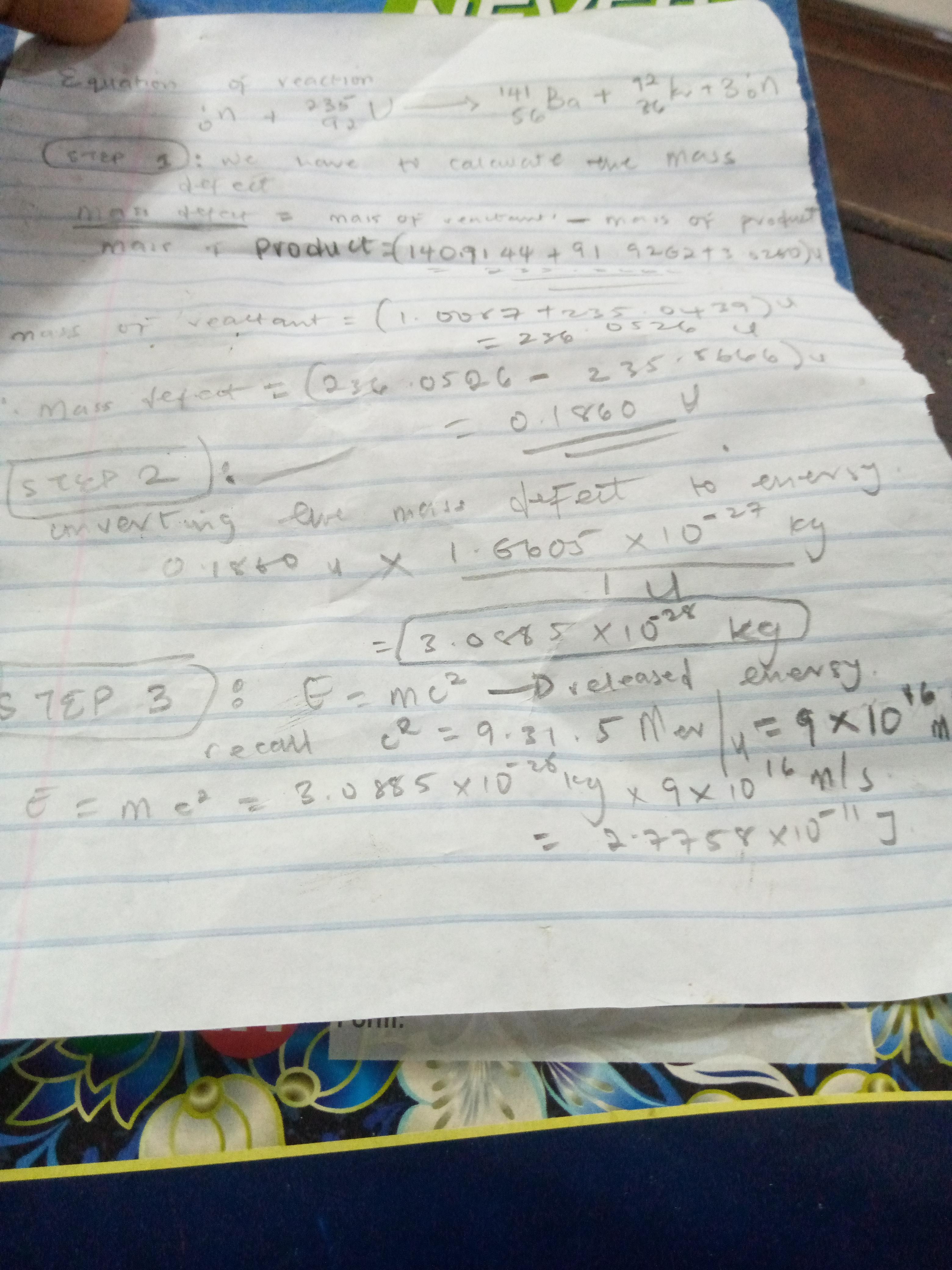
What is the reaction energy Q of this reaction? Use c2=931.5MeV/u. Express your answer in millions of electron volts to three si
emmasim [6.3K]

Answer:

Energy= 2.7758 × 10^-11 J ;

71.112×10^-6 kJ.

Mass defect in Kilogram= 3.0885×10^-28 kg.

That is; 3.1×10^-28 kg(to two significant figure).

Explanation:

(Note: Check equation of reaction in the attached file/picture).

STEP ONE: we have to calculate the Mass defect.

Mass defect= Mass of reactants -- Mass of products.

Mass of the products: (140.9144+91.9262+3.060) u.

= 235.8666 u.

Mass of reactants: (1.0087+235.0439) u= 236.0526 u.

Therefore, the Mass defect= (236.0526 -- 235.8666) u

= 0.1860 u.

STEP TWO: Converting the Mass defect to energy;

0.18860 × 1.6605 × 10^27 kg

= 3.0885× 10^-28 kg

STEP THREE: Calculating energy released . Recall(from the question) c^2= 931.5 Mev/u. This is also equals to 9×10^16 m/s.

E=Mc^2.

Where E= energy released, c= speed of light, M= Mass.

Slotting in the values;

E= 3.0885×10^-28 kg × 9×10^16 m/s.

E=2.7758 × 10^-11 J.

Know that;( 1g of uranium × 1 mol of uranium ÷ 235.0439 g of uranium) × (6.002×10^23 atom of uranium/ 1 mol of uranium) × 2.7758× 10^-11.

=7.1112×10^-10 J

= 71.112×10^6 kJ.

3 0
2 years ago
During an endothermic phase change, what happens to potential energy and the kinetic energy
polet [3.4K]
During this phase Change heat energy is being absorbed by the molecules, and as a result the molecules possess a greater ability to move around and possess higher kinetic energy because of this. The molecules also possess a higher potential energy.
7 0
2 years ago
Read 2 more answers
When iron pyrite (FeS2) is heated in air, the process known as "roasting" forms sulfur dioxide and iron(III) oxide. When the equ
Ronch [10]

Answer:

The coefficient of O2 is 11

Explanation:

Step 1:

The equation for the reaction:

FeS2 + O2 → SO2 + Fe2O3

Step 2:

Balancing the equation. The equation can be balance as follow:

FeS2 + O2 → SO2 + Fe2O3

There are 2 atoms of Fe on the right side and 1 atom on the left. It can be balance by putting 2 in front of FeS2 as shown below:

2FeS2 + O2 → SO2 + Fe2O3

There are 4 atoms of S on the left side and 1 atom on the right side. It can be balance by putting 4 in front of SO2 as shown below:

2FeS2 + O2 → 4SO2 + Fe2O3

Now, there are a total of 11 atoms of O on the right side and 2 atoms on the left side. It can be balance by putting 11/2 in front of O2 as shown below:

2FeS2 + 11/2O2 → 4SO2 + Fe2O3

Multiply through by 2 to clear the fraction as shown below:

4FeS2 + 11O2 → 8SO2 + 2Fe2O3

Now the equation is balanced.

The coefficient of O2 is 11

8 0
2 years ago
Other questions:
  • if 5 moles of P4 reacted with 22 moles Cl2 according to the above reaction, determine:How many moles PCl3 are produced
    14·1 answer
  • How can you tell if a sample contains baking soda and cornstarch or baking powder?
    6·2 answers
  • an element x has two naturally occurring isotopes: X-79 (abundance+50.69%, mass +78.918amu) and X-81 (abundance+49.31% mass+80.9
    9·1 answer
  • A grocery store has 75 dozen packages of hotdogs In stock. If there are 10 hot dogs in each package, how many moles of hot dogs
    13·2 answers
  • ANSWER FOR: How did the lab activities help you answer the lesson question "How do the processes of conduction, convection, and
    12·2 answers
  • 3 Ni2+(aq) + 2 Cr(OH)3(s) + 10 OH− (aq) → 3 Ni(s) + 2 CrO42−(aq) + 8 H2O(l) ΔG∘ = +87 kJ/molGiven the standard reduction potenti
    10·1 answer
  • In a hospital laboratory, a 10.0 mL sample of gastric juice (predominantly HCl), obtained several hours after a meal, was titrat
    13·1 answer
  • Problem Page A chemist measures the amount of bromine liquid produced during an experiment. He finds that of bromine liquid is p
    12·1 answer
  • Which will not appear in the equilibrium constant expression for the reaction below?
    8·1 answer
  • Sugar is easily soluble in water and has a molar mass of 342.30 g/mol. What is the molar concentration of a 259.8 mL aqueous sol
    15·1 answer
Add answer
Login
Not registered? Fast signup
Signup
Login Signup
Ask question!