answer.
Ask question
Login Signup
Ask question
All categories
  • English
  • Mathematics
  • Social Studies
  • Business
  • History
  • Health
  • Geography
  • Biology
  • Physics
  • Chemistry
  • Computers and Technology
  • Arts
  • World Languages
  • Spanish
  • French
  • German
  • Advanced Placement (AP)
  • SAT
  • Medicine
  • Law
  • Engineering
Anestetic [448]
2 years ago
10

Gabe is sitting in his boat and sees a famous building onshore which is known to be 250 meters tall. gabe sights the top of the

building, and finds that the angle of elevation is 19°. about how far, in meters, is gabe from the base of the building? (disregard gabe's height from the water in your calculations.)

Physics
2 answers:
Luda [366]2 years ago
5 0

Answer:

The distance between the gabe and the base of the building is 726.07 meters.

Explanation:

It is given that,

Gabe is sitting in his boat and sees a famous building onshore which is known to be 250 meters tall.

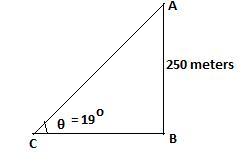
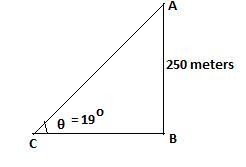
The angle of elevation, θ = 19°

We have to find the the distance between the gabe and the base of the building. From the attached figure, AB = height of building = 250 meters

BC = distance between the gabe and the base of the building

Using trigonometric equation as :

tan\ \theta=\dfrac{AB}{BC}

BC=\dfrac{AB}{tan\ \theta}

BC=\dfrac{250}{tan(19)}

BC = 726.05 meters

So, the gabe is 726.05 meters away from the base of the building.

Rina8888 [55]2 years ago
4 0
If we connect Gabe's current position to the top of the building, to the bottom of the building and back to Gabe, we form a right triangle with the height of 250 m and the angle opposite to the height being equal to 19°. If we let x be his distance from the building, we use the trigonometric formula,
                               tan 19° = x/250 m
The value of x from the equation is 86.08 m. Thus, the answer is 86.08 m. 
You might be interested in
An inline skater skates on a circular track 120.0 m in diameter at a tangential speed of 9.20 m/s. If the skater’s mass is 68.5
jok3333 [9.3K]

Answer:

The centripetal force acting on the skater is <u>48.32 N.</u>

Explanation:

Given:

Radius of circular track is, R=120.0\ m

Tangential speed of the skater is, v=9.20\ m/s

Mass of the skater is, m=68.5\ kg

We are asked to find the centripetal force acting on the skater.

We know that, when an object is under circular motion, the force acting on the object is directly proportional to the mass and square of tangential speed and inversely proportional to the radius of the circular path. This force is called centripetal force.

Centripetal force acting on the skater is given as:

F_c=\frac{mv^2}{R}

Now, plug in the given values of the known quantities and solve for centripetal force, F_c. This gives,

F_c=\frac{68.5\times (9.20)^2}{120.0}\\\\F_c=\frac{68.5\times 84.64}{120}\\\\F_c=\frac{5797.84}{120}\\\\F_c=48.32\ N

Therefore, the centripetal force acting on the skater is 48.32 N.

3 0
2 years ago
As shown in the figure below, Justin walks from the house to his truck on a windy day. He walks 20 m toward
juin [17]

Complete Question

The complete question is shown on the first uploaded image

Answer:

The velocity is   v =0.333 \  m/s in positive x -direction

The speed is s = 0.733 \ m/s

Explanation:

From the question we are told that

The distance from the house to truck is  D =  20 m

  The distance traveled back to retrieve  wind-blown hat is  d =  15

  The distance from the wind-blown hat position too the truck is  k =  20  m

  The total time taken is  t  =  75 s

Generally when calculating the displacement the Justin's backward movement to collect his wind - blown hat is taken as negative

Generally Justin's displacement is mathematically represented as

      L  =  20 - 15 + 20

=>    L  =  25 \ m

Generally the average velocity is mathematically represented as

          v  =  \frac{L}{t}

=>      v = \frac{25}{75}

=>      v =0.333 \  m/s

Generally the distance covered by Justin is mathematically represented as  

         R =  D+ d + k

=>      R =  20 + 15 +20

=>     R =  55 \  m

Generally Justin's average speed over a 75 s period is mathematically represented as

            s = \frac{R}{ t}

=>         s = \frac{55}{ 75}

=>        s = 0.733 \ m/s

8 0
2 years ago
Rotational dynamics about a fixed axis: A person pushes on a small doorknob with a force of 5.00 N perpendicular to the surface
FrozenT [24]

Answer:

I = 2 kgm^2

Explanation:

In order to calculate the moment of inertia of the door, about the hinges, you use the following formula:

\tau=I\alpha     (1)

I: moment of inertia of the door

α: angular acceleration of the door = 2.00 rad/s^2

τ: torque exerted on the door

You can calculate the torque by using the information about the Force exerted on the door, and the distance to the hinges. You use the following formula:

\tau=Fd        (2)

F: force = 5.00 N

d: distance to the hinges = 0.800 m

You replace the equation (2) into the equation (1), and you solve for α:

Fd=I\alpha\\\\I=\frac{Fd}{\alpha}

Finally, you replace the values of all parameters in the previous equation for I:

I=\frac{(5.00N)(0.800m)}{2.00rad/s^2}=2kgm^2

The moment of inertia of the door around the hinges is 2 kgm^2

3 0
2 years ago
Two vectors A⃗ and B⃗ are at right angles to each other. The magnitude of A⃗ is 4.00. What should be the length of B⃗ so that th
Soloha48 [4]

Answer:

B= \sqrt{65} ≅8.06

Explanation:

Using the Pythagorean theorem:

C^{2}= A^{2} + B^{2}

where C represents the length of the hypotenuse and A and B the lengths of the triangle's other two sides, we can find out the lenght of B assuming the value of the hypotenuse being 9 and A being 4.

9^{2}=4^{2} + B^{2}

81= 16+ B^{2}

81-16= B^{2}

B= \sqrt{65} ≅8.06

8 0
2 years ago
A soccer ball kicked with a force of 13.5 n accelerates at 6.5 m/s^2 to the right. what is the mass of the ball?
natita [175]

Answer:

2.08 kg

Explanation:

Newton's second law states that the acceleration of an object is proportional to the force applied to the object, according to the equation:

F=ma

where F is the force applied, m is the mass of the object and a its acceleration.

In this situation, the soccer ball is kicked with a force F=13.5 N and its acceleration is a=6.5 m/s^2, therefore its mass is

m=\frac{F}{a}=\frac{13.5 N}{6.5 m/s^2}=2.08 kg

6 0
2 years ago
Other questions:
  • Find τf, the torque about point p due to the force applied by the achilles' tendon.
    11·1 answer
  • A pulley system used to lift car tires has a mechanical advantage of 11.2. If you pull on the pulley with a force of 150 N, how
    12·2 answers
  • If a train is 100 kilometers away, how much sooner would you hear the train coming by listening to the rails (iron) as opposed t
    7·1 answer
  • Suppose that a rectangular toroid has 2,000 windings and a self-inductance of 0.060 H. If the height of the rectangular toroid i
    13·1 answer
  • 3. A 75kg man sits at one end of a uniform seesaw pivoted at its center, and his 24kg son sits at the
    11·1 answer
  • A radar used to detect the presence of aircraft receives a pulse that has reflected off an object 5 ✕ 10−5 s after it was transm
    5·1 answer
  • A ping-pong ball weighs 0.025 N. The ball is placed inside a cup that sits on top of a vertical spring. If the spring is compres
    6·1 answer
  • Psi communication refers to the transfer of information through a/an ________ process.
    10·1 answer
  • This is a problem about a child pushing a stack of two blocks along a horizontal floor. The masses of the blocks, and the coeffi
    13·1 answer
  • Gregor Mendel finished his pea plant experiments in 1863 and published his results in 1866. However, few scientists saw Mendel's
    6·1 answer
Add answer
Login
Not registered? Fast signup
Signup
Login Signup
Ask question!