answer.
Ask question
Login Signup
Ask question
All categories
  • English
  • Mathematics
  • Social Studies
  • Business
  • History
  • Health
  • Geography
  • Biology
  • Physics
  • Chemistry
  • Computers and Technology
  • Arts
  • World Languages
  • Spanish
  • French
  • German
  • Advanced Placement (AP)
  • SAT
  • Medicine
  • Law
  • Engineering
Katyanochek1 [597]
2 years ago
9

A chemical supply company sells sulfuric acid (H2SO4) in a concentration of 4.00 M. What volume of this solution would you need

to make 12.0 mL of a 0.50 M H2SO4 solution? what is the volume needed?
Chemistry
2 answers:
AURORKA [14]2 years ago
7 0
C₁=4.00 mol/L
c₂=0.50 mol/L
v₂=12.0 mL=0.012 L

n(H₂SO₄)=c₁v₁=c₂v₂

v₁=c₂v₂/c₁

v₁=0.50*0.012/4.00=0.0015 L = 1.5 mL
AlladinOne [14]2 years ago
7 0
Equation: Vi=MfVf/Mi
mL of 4.00 M H2SO4: 1.5
Statement: Add 1.5 mL of 4.00 M H2SO4 to 10.5 mL of water to get 12 mL of 0.50 M H2SO4.
You might be interested in
In [cu(nh3)4]co3, how many 3d electrons does copper have?
Andreyy89

Copper has a total of 29 electrons which would place the atom on the 29th number in the periodic table. In [Cu(NH₃)₄], there are 9 3d electrons of copper. The electron configuration of copper is [Ar] 4s² 3d¹⁰ but since there is a sub shell of its figuration that indicates only 1 electron filled, and since it is in the law that an electron must be paired up with another electron no matter how completely filled is the last sub shell, that is why the ast electron was given up to the other sub shell making it 9. The d shell can occupy around 10 electrons so it means that copper is a stable atom in the 3d sub shell. When you add [Cr(H₂O)₆]³⁺ (aq) and NH₃ (aq) a green solution because both are aqueous in form, you will get a purple solution containing [Cr(NH₃)₆]³⁺ (aq) and H₂O (l). 

4 0
2 years ago
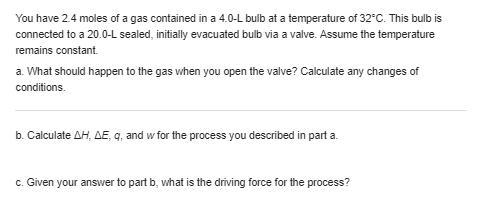
Consider 2.4 moles of a gas contained in a 4.0 L bulb at a constant temperature of 32°C. This bulb is connected to an evacuated
Luden [163]

Complete Question

The complete question is shown on the first uploaded image

Answer

a

As the valve is opened , the gas will flow into the empty container until the both containers have the same pressure

b

\Delta H = 0\ , \Delta E = 0 , q= 0 , w= 0

c

The driving force for this process is the increase in entropy this is because the movement of the internal energy of the gas into a larger volume, what this does is that it increases the amount of disorder(entropy).

Explanation

In order to obtain the parameter in the part B of the question we are first obtain the initial pressure, using the ideal gas equation  

                      P = \frac{nRT}{V}

                     P = \frac{(2.4mol)(0.0821\frac{1 atm}{K \cdot \ mol} )}{4.0L}

                         P =15 \ atm

The next thing is to obtain the new pressure of the gas , using boyle's law

              P_1V_1 = P_2V_2

                  P_2 = \frac{P_1 V_1}{V_2}

                  P_2 = \frac{(15 \ atm)(4.0L)}{24.0 L}

                  P_2 = 2.5 \ atm    

Since the this process is isothermal , the change in heat is equal to zero

                      i.e  q = 0 J

  The workdone to move  the gas to the other container is zero because the  the pressure at this second container is zero due to the fact that it is a vacuum

    i.e  w = -P_{external} \Delta V

              =-(0 \ atm) (24.0 - 4.0L)

              = 0L \cdot atm

  Since the change in heat is zero and the workdone is zero then the change in internal energy is equal to 0

     This is because the change in internal energy is equal to a summation of change in heat and the workdone

                i.e \Delta E = q + w

                            = 0J

Generally the change in enthalpy is mathematically represented as

                \Delta H = n C_p \Delta T

Since the temperature is zero this means that the change in temperature is zero , substituting this value for change in temperature into the equation for  change in enthalpy

           \Delta H = n C_p (0)

                   = 0J


7 0
2 years ago
Which missing item would complete this beta decay reaction?<br> PLATO
goldfiish [28.3K]

Answer: _{-1}^0\beta

Explanation:  

General representation of an element is given as:   _Z^A\textrm{X}

where,

Z represents Atomic number

A represents Mass number

X represents the symbol of an element

Beta decay : In this process, a neutron gets converted into a proton and an electron releasing a beta-particle. The beta particle released carries a charge of -1 units.

_Z^A\textrm{X}\rightarrow _{Z+1}^A\textrm{Y}+_{-1}^0\beta

The given reaction would be represented as:

_{43}^{98}\textrm{Tc}\rightarrow_{44}^{98}\textrm{Pb}+_{-1}^0\beta

7 0
2 years ago
Read 2 more answers
A proton transfer reaction can occur when an aldehyde is placed in strong base, such as an alkoxide ion, producing an alcohol an
Pani-rosa [81]

Hi, you have not provided structure of the aldehyde and alkoxide ion.

Therefore i'll show a mechanism corresponding to the proton transfer by considering a simple example.

Explanation: For an example, let's consider that proton transfer is taking place between a simple aldehyde e.g. acetaldehyde and a simple alkoxide base e.g. methoxide.

The hydrogen atom attached to the carbon atom adjacent to aldehyde group are most acidic. Hence they are removed by alkoxide preferably.

After removal of proton from aldehyde, a carbanion is generated. As it is a conjugated carbanion therefore the negative charge on carbon atom can conjugate through the carbonyl group to form an enolate which is another canonical form of the carbanion.

All the structures are shown below.

7 0
2 years ago
The potential energy diagram for a reaction starts at 180 kJ and ends at 300 kJ. What type of reaction does the diagram best rep
aleksklad [387]

Answer: Endothermic reaction

Explanation:

Exothermic reactions are defined as the reactions in which energy of the product is lesser than the energy of the reactants. The total energy is released in the form of heat and \Delta H for the reaction comes out to be negative.

Endothermic reactions are defined as the reactions in which energy of the product is greater than the energy of the reactants. The total energy is absorbed in the form of heat and \Delta H for the reaction comes out to be positive.

As the energy of reactants is 180 kJ and that of products is 300 kJ, the energy of products is greater than that of reactants, which means  the energy has been absorbed and reaction is endothermic.

8 0
2 years ago
Other questions:
  • Which of the following systems has the highest entropy?
    10·2 answers
  • List the number of each type of atom on the left side of the equation 2C10H22(l)+31O2(g)→20CO2(g)+22H2O(g)
    14·1 answer
  • The atomic mass of carbon is 12.01, sodium is 22.99, and oxygen is 16.00. What is the molar mass of sodium oxalate (Na2C2O4)?
    6·1 answer
  • a mixture contains cobalt metal copper metal, and tin metal. This metal is mixed with nickel nitrate. Which metals, if any will
    8·1 answer
  • A student adds 10.00 mL of a 2.0 M nitric acid solution to a 100.00 mL volumetric flask. Next, 50.00 mL of a 0.00500 M solution
    15·1 answer
  • The above shows a balloon full of gas which has a volume of 120.0 mL
    9·1 answer
  • C5H12, pentane, is a liquid at room temperature.
    15·1 answer
  • The pressure inside of a sealed tube if you raise the temperature go ______..
    14·2 answers
  • The equilibrium reaction below has the Kc = 4.00 at 25°C. If the temperature of the system at equilibrium is increased to 100°C,
    11·1 answer
  • Acetylenic fatty acids are found in many tropical plants. Compound B, C18H32O2, is one such compound; it absorbs 2 equivalents o
    9·1 answer
Add answer
Login
Not registered? Fast signup
Signup
Login Signup
Ask question!