answer.
Ask question
Login Signup
Ask question
All categories
  • English
  • Mathematics
  • Social Studies
  • Business
  • History
  • Health
  • Geography
  • Biology
  • Physics
  • Chemistry
  • Computers and Technology
  • Arts
  • World Languages
  • Spanish
  • French
  • German
  • Advanced Placement (AP)
  • SAT
  • Medicine
  • Law
  • Engineering
Alja [10]
2 years ago
11

Q 3.6: calculate the number of po43- ions present in 23.7 g of ca3(po4)2.

Chemistry
2 answers:
malfutka [58]2 years ago
6 0
Moles of ca3(po4)2 = 23.7 / 310.17 =  0.076

moles of (PO4)3- = 0.076 x 2 = 0.152

now, no. of ions = 0.152 x 6.022 x 10^{23}

                          =  9.2 x 10^{22}
disa [49]2 years ago
6 0

23.7 g of Ca₃(PO₄)₎₂ contains 9.20 x 10^22 ions of PO₄³⁻  

23.7 g of Ca₃(PO₄)₎₂ contains <u>0.1528 moles of PO₄³⁻ </u>which is equivalent to <u>9.20 x 10^22 ions of PO₄³⁻</u>

<h2>Further Explanation:</h2><h3>An Atom</h3>
  • An atom is the smallest particle of an element that can take part in a chemical reaction. For example, sodium atom, Na.  
<h3>A Molecule</h3>
  • A molecule is a substance that is made up of one or more atoms. The atoms in a molecule may be similar or different making a compound.  
<h3>A compound  </h3>
  • A compound is a substances that contains two or more different atoms that are bonded together. When the atoms are similar the substance is known as a molecule, therefore not all molecules are compounds.
  • Ca₃(PO₄)₎₂  is an example of a compound that contains three calcium ions and two Phosphate ions.

Therefore;

Ca₃(PO₄)₎₂ ionizes to give out 3 Ca²⁺ ions and 2 PO₄³⁻ ions

Ca₃(PO₄)₎₂ → 3Ca²⁺ + 2PO₄³⁻

Required to determine the number of ions of PO₄³⁻ ions

<h3>Step 1: Moles of Ca₃(PO₄)₎₂</h3>

Number of moles = Mass /Molar mass

Molar mass of Ca₃(PO₄)₎₂ = 310.1767 g/mol

Thus;

Moles = 23.7 g/310.1767 g/mol

          = 0.0764 moles

<h3>Step 3: Moles of PO₄³⁻ ions</h3>

1 mole of  Ca₃(PO₄)₎₂ ionizes to give 2 moles PO₄³⁻ ions

Therefore;

0.0764 moles will produce;

 = 0.0764 moles x 2

 = 0.0152 moles PO₄³⁻ ions

<h3>Step 3: Number of PO₄³⁻ ions</h3>

1 mole of PO₄³⁻ ions contains 6.022 x 10^23 ions

Therefore;

0.01528 moles PO₄³⁻ ions contains;

= 0.01528 x 6.022 x 10^23 ions

= 9.20 x 10^22 ions

Keywords: Atoms, ions, Moles, molar mass

<h3>Learn more about; </h3>
  • Atom: brainly.com/question/1841136
  • Molecules brainly.com/question/1841136
  • Compounds brainly.com/question/1841136
  • Avogadro’s constant: brainly.com/question/10466480
  • Molecular mass: brainly.com/question/10466480

Level: High school

Subject: Chemistry

Topic: Moles

Sub-topic: Avogadro's constant

You might be interested in
How many grams of K2CO3 would you need to put on the spill to neutralize the acid according to the following equation? 2HBr(aq)+
Mkey [24]

Full Question:

A flask containing 420 Ml of 0.450 M HBr was accidentally knocked to the floor.?

How many grams of K2CO3 would you need to put on the spill to neutralize the acid according to the following equation?

2HBr(aq)+K2CO3(aq) ---> 2KBr(aq) + CO1(g) + H2O(l)

Answer:

13.1 g K2CO3 required to neutralize spill

Explanation:

2HBr(aq) + K2CO3(aq) → 2KBr(aq) + CO2(g) + H2O(l)

Number of moles = Volume * Molar Concentration

moles HBr= 0.42L x .45 M= 0.189 moles HBr

From the stoichiometry of the reaction;

1 mole of K2CO3 reacts  with 2 moles of HBr

1 mole = 2 mole

x mole = 0.189

x = 0.189 / 2 = 0.0945 moles

Mass = Number of moles * Molar mass

Mass = 0.0945 * 138.21  = 13.1 g

3 0
2 years ago
In 200 g of a concentrated solution of 70.4 wt% nitric acid (r = 1.41 g/mL, FW(HNO3) = 63.01 g/mol), how many grams of water are
mars1129 [50]

Answer:

59.2 grams

Explanation:

We are given that 70.4% of the weight of the total 200 g of the concentration is made up of nitric acid, the remaining information is not required to solve the problem. Since water and nitric acid are the only components of the solution, the total weight of water is given by:

W = 200*(1-0.704)\\W=59.2\ g

There are 59.2 grams of water in this solution.

5 0
2 years ago
Why is radioactive dating important when approximating the age of earth?
Furkat [3]

Answer:

So, we rely on radiometric dating to calculate their ages. Radiometric dating, or radioactive dating as it is sometimes called, is a method used to date rocks and other objects based on the known decay rate of radioactive isotopes.

Explanation:

radiometric dating is a very accurate way to date the Earth.We know it is accurate because radiometric dating is based on the radioactive decay of unstable isotopes. When an unstable Uranium (U) isotope decays, it turns into an isotope of the element Lead (Pb).

6 0
2 years ago
Read 2 more answers
What is the name of Pb(NO3)2? Explain how you determined the bond type and the steps you used to determine the naming convention
Elena L [17]

Answer: Lead(II) nitrate but idk the rest

Explanation:

5 0
2 years ago
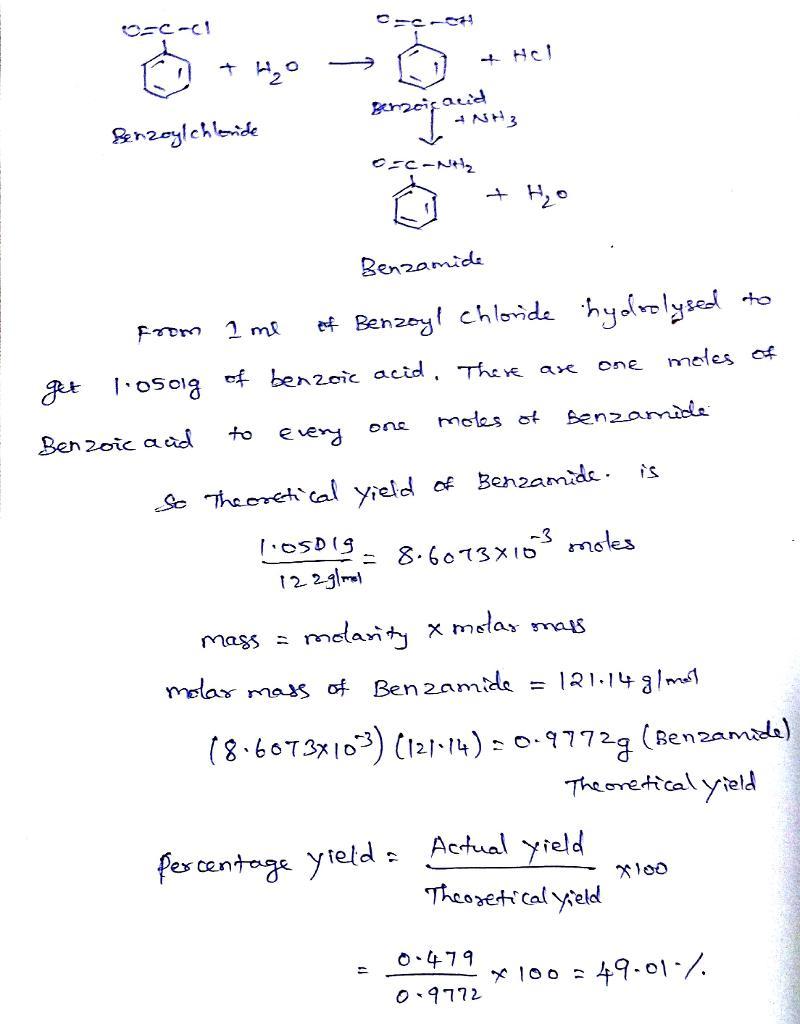
Consider the ammonolysis of benzoyl chloride by adding concentrated ammonium hydroxide to form the final product, benzamide. Rea
gizmo_the_mogwai [7]

Answer:

Explanation: see attachment below

4 0
2 years ago
Other questions:
  • Looking at the same nonmetal group on the periodic table, how does the reactivity of an element in period 2 compare to the react
    12·2 answers
  • 131i has a half-life of 8.04 days. assuming you start with a 1.53 mg sample of 131i, how many mg will remain after 13.0 days ___
    6·1 answer
  • The lab procedure involves several factors, listed below. Some were variable and some were constant. Label each factor below V f
    8·2 answers
  • How many moles of calcium chloride (CaCl2) are needed to react completely with 6.2 moles of silver nitrate (AgNO3)? 2AgNO3 + CaC
    15·1 answer
  • How many moles of O are in 2.45 moles of H2CO3?​
    5·1 answer
  • What are the respective central-metal oxidation state, coordination number, and overall charge on the complex ion in Na2[Cr(NH3)
    14·1 answer
  • What is the molarity and molality of a solution that is 10.00 % by mass potassium hydrogen carbonate (KHCO3, 100.11 g/mol) and h
    15·1 answer
  • A sample of gas with an initial volume of 28.4 Liters at a pressure of 725 mmHg and a temperature of 305 K is compressed to a vo
    9·1 answer
  • Which of the following organisms are carnivores?
    12·1 answer
  • A mixture containing 20 mole % butane, 35 mole % pentane and rest
    15·2 answers
Add answer
Login
Not registered? Fast signup
Signup
Login Signup
Ask question!