answer.
Ask question
Login Signup
Ask question
All categories
  • English
  • Mathematics
  • Social Studies
  • Business
  • History
  • Health
  • Geography
  • Biology
  • Physics
  • Chemistry
  • Computers and Technology
  • Arts
  • World Languages
  • Spanish
  • French
  • German
  • Advanced Placement (AP)
  • SAT
  • Medicine
  • Law
  • Engineering
ziro4ka [17]
2 years ago
9

The essential oil found in cloves, eugenol, can be isolated by steam distillation because it is insoluble in water and has a mea

surable vapor pressure at 100 °c even though it has a much higher boiling point than water. use data from the table to calculate the volume of eugenol in 30 ml of distillate.
Chemistry
1 answer:
Arada [10]2 years ago
6 0
Molar Mass of Water: 18 g/mol
Molar Mass of Eugenol: 164 g/mol
Boiling point of water: 100 degrees C
Boiling point of eugenol: 254 degrees C
Vapor pressure of Water at 100 degrees C: 760 mmHG
Vapor pressure of Eugenol at 100 degrees C: 4.0 mmHG


HINT: Steam distillation is particularly useful for purifying materials that decompose before reaching their normal boiling point. Steam causes high-boiling components that are immiscible in water to boil at significantly lower temperatures than their normal boiling point. Because the mole fraction of the components only depends on the vapor pressure of the components:

I have attempted this problem numerous times here is what i am doing what am i doing wrong?

Xorg = 4.0/4.0+760 = 0.0053
1-0.0053=0.9947 = XH20

mH2O = 0.9947 * 18 = 17.9046
morg = 0.0053 * 164 = 0.8692

m%org = [0.8692/ (0.8692 + 17.9046)] * 100 = 4.62%
<span>Rounded to 5%</span>
You might be interested in
Phosphorous acid, H3PO3(aq), is a diprotic oxyacid that is an important compound in industry and agriculture. K pKa1 K pKa2 1.30
FrozenT [24]

Answer:

* Before addition of any KOH:

pH = 0,0301

*After addition of 25.0 mL KOH:

pH = 1,30

*After addition of 50.0 mL KOH:

pH = 2,87

*After addition of 75.0 mL KOH:

pH = 6,70

*After addition of 100.0 mL KOH:

pH = 10,7

Explanation:

H₃PO₃ has the following equilibriums:

H₃PO₃ ⇄ H₂PO₃⁻ H⁺

k = [H₂PO₃⁻] [H⁺] / [H₃PO₃] k = 10^-(1,30) <em>(1)</em>

H₂PO₃⁻ ⇄ HPO₃²⁻ + H⁺

k = [HPO₃²⁻] [H⁺] / [H₂PO₃⁻] k = 10^-(6,70) <em>(2)</em>

Moles of H₃PO₃ are:

0,0500L×(1,8mol/L) = 0,09 moles of H₃PO₃

* Before addition of any KOH:

Using (1), moles in equilibrium are:

H₃PO₃: 0,09-x

H₂PO₃⁻: x

H⁺: x

Replacing:

10^{-1.30} = \frac{x^2}{0.09-x}

4.51x10⁻³ - 0.050x -x² = 0

The right solution of x is:

x = 0.0466589

As volume is 0,050L

[H⁺] = 0.0466589moles / 0,050L = 0,933M

As pH = -log [H⁺]

<em>pH = 0,0301</em>

*After addition of 25.0 mL KOH:

0,025L×1,8M = 0,045 moles of KOH that reacts with H₃PO₃ thus:

KOH + H₃PO₃ → H₂PO₃⁻ + H₂O

That means moles of KOH will be the same of H₂PO₃⁻ and moles of H₃PO₃ are 0,09moles - 0,045moles = 0,045moles

Henderson-Hasselbalch formula is:

pH = pka + log₁₀ [A⁻] /[HA]

Where A⁻ is H₂PO₃⁻ and HA is H₃PO₃.

Replacing:

pH = 1,30 + log₁₀ [0,045mol] / [0,045mol]

<em>pH = 1,30</em>

*After addition of 50.0 mL KOH:

The addition of 50.0 mL KOH consume all H₃PO₃. Thus, in the solution you will have just H₂PO₃⁻. Thus, moles in solution for the equilibrium will be:

H₂PO₃⁻: 0,09-x

HPO₃²⁻: x

H⁺: x

Replacing:

10^{-6.70} = \frac{x^2}{0.09-x}

1.8x10⁻⁸ - 2x10⁻⁷x - x² = 0

The right solution of x is:

x = 0.000134064

As volume is 50,0mL + 50,0mL = 100,0mL

[H⁺] = 0.000134064moles / 0,100L = 1.34x10⁻³M

As pH = -log [H⁺]

<em>pH = 2,87</em>

*After addition of 75.0 mL KOH:

Applying Henderson-Hasselbalch formula you will have 0,045 moles of both H₂PO₃⁻ HPO₃²⁻ and pka: 6,70:

pH = 6,70 + log₁₀ [0,045mol] / [0,045mol]

<em>pH = 6,70</em>

*After addition of 100.0 mL KOH:

You will have just 0,09moles of HPO₃²⁻, the equilibrium will be:

HPO₃²⁻ + H₂O ⇄ H₂PO₃⁻ + OH⁻ with kb = kw/ka = 1x10⁻¹⁴/10^-(6,70) = 5,01x10⁻⁸

kb = [H₂PO₃⁻] [OH⁻] / [HPO₃²⁻]

Moles are:

H₂PO₃⁻: x

OH⁻: x

HPO₃²⁻: 0,09-x

Replacing:

5.01x10^{-8} = \frac{x^2}{0.09-x}

4.5x10⁻⁹ - 5.01x10⁻⁸x - x² = 0

The right solution of x is:

x = 0.000067057

As volume is 50,0mL + 100,0mL = 150,0mL

[OH⁻] = 0.000067057moles / 0,150L = 4.47x10⁻⁴M

As pH = 14-pOH; pOH = -log [OH⁻]

<em>pH = 10,7</em>

<em></em>

I hope it helps!

6 0
2 years ago
Which has not been suggested as a reasonably practical way to store large amounts of hydrogen in relatively small spaces for its
Yakvenalex [24]

Answer: A. Liquefy hydrogen under pressure and store it much as we do with liquefied natural gas today.

Explanation:

Current Hydrogen storage methods fall into one of two technologies;

  1. <em>physical storage</em> where compressed hydrogen gas is stored under pressure or as a liquid; and
  2. <em>chemical storage</em>, where the hydrogen is bonded with another material to form a hydride and released through a chemical reaction.

Physical storage solutions are commonly used technologies but are problematic when looking at using hydrogen to fuel vehicles. Compressed hydrogen gas needs to be stored under high pressure and  requires large and heavy tanks. Also, liquid hydrogen boils at -253°C (-423°F) so it needs to be stored cryogenically with heavy insulation and actually contains less hydrogen compared with the same volume of gasoline.  

Chemical storage methods allow hydrogen to be stored at much lower pressures and offer high storage performance due to the strong binding of hydrogen and the high storage densities. They also occupy relatively smaller spaces than either compressed hydrogen gas or liquified hydrogen. A large number of chemical storage systems are under investigation, which involve hydrolysis reactions, hydrogenation/dehydrogenation reactions, ammonia borane and other boron hydrides, ammonia, and alane etc.

Other practical storage methods being researched that focuses on storing hydrogen as a lightweight, compact energy carrier for mobile applications include;

  • Metal hydrides  e.g. LiH
  • Nanostructured metal hydrides
  • Non-metal hydrides
  • Carbohydrates
  • Synthesized hydrocarbons
  • Aluminum
  • Liquid organic hydrogen carriers (LOHC)
  • Encapsulation , e.t.c.
5 0
2 years ago
LOOK AT THE IMAGE ABOVE CAN SOMEONE PLEASE HELP ME AND SHOW FULL STEPS PLEASE
Tju [1.3M]

answer:

no

explanation:

cause you dumb

5 0
2 years ago
compare the mass and volume of each object what is true of the mass and volume of all the floating objects
V125BC [204]

Answer:

Volume is always more than the mass for floating objects. For sinking objects mass is always more than the volume

Explanation:

None

3 0
2 years ago
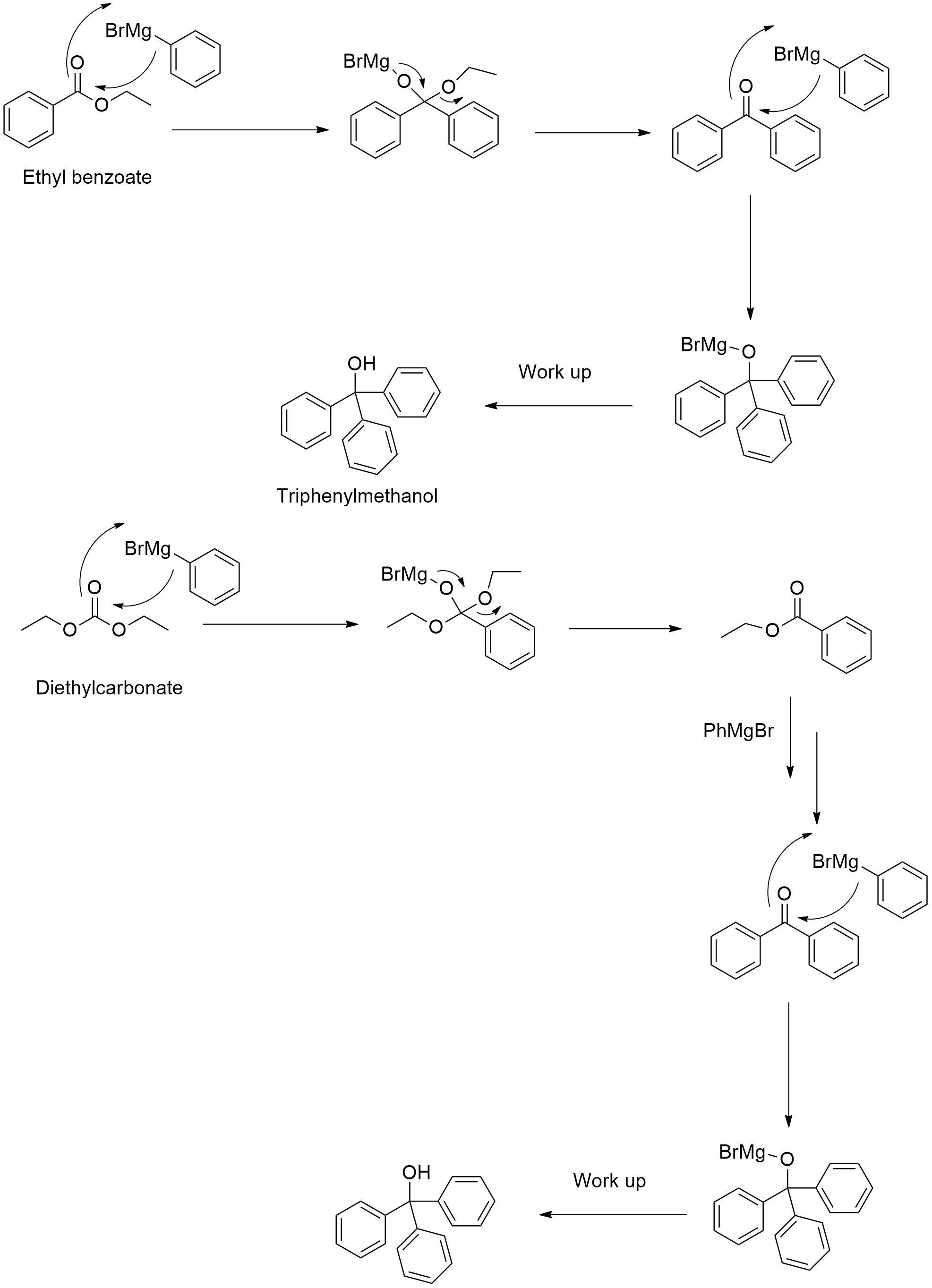
Triphenylmethanol can also be prepared by reacting ethyl benzoate with phenylmagnesium bromide, and by reacting diethylcarbonate
inysia [295]

Answer:

Both reactions proceeds  through nucleophilic acyl substitution reaction

Explanation:

  • Both these two reactions proceeds through nucleophilic acyl substitution reaction where phenyl magnesium bromide replaces one ethoxide ion.
  • Then another another equivalent of phenyl magnesium bromide give nucleophilic addition reaction with resulting keto group to produce triphenylmethanol
  • Full reaction mechanism has been shown below    

3 0
2 years ago
Other questions:
  • A heat energy of 645 J is applied to a sample of glass with a mass of 28.4 g. Its temperature increases from –11.6 ∞C to 15.5 ∞C
    11·1 answer
  • You are on a field trip to a nearby lake for biology class and want to perform a quick analysis of the water’s approximate pH le
    6·2 answers
  • Please Help Potassium sulfate has a solubility of 15g/100g water at 40 Celsius. A solution is prepared by adding 39.0g of potass
    10·1 answer
  • The equilibrium constant for the gas-phase isomerization of borneol (c10h17oh) to isoborneol at 503 k is 0.106. a mixture consis
    12·1 answer
  • During this reaction, p4 + 5o2 → p4o10, 0.800 moles of product was made in 15.0 seconds. what is the rate of reaction? 56.8 g/mi
    12·1 answer
  • How many equivalents are in 0.60 mole of Mg2+
    7·1 answer
  • If you were to perform the reaction KCl (s)→K+ (g)+ Cl−(g), would energy be absorbed or released? Lattice Energies for Some Ioni
    5·1 answer
  • Exactly 17.0 mL of a H2SO4 solution was required to neutralize 45.0 mL of 0.235 M NaOH. What was the concentration of the H2SO4
    6·1 answer
  • Challenge question: This question is worth 6 points. As you saw in problem 9 we can have species bound to a central metal ion. T
    7·1 answer
  • g You observed the formation of several precipitates in the Reactions in Solution lab exercise. Identify the precipitate in each
    6·1 answer
Add answer
Login
Not registered? Fast signup
Signup
Login Signup
Ask question!