answer.
Ask question
Login Signup
Ask question
All categories
  • English
  • Mathematics
  • Social Studies
  • Business
  • History
  • Health
  • Geography
  • Biology
  • Physics
  • Chemistry
  • Computers and Technology
  • Arts
  • World Languages
  • Spanish
  • French
  • German
  • Advanced Placement (AP)
  • SAT
  • Medicine
  • Law
  • Engineering
kolezko [41]
2 years ago
12

How many atoms are there in 5.699 g of cobalt, Co? Express your answer with the appropriate significant figures and unit.

Chemistry
1 answer:
rjkz [21]2 years ago
6 0
<span>5.824x10^22 atoms of cobalt are in 5.699 grams of cobalt. First, determine the number of moles of cobalt you have by dividing the mass of cobalt by the atomic weight of cobalt. So Atomic weight cobalt = 58.933195 Mole cobalt = 5.699 g / 58.933195 g/mol = 0.096702716 mol Now to determine the number of atoms, multiply by Avogadro's number. So 0.096702716 * 6.0221409x10^23 = 5.823574x10^22 Rounding to 4 significant figures, gives 5.824x10^22</span>
You might be interested in
Two electrons in an atom are separated by 1.5 ✕ 10-10 m, the typical size of an atom. what is the electric force between them?
densk [106]
Given two electrons with charge of 1.5x10^-10 m 

The electostatic force between them is determined by this formula: 

F = kq1q2/r^2
   
where 

k = 9x10^9
q1 = q2 = 1.5x10^-10
r = 2.82x10^-15

F = 9x10^9 * (1.5x10^-10)^2 / 2.82x10^-15
   = 71808.51
4 0
2 years ago
Read 2 more answers
An empty beaker is weighed and found to weigh 23.1 g. Some potassium chloride is then added to the beaker and weighed again. The
GuDViN [60]

Answer:Mass of Potassium chloride =1.762g

Explanation:

Mass of empty beaker = 23.100 g

Mass of beaker with Potassium chloride = 24.862g

Mass of Potassium chloride = Final weight - initial weight = Mass of beaker with Potassium chloride  - Mass of empty beaker = 24.862-23.100 = 1.762g

8 0
2 years ago
Convert 4.77x10^24 molecules of SO2 to grams
tensa zangetsu [6.8K]
Those are the correct steps, young chemist. Don't be discouraged by an insane answer. 
5 0
2 years ago
25.0 mL of an HBr solution were titrated with 29.15 mL of a 0.205 M LiOH solution to reach the equivalence point. What is the mo
krok68 [10]

HBr reacts with LiOH and forms LiBr and H₂O as the products. The balanced reaction is

LiOH(aq) + HBr(aq) → LiBr(aq) + H₂O(l)

Molarity (M) = moles of solute (mol) / volume of the solution (L)

Molarity of LiOH = 0.205 M

Volume of LiOH = 29.15 mL = 29.15 x 10⁻³ L

Hence,

moles of LiOH = molarity x volume of the solution

= 0.205 M x 29.15 x 10⁻³ L

= 5.97575 x 10⁻³ mol

The stoichiometric ratio between LiOH and HBr is 1 : 1.

Hence,

moles of HBr in 25.0 mL = moles of LiOH added

= 5.97575 x 10⁻³ mol

Hence, molarity of HBr = 5.97575 x 10⁻³ mol / 25.00 x 10⁻³ L

= 0.23903 M

≈ 0.239 M

Hence, the molarity of the HBr is 0.239 M.

6 0
2 years ago
Read 2 more answers
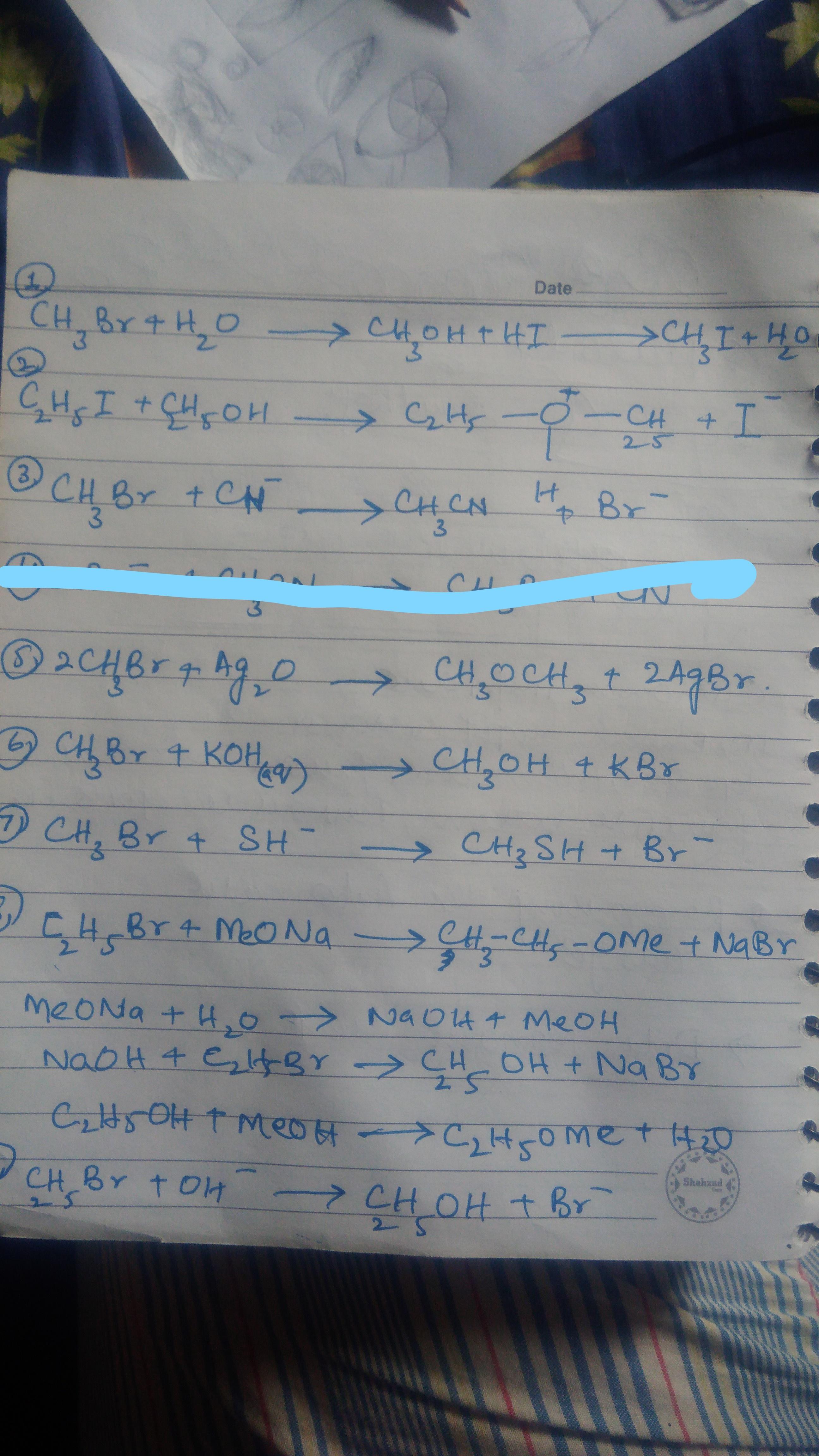
With methyl, ethyl, or cyclopentyl halides as your organic starting materials and using any needed solvents or inorganic reagent
Scorpion4ik [409]

Answer:

In the attachment you can find all the possible chemical reactions.

Some reaction can not be obtained by using alkyl halides because halides are weak leaving group which can leave compound during reaction easily but hydroxyl groups is a strong nucleophile which can not leave compound easily. So we can obtain alcohol from ethyl bromide, but we can not obtain hydroxyl ion from ethyl bromide.  

Explanation:

7 0
2 years ago
Other questions:
  • There are two types of nucleic acids, dna and rna. nearly all organisms use dna, not rna, as the central repository for genetic
    15·1 answer
  • A biology student wants to conduct a study of how the amount of food affects weight gain for mice. He sets up four cages with a
    12·1 answer
  • Compare and contrast the outer core and the inner core.
    8·2 answers
  • A chemist mixes two liquids A and B to form a homogeneous mixture. The densities of the liquids are 2.0514 g/mL for A and 2.6678
    8·1 answer
  • Glucose (C6H12O6) can be fermented to yield ethanol (CH3CH2OH) and carbon dioxide (CO2). C6H12O6⟶2CH3CH2OH+2CO2 The molar mass o
    15·1 answer
  • A 100 mL reaction vessel initially contains 2.60×10^-2 moles of NO and 1.30×10^-2 moles of H2. At equilibrium the concentration
    13·1 answer
  • What mass of NH3 can be made from 1221g of H2 and excess N2
    8·1 answer
  • If Co(NH3)63+ has a λmax at 440 nm, calculate ΔE for the complex. A) 2.72 x 10⁻⁴ kJ/mol B) 4.52 x 10⁻² kJ/mol C) 2.72 x 10 2 kJ/
    5·1 answer
  • Aluminum has a specific heat of 0.902 j/gC. How much heat is lost when a piece of aluminum with a mass of 23.984 g cools from a
    6·1 answer
  • In this problem, you will use Lenz's law to explore what happens when an electromagnet is activated a short distance from a wire
    13·1 answer
Add answer
Login
Not registered? Fast signup
Signup
Login Signup
Ask question!