answer.
Ask question
Login Signup
Ask question
All categories
  • English
  • Mathematics
  • Social Studies
  • Business
  • History
  • Health
  • Geography
  • Biology
  • Physics
  • Chemistry
  • Computers and Technology
  • Arts
  • World Languages
  • Spanish
  • French
  • German
  • Advanced Placement (AP)
  • SAT
  • Medicine
  • Law
  • Engineering
Airida [17]
2 years ago
4

Calculate the amount of hcn that gives the lethal dose in a small laboratory room measuring 12.0 ft×15.0 ft×9.50ft.

Chemistry
1 answer:
sergey [27]2 years ago
4 0

1710ft is your answer
hope this helps

You might be interested in
Bonds between two atoms that are equally electronegative are _____. bonds between two atoms that are equally electronegative are
Anna [14]
Bonds of two atoms of equal electronegativity are nonpolar covalent bonds.

Your second sentence is identical to the first sentence; I'll bet the second sentence is "Bonds between two atoms that are unequally electronegative are polar covalent bonds."
4 0
2 years ago
How many milliliters of 0.200 M NH4OH are needed to react with 12.0 mL of 0.550 M FeCl3?
trapecia [35]

Answer:

9.9 ml of 0.200M NH₄OH(aq)

Explanation:

3NH₄OH(Iaq) + FeCl₃(aq) => NH₄Cl(aq) + Fe(OH)₃(s)

?ml of 0.200M NH₄OH(aq) reacts completely with  12ml of 0.550M FeCl₃(aq)

1 x Molarity NH₄OH x Volume Am-OH Solution(L) = 2 x Molarity FeCl₃ x Volume FeCl₃ Solution

1(0.200M)(Vol Am-OH Soln) = 3(0.550M)(0.012L)

=> Vol Am-OH Soln = 3(0.550M)(0.012L)/1(0.200M) = 0.0099 Liter = 9.9 milliliters  

5 0
2 years ago
Jesse travels 3.0 meters east and then turns and travels 4.0 meters north. The trip requires 35 seconds. What is his velocity? 0
melisa1 [442]
Displacement = √(3² + 4²)
Displacement = 5 meters north east

Velocity = displacement / time
Velocity = 5 / 35
Velocity = 0.14 m/s northeast
6 0
2 years ago
Read 2 more answers
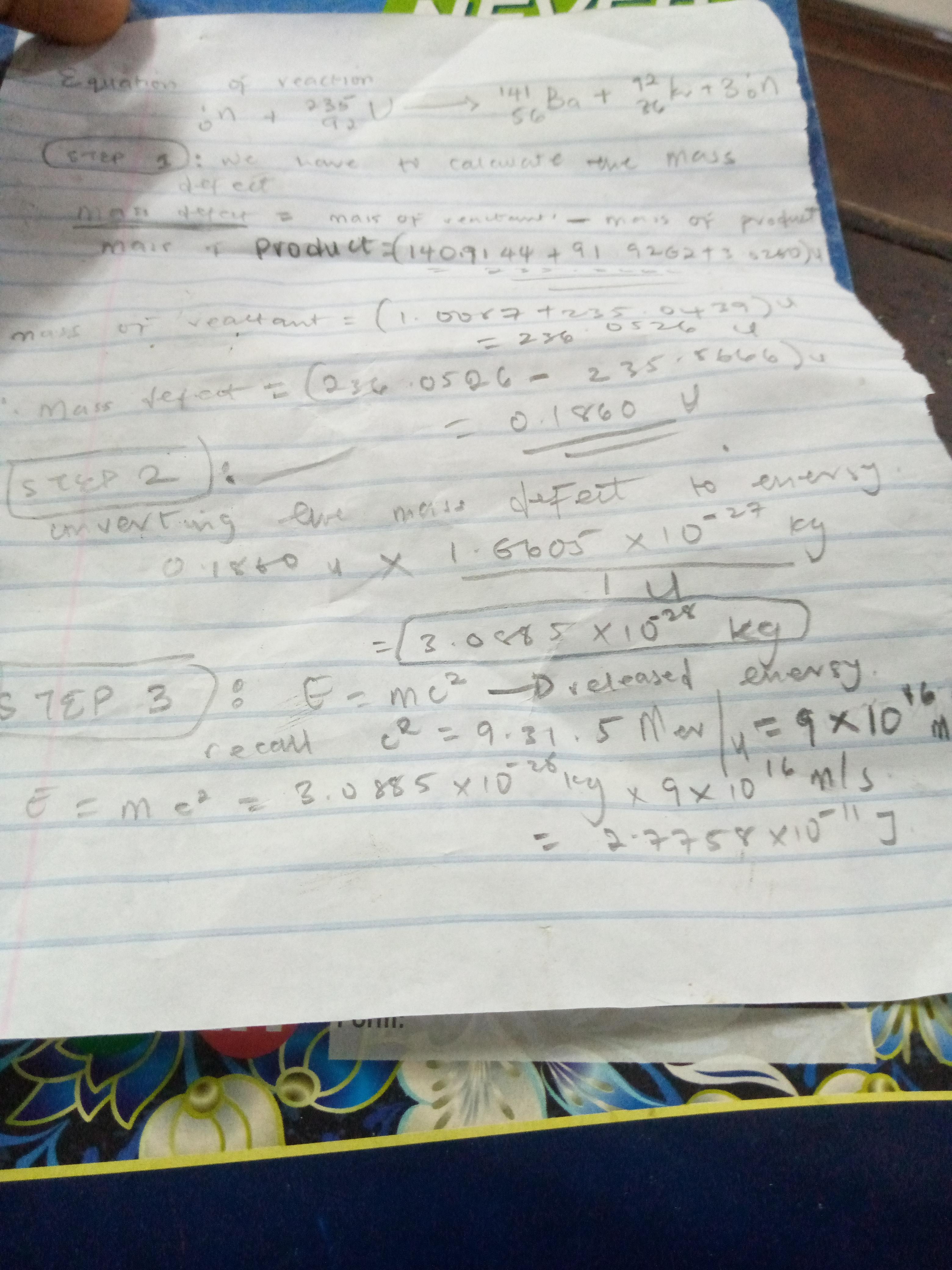
What is the reaction energy Q of this reaction? Use c2=931.5MeV/u. Express your answer in millions of electron volts to three si
emmasim [6.3K]

Answer:

Energy= 2.7758 × 10^-11 J ;

71.112×10^-6 kJ.

Mass defect in Kilogram= 3.0885×10^-28 kg.

That is; 3.1×10^-28 kg(to two significant figure).

Explanation:

(Note: Check equation of reaction in the attached file/picture).

STEP ONE: we have to calculate the Mass defect.

Mass defect= Mass of reactants -- Mass of products.

Mass of the products: (140.9144+91.9262+3.060) u.

= 235.8666 u.

Mass of reactants: (1.0087+235.0439) u= 236.0526 u.

Therefore, the Mass defect= (236.0526 -- 235.8666) u

= 0.1860 u.

STEP TWO: Converting the Mass defect to energy;

0.18860 × 1.6605 × 10^27 kg

= 3.0885× 10^-28 kg

STEP THREE: Calculating energy released . Recall(from the question) c^2= 931.5 Mev/u. This is also equals to 9×10^16 m/s.

E=Mc^2.

Where E= energy released, c= speed of light, M= Mass.

Slotting in the values;

E= 3.0885×10^-28 kg × 9×10^16 m/s.

E=2.7758 × 10^-11 J.

Know that;( 1g of uranium × 1 mol of uranium ÷ 235.0439 g of uranium) × (6.002×10^23 atom of uranium/ 1 mol of uranium) × 2.7758× 10^-11.

=7.1112×10^-10 J

= 71.112×10^6 kJ.

3 0
2 years ago
For which of the following properties does sodium have a larger value than rubidium? Select all that apply.
Doss [256]

Answer:

Ionization energy

Electronegativity

Explanation:

-due to its smaller ionic radius....the electron in the outter most shell tends to expierence a stronger nuclear attraction...which makes it harder to remove the electron from the sodium atom

-Rubidium has lesser ionization energy because its (i) affected by its larger ionic radius which tends to lessen the nuclear attraction ...hence making it easier to remove the electron...(ii)and also by the screening effect done by the inner shells, which also tends to lessen the nuclear attraction.

Sodium has a higher electronegativity than rubidium;

Electronegativity is the charge density of electrons in an atom...in which its high when the atomic radius is smaller...

So hence due to the sodium atomic radius being smaller...it tends to have a higher charge density than rubidium....which then gives it a higher electronegativity value

4 0
2 years ago
Other questions:
  • In 1803, the British chemist John Dalton proposed several atomic theories. Which one of his theories was later shown to be incor
    8·1 answer
  • 1. How many grams of chromium metal are plated out when a constant current of 8.00 A is passed through an aqueous solution conta
    15·1 answer
  • For an experiment, a biology student makes 1 liter of a solution containing the following substances, which are shown in the tab
    5·1 answer
  • When a small piece of white marble rock is carefully placed in a beaker of hydrochloric acid, bubbles form on the surface of the
    13·2 answers
  • What is the volume in mL of a 1.11 carat diamond, given the density of diamond is 3.51 g/mL? (1 carat = 200 mg). Use significant
    15·1 answer
  • Jessica has 12.7 moles of a compound for an experiment. How many particles of the compound does she have?
    13·1 answer
  • Can 1750 mL of water dissolve 4.6 moles of Copper Sulfate CuSO4? _________ Why? / Why not?
    8·1 answer
  • Hydroxyl radicals react with and eliminate many atmospheric pollutants. However, the hydroxyl radical does not clean up everythi
    15·1 answer
  • consideras util conocer las propiedades extensivas e intensivas de los insumos utilizados para la elaboración de producto ¿por q
    14·1 answer
  • A student places 1.38g of unknown metal at 99.6C into 60.50g of water at 22.1C. The entire system reaches a uniform temperature
    14·1 answer
Add answer
Login
Not registered? Fast signup
Signup
Login Signup
Ask question!