answer.
Ask question
Login Signup
Ask question
All categories
  • English
  • Mathematics
  • Social Studies
  • Business
  • History
  • Health
  • Geography
  • Biology
  • Physics
  • Chemistry
  • Computers and Technology
  • Arts
  • World Languages
  • Spanish
  • French
  • German
  • Advanced Placement (AP)
  • SAT
  • Medicine
  • Law
  • Engineering
Alex73 [517]
2 years ago
3

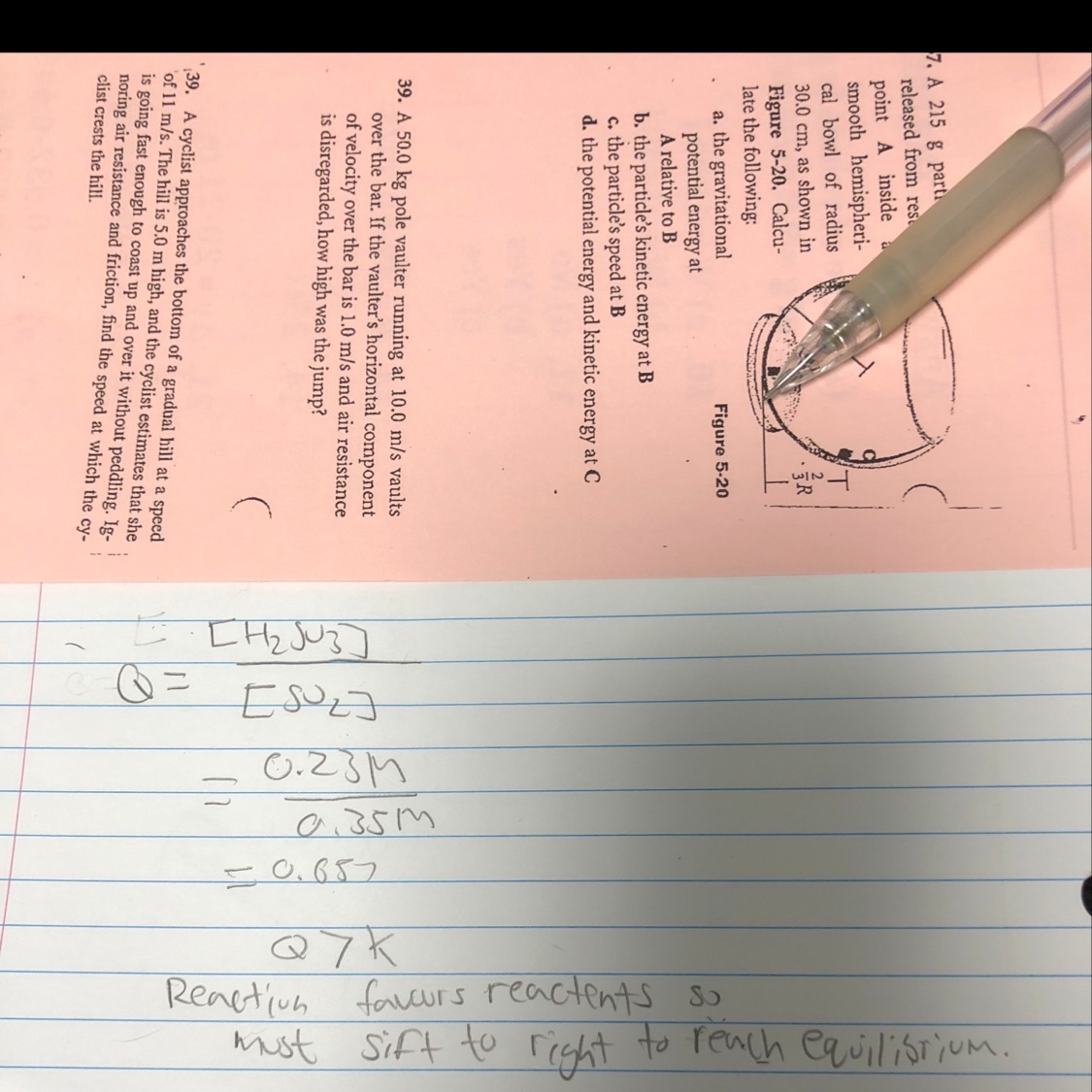
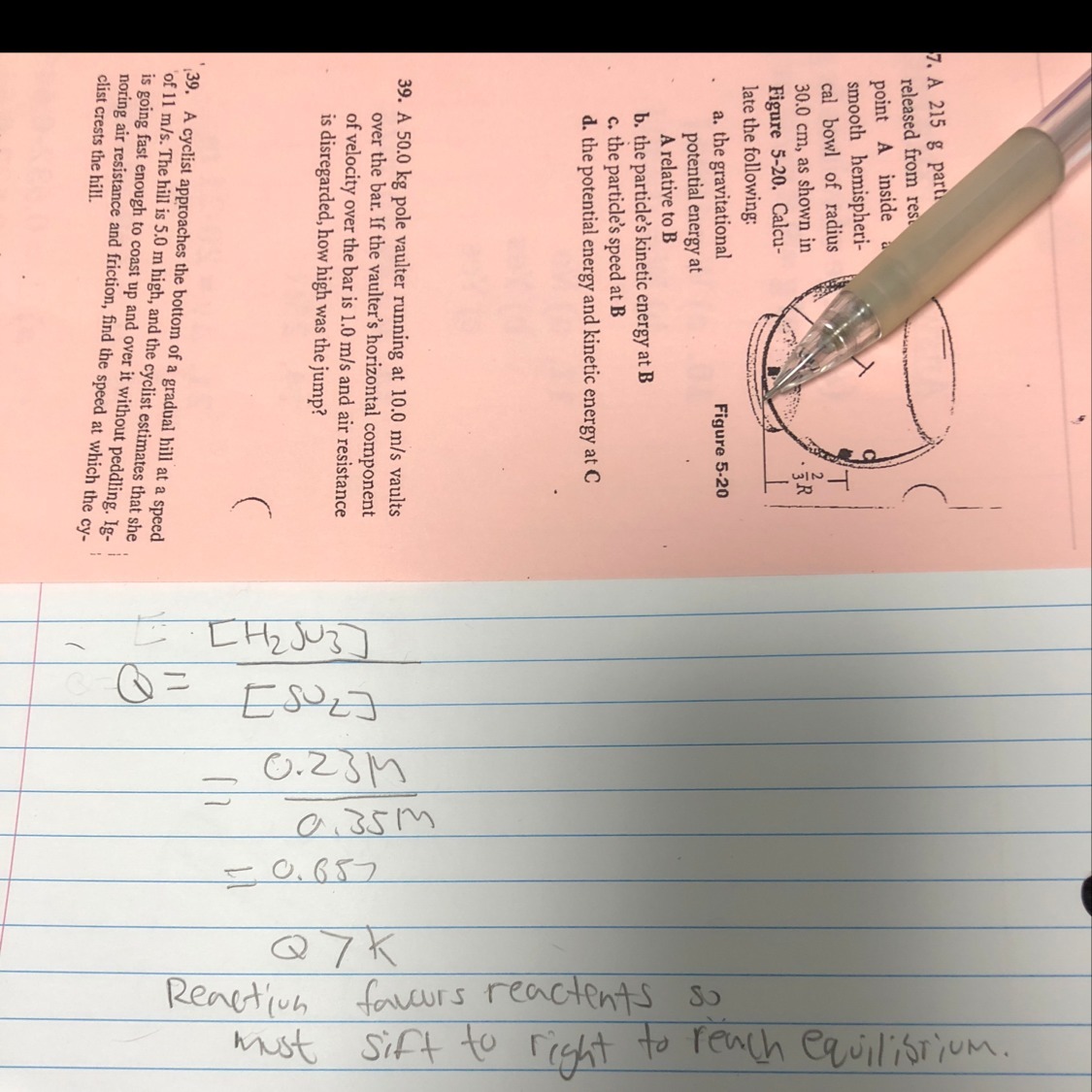
In the reaction SO2 (g) + H2O (l) ↔ H2SO3 (aq), with K = 2.1 × 10⁻³, the concentration of SO2 is 0.35 M, and the concentration o

f H2SO3 is 0.23 M. This reaction _______. A. is in equilibrium B. must shift to the reactants to be in equilibrium C. must shift to the products to be in equilibrium D. must have the pressure increased to reach equilibrium E. None of the Above

Chemistry
2 answers:
rosijanka [135]2 years ago
8 0

Answer : The correct option is, (B) must shift to the reactants to be in equilibrium.

Explanation :

Reaction quotient (Q) : It is defined as the measurement of the relative amounts of products and reactants present during a reaction at a particular time.

The given balanced chemical reaction is,

SO_2(g)+H_2O(l)\rightarrow H_2SO_3(aq)

The expression for reaction quotient will be :

Q=\frac{[H_2SO_3(aq)]}{[SO_2(g)]}

In this expression, only gaseous or aqueous states are includes and pure liquid or solid states are omitted.

Now put all the given values in this expression, we get

Q=\frac{0.23}{(0.35)}=0.657

The given equilibrium constant value is, K=2.1\times 10^{-3}

Equilibrium constant : It is defined as the equilibrium constant. It is defined as the ratio of concentration of products to the concentration of reactants.

There are 3 conditions:

When Q>K that means product > reactant. So, the reaction is reactant favored.

When Q that means reactant > product. So, the reaction is product favored.

When Q=K that means product = reactant. So, the reaction is in equilibrium.

From the above we conclude that, the Q>K that means product > reactant. So, the reaction is reactant favored that means reaction must shift to the reactants to be in equilibrium.

Hence, the correct option is, (B) must shift to the reactants to be in equilibrium.

Ivenika [448]2 years ago
6 0
C
Q>K so reaction needs to shift to the products

You might be interested in
What is the empirical formula of C6H18O3?
Aloiza [94]

Answer:

The answer to your question is C₂H₆O

Explanation:

Data

Molecular formula = C₆H₁₈O₃

Empirical formula = ?

Empirical formula is defined as the simplest ratio of the elements that form part of a molecule.

Process

To find the empirical formula find the greatest common factor of the subscripts.

                             6    18   3   2

                             3      9  3   3

                              1     3    1   3

                                     1

The GCF is 3, so factor 3 of the molecular formula

                         3 ( C₂H₆O)  

The result is the empirical formula C₂H₆O

7 0
2 years ago
If 14c-labeled uracil is added to the growth medium of cells, what macromolecules will be labeled?
ziro4ka [17]
When there are 14c-lable uracil that are added to the growth medium of cells, the macromolecules that will be labled are RNA. Uracil is a nucleobase that make up the DNA or the RNA. In RNA, uracil binds with other nucleobase (adenine) through hydrogen bonds.
6 0
2 years ago
Read 2 more answers
How many lead (Pb) atoms will be generated when 5.38 moles of ammonia react according to the following equation: 3PbO+2NH3→3Pb+N
jasenka [17]

Answer:

4.86×10^23 molecule of Pb

Explanation:

Based on that equation, for every 2 moles of ammonia, you get 3 moles of lead.

So:

2 mol NH3/ 3 mol Pb

Using this ratio we can find the amounts of either molecule. Given 5.38 mol NH3:

(5.38 NH3)(3 Pb/ 2 NH3) = (5.38)(3/2) mol Pb = 8.07 mol Pb

Then, we just need to use Avagadro's number to get the number of molecules.

(8.07)(6.02×10^23) = 4.86×10^23 molecule of Pb

4 0
2 years ago
Read 2 more answers
At the equivalence point of a KHP/NaOH titration, you have added enough OH- to react with all of the HP- such that the only spec
Nataly_w [17]

Explanation:

The given data is as follows.

  [P^{2-}] = 0.042 M,      K_{a} for HP^{-} = 3.9 \times 10^{-6}

According to the given situation P^{2-} acts as a base.The reaction equation will be as follows.

            P^{2-} + H_{2}O \rightleftharpoons HP^{-} + OH^{-}

Relation between K_{b} and K_{a} are as follows.

                   K_{a} \times K_{b} = K_{w}

                     K_{b} = \frac{1 \times 10^{-14}}{K_{a}}

                                      =  \frac{1 \times 10^{-14}}{3.9 \times 10^{-6}}}

                                      = 2.6 \times 10^{-9}

Also,      K_{b} = \frac{[HP^{-}][OH^{-}]}{P^{2-}}

Let us take [OH^{-}] = [HP^{-}] = x

So,                       K_{b} = \frac{[HP^{-}][OH^{-}]}{P^{2-}}

                           2.6 \times 10^{-9} = \frac{x \times x}{0.042}

                      x = 1.04 \times 10^{-5}

[OH^{-}] = [HP^{-}] = 1.04 \times 10^{-5}

                          pOH = - log[OH^{-}]

                                   = - log (1.04 \times 10^{-5})

                                   = 4.99

As it is known that pH + pOH = 14

so,                  pH + 4.99 = 14

                         pH = 9.01

Thus, we can conclude that pH of the solution is 9.01.                  

4 0
2 years ago
A race car is driven by a professional driver at 99 . What is this speed in and ? 1 mile = 1.61 kilometers 1 hour = 60 minutes E
slavikrds [6]

Answer: The speed is equivalent to <u>159.39 kilometers per hour </u>or <u>2.65 kilometers per minute.</u>

Explanation:

Given, The speed of a race car = 99 miles/ hour

To convert the speed into  kilometers per hour and kilometers per minute

Since   1 mile = 1.61 kilometers

So, Speed of car = (99 ) x (1.61 )

= 159.39 kilometers per hour.

Also, 1 hour = 60 minutes

Then, Speed of car = (159.39) ÷60

= 2.6565≈2.65 kilometer per minute.

Hence, the speed is equivalent to <u>159.39 kilometers per hour </u>or <u>2.65 kilometers per minute.</u>

4 0
2 years ago
Other questions:
  • 10.0 mL of a 0.100 mol L–1 solution of a metal ion M2+ is mixed with 10.0 mL of a 0.100 mol L–1 solution of a substance L. The f
    9·2 answers
  • Monochlorination of propane yields two constitutional isomers, and dichlorination yields four. Trichlorination yields five const
    6·2 answers
  • Seen from the north pole, which side of a waxing moon is illuminated
    9·1 answer
  • Methylamine (ch3nh2) is a weakly basic compound. calculate the kb for methylamine if a 0.253 m solution is 4.07% ionized.
    8·1 answer
  • Suppose that one of millikan's oil drops has a charge of −4.8×10⁻¹⁹
    5·2 answers
  • 13.3 g of benzene (C6H6) is dissolved in 282 g of carbon tetrachloride. What is the molal concentration of benzene in this solut
    14·1 answer
  • In a certain compound of iron and oxygen, FexOy, it is found that a sample of this compound weighing 6.285 g contains 4.396 g of
    5·1 answer
  • Marcie is hiking in the mountains and she discovers an interesting shiny rock.As she picks it up she wonders whether it could be
    5·1 answer
  • Lisa’s book measures 40 cm x 10 cm x 2 cm. What is the volume of her book
    7·2 answers
  • HALPPPPPPPPPPPPPPPPPPPPPPPPPPPPPPPPPPPPPPPPPPPPPPPPPPPPPPPPPPPPPPPPPPPPPPPPPPPPPPPPPPPPPPPPPPPPPPPPPPPPPPPPPPPPPP!!!!!!!!!!!!!!!
    13·1 answer
Add answer
Login
Not registered? Fast signup
Signup
Login Signup
Ask question!