answer.
Ask question
Login Signup
Ask question
All categories
  • English
  • Mathematics
  • Social Studies
  • Business
  • History
  • Health
  • Geography
  • Biology
  • Physics
  • Chemistry
  • Computers and Technology
  • Arts
  • World Languages
  • Spanish
  • French
  • German
  • Advanced Placement (AP)
  • SAT
  • Medicine
  • Law
  • Engineering
LiRa [457]
2 years ago
3

A 10-m-long wire with a diameter of 0.80 mm has a resistance of 1.1ω. of what material is the wire made?

Physics
2 answers:
Marianna [84]2 years ago
6 0
The radius of the wire is 
r= \frac{d}{2}= \frac{0.80 mm}{2}=0.40 mm=0.4 \cdot 10^{-3}m
and so the cross-sectional area of the wire is
A=\pi r^2=\pi ( 0.4 \cdot 10^{-3}m)^2 =5\cdot 10^{-7} m^2

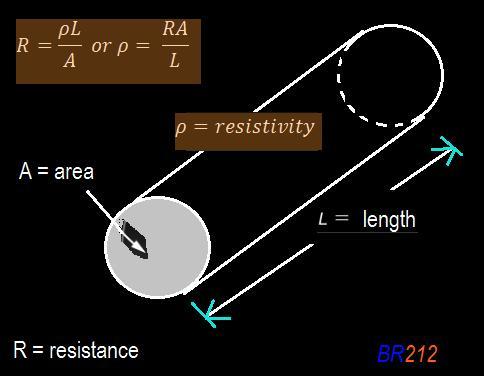
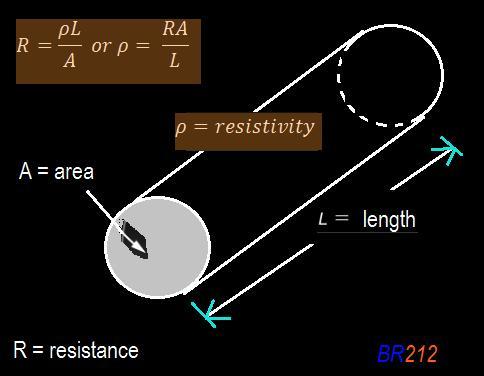
The relationship between the resistance of the wire R, its length L, its cross-sectional area A and the resistivity of the material \rho is
\rho =  \frac{RA}{L}
So by using the data of the problem we find the resistivity of the material:
\rho= \frac{(1.1 \Omega)(5 \cdot 10^{-7}m^2)}{10.0 m}=5.5 \cdot 10^{-8} \Omega \cdot m

And by looking at the table of the resistivities for different materials, we find that this value corresponds to tungsten, so the wire is made of tungsten.
cricket20 [7]2 years ago
3 0

Because of its resistivity of 5.5 x 10 ⁻⁸ Ωm, the wire is made of tungsten material.

<h3>Further explanation</h3>

Given:

  • A 10-m-long wire ⇒ \boxed{ \ L = 10 \ m \ }
  • A diameter of 0.80 mm ⇒ \boxed{ \ D = 0.80 \ mm = 8.0 \cdot 10^{-4} \ m \ } or the radius of the wire is \boxed{ \ r = \frac{1}{2} D \ } ⇒ \boxed{ \ r = 0.40 \ mm = 4.0 \cdot 10^{-4} \ m \ }
  • A resistance of 1.1 Ω ⇒ \boxed{ \ R = 0.80  \ \Omega \ }

Question:

Of what material is the wire made?

The Process:

<u>Step-1</u>

Let us find out the cross-sectional area of the wire.  The shape of the wire cross-section is a circle, and the wire itself is a tube.

Area of circle is

\boxed{ \ A = \pi r^2 \ } \ or \ \boxed{ \ A = \frac{1}{4} \pi D^2 \ }

Whichever formula we use, the results remain the same.

\boxed{ \ A = \pi (4.0 \cdot 10^{-4})^2 \ } \ or \ \boxed{ \ A = \frac{1}{4} \pi (8.0 \cdot 10^{-4})^2 \ }

We get  the cross-sectional area of the wire of \boxed{ \ A \approx 5.0 \cdot 10^{-7} \ m^2 \ }

<u>Step-2</u>

In the next step, we have to calculate the resistivity of the material. After that, we compare it to the table of the resistivity of various materials.

We use the electric resistivity formula shown by

\boxed{ \ \rho = R \ \frac{A}{L} \ }.

where,

  • ρ = resistivity  (in Ωm)
  • R = resistance (in Ω)
  • A = the cross-sectional area (in m²)
  • L = length (in m)

Let us find out the resistivity of the material by substituting all the data above and calculating it.

\boxed{ \ \rho = \frac{(1.1  \ \Omega )(5.0 \cdot 10^{-7} \ m^2)}{10 \ m} \ }

We get a resistivity value of \boxed{ \ \rho = 5.5 \cdot 10^{-8} \ \Omega m \ }.

Based on the source table that contains the resistivity of various materials, the wire is made of tungsten.

_ _ _ _ _ _ _ _ _ _

Notes

Let us consider the relationship between resistance, resistivity, wire length, and cross-sectional area.

\boxed{ \ R = \rho \ \frac{L}{A} \ }

The conclusions that can be drawn from the formula are as follows.

  • Resistance is directly proportional to resistivity and length, i.e., \boxed{ \ R \sim \rho \ } \ or \ \boxed{ \ R \sim L \ }
  • Resistance is inversely proportional to the cross-sectional area. i.e., \boxed{ \ R \sim \frac{1}{A} \ }
  • Resistance is inversely proportional to the square of the radius or diameter of the cross-sectional area, if the cross-section of the wire is a circle, i.e.,  \boxed{ \ R \sim \frac{1}{r^2} \ } \ or \ \boxed{ \ R \sim \frac{1}{D^2} \ }
<h3>Learn more</h3>
  1. How long is the wire? A problem of density  brainly.com/question/4178726#
  2. About the mass and density of substances  brainly.com/question/4053884
  3. The theoretical density of platinum which has the FCC crystal structure. brainly.com/question/5048216

You might be interested in
To practice Problem-Solving Strategy 10.1 for energy conservation problems. A sled is being held at rest on a slope that makes a
Gwar [14]

Answer:

μk = (d1)sin(θ) / [(cosθ)(d1) + (d2)]

Explanation:

To solve this, let's use the work/energy theorem which states that: The change in an object's Kinetic energy is equal to the total work (positive and/or negative) done on the system by all forces.

Now, in this question, the change in the object's KE is zero because it starts at rest and ends at rest. (ΔKE = KE_final − KE_initial = 0). Thus, it means the sum of the work, over the whole trip, must also be zero.

Now, if we consider the work done during the downhill slide,there will be three forces acting on the sled:

1. Weight (gravity). This force vector has magnitude "mg" and points points straight down. It makes an angle of "90°–θ" with the direction of motion. Thus;

Wgrav = (mg)(d1)cos(90°–θ)

From trigonometry, we know that cos(90°–θ) = sinθ, thus:

Wgrav = (mg)(d1)sin(θ)

2. Normal force, Fn=(mg)cosθ. This force vector is perpendicular to the direction of motion, so it does zero work.

3. Friction, Ff = (Fn)μk = (mg) (cosθ)μk and it points directly opposite of the direction of motion,

Thus;

Wfric = –(Fn)(d1) = –(mg)(cosθ)(μk)(d1)

(negative sign because the direction of force opposes the direction of motion.)

So, the total work done on the sled during the downhill phase is:

Wdownhill = [(mg)(d1)sin(θ)] – [(mg)(cosθ)(μk)(d1)]

Now, let's consider the work done during the "horizontal sliding" phase. The forces here are:

1. Gravity: it acts perpendicular to the direction of motion, so it does zero work in this phase.

2. Normal force, Fn = mg. It's also perpendicular to the motion, so it also does zero work.

3. Friction, Ff = (Fn)(μk) = (mg)(μk). Thus; Wfric = –(mg)(μk)(d2) (negative because the direction of the friction force opposes the direction of motion).

The total work done during this horizontal phase is:

Whoriz = –(mg)(μk)(d2)

Hence, the total work done on the sled overall is:

W = Wdownhill + Whoriz

= (mg)(d1)sin(θ) – (mg)(cosθ)(μk)(d1) – (mg)(μk)(d2)

I have deduced that the total work is zero (because change in kinetic energy is zero), thus;

(mg)(d1)sin(θ) – (mg)(cosθ)(μk)(d1) – (mg)(μk)(d2) = 0

Now, let's make μk the subject of the equation:

First of all, divide each term by mg;

(d1)sin(θ) – (cosθ)(μk)(d1) – (μk)(d2) = 0

Rearranging, we have;

(d1)sin(θ) = (cosθ)(μk)(d1) + (μk)(d2)

So,

(d1)sin(θ) = [(cosθ)(d1) + (d2)](μk)

And

μk = (d1)sin(θ) / [(cosθ)(d1) + (d2)]
5 0
2 years ago
An early submersible craft for deep-sea exploration was raised and lowered by a cable from a ship. When the craft was stationary
Assoli18 [71]

Answer:

The tension in the cable when the craft was being lowered to the seafloor is 4700 N.

Explanation:

Given that,

When the craft was stationary, the tension in the cable was 6500 N.

When the craft was lowered or raised at a steady rate, the motion through the water added an 1800 N.

The drag force of 1800 N will act in the upward direction. As it was lowered or raised at a steady rate, so its acceleration is 0. As a result, net force is 0. So,

T + F = W

Here, T is tension

F = 1800 N

W = 6500 N

Tension becomes :

T=W-F\\\\T=6500-1800\\\\T=4700\ N

So, the tension in the cable when the craft was being lowered to the seafloor is 4700 N.

7 0
2 years ago
The Slowing Earth The Earth's rate of rotation is constantly decreasing, causing the day to increase in duration. In the year 20
NNADVOKAT [17]

Answer:

The average angular acceleration of the Earth, α  = 6.152 X 10⁻²⁰ rad/s²

Explanation:

Given data,

The period of 365 rotation of Earth in 2006, T₁ = 365 days, 0.840 sec

                                                                                  = 3.1536 x 10⁷ +0.840

                                                                                 = 31536000.84 s

The period of 365 rotation of Earth in 2006, T₀ = 365 days

                                                                               = 31536000 s

Therefore, time period of one rotation on 2006, Tₐ = 31536000.84/365

                                                                                   = 86400.0023 s

The time period of rotation is given by the formula,

                                <em>Tₐ = 2π /ωₐ</em>

                                 ωₐ = 2π / Tₐ

Substituting the values,

                                  ωₐ = 2π /  365.046306        

                                      = 7.272205023 x 10⁻⁵ rad/s

Therefore, the time period of one rotation on 1906, Tₓ = 31536000/365

                                                                                    = 86400 s

Time period of rotation,

                                   Tₓ = 2π /ωₓ

                                    ωₓ = 2π / T

                                           =  2π /86400

                                          = 7.272205217  x 10⁻⁵ rad/s

The average angular acceleration

                                   α  = (ωₓ -   ωₐ) /  T₁

             = (7.272205217  x 10⁻⁵ - 7.272205023 x 10⁻⁵) / 31536000.84

                                    α  = 6.152 X 10⁻²⁰ rad/s²

Hence the average angular acceleration of the Earth, α  = 6.152 X 10⁻²⁰ rad/s²

3 0
2 years ago
Use the terms "force", "weight", "mass", and "inertia" to explain why it is easier to tackle a 220 lb football player than a 288
Tomtit [17]
<span><u>Answer </u>
The mass of 220 lb football has less than 288 lb football. So, it will be easier to move it since it will require less force. The heavy football will have a bigger momentum. Since 288 lb has more weight than 220 lb, it will have bigger inertia making it difficult for the players to stop it.
This makes it easier to tackle 220 lb football than 288 lb football. 
</span>
7 0
2 years ago
Read 2 more answers
1. When the fission of uranium-235 is carried out, about 0.1 percent of the mass of the reactants is lost during the reaction. W
DerKrebs [107]

The correct answer to the question is that the lost mass has been converted into energy.

EXPLANATION:

From Einstein's theory, we know that energy and mass are inter convertible .

When some amount of mass is lost, same amount of energy equivalent to mass is produced.

Let us consider m is the mass lost during any reaction. Hence, the amount of energy produced will be-

                                 Energy E = mc^2                

Here, c is the velocity of light i.e c = 3\times 10^8\ m/s

As per the question, uranium-235 undergoes fission. The amount of mass defect is 0.1 %.

The mass defect is defined as the difference between mass of reactants and products. During the fission, energy is produced.

The energy produced in this reaction is nothing else than the energy equivalent to mass defect.  Approximately 199.5 Mev of energy equivalent to this mass defect is produced in this reaction.

6 0
2 years ago
Read 2 more answers
Other questions:
  • One reason you should avoid taking risks as a driver is:
    12·1 answer
  • A 8.00g sample of substance (substance, molar mass = 152.0 g/mol) was combusted in a bomb calorimeter with a heat capacity of 6.
    13·1 answer
  • A celebrating student throws a water balloon horizontally from a dormitory window that is 50 m above the ground. It hits the gro
    11·1 answer
  • Two identical ladders are 3.0 m long and weigh 600 N each. They are connected by a hinge at the top and are held together by a h
    6·2 answers
  • A particle has a velocity of v→(t)=5.0ti^+t2j^−2.0t3k^m/s.
    7·1 answer
  • he first excited state of the helium atom lies at an energy 19.82 eV above the ground state. If this excited state is three-fold
    15·1 answer
  • Find the electric field inside a hollow plastic ball of radius R that has charge Q uniformly distributed on its outer surface. G
    5·1 answer
  • An aircraft acceleration from 100m/s to 300m/s in 100 s what is acceleration​
    15·1 answer
  • A 4.00-Ω resistor, an 8.00-Ω resistor, and a 24.0-Ω resistor are connected together. (a) What is the maximum resistance that can
    5·1 answer
  • ery large accelerations can injure the body, especially if they last for a considerable length of time. One model used to gauge
    8·1 answer
Add answer
Login
Not registered? Fast signup
Signup
Login Signup
Ask question!