answer.
Ask question
Login Signup
Ask question
All categories
  • English
  • Mathematics
  • Social Studies
  • Business
  • History
  • Health
  • Geography
  • Biology
  • Physics
  • Chemistry
  • Computers and Technology
  • Arts
  • World Languages
  • Spanish
  • French
  • German
  • Advanced Placement (AP)
  • SAT
  • Medicine
  • Law
  • Engineering
Viefleur [7K]
2 years ago
9

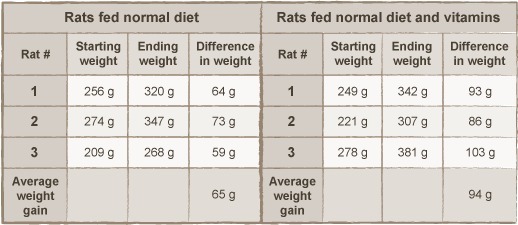
A scientist was asked to test the effect of a new vitamin for rats. His hypothesis was that young rats that had vitamins added t

o their food would gain weight faster than young rats fed a normal diet. He predicted that if young rats were fed vitamins, then they would gain more weight by the end of the experiment. He tested the effect of adding vitamins to some of the rats' diet by measuring the amount of weight each rat gained after three months. He then determined the average weight gained in each group. To analyze his results, he put the data he collected into the table shown below.
Which of the following could have added bias to the data?

 A.Keeping the rats in the same room, but in separate cages during the experiment B.Not using all male or all female rats, since they are different sizes when grown C.Recording the data in a table instead of on a graph D.Not having the experimental results peer reviewed

Chemistry
2 answers:
Olin [163]2 years ago
8 0

A: incorrect because there will be no effect on keeping the rats in separate cage in the same room at the time of the experiment.

C: incorrect because it's depend upon scientist whether he wants to record the observation on the graph or on the table. Thus, no affect will be caused on the observations.

D: incorrect because peer review is done only after the experiment is completed.

Thus, statement B is correct because the growth graph of male and female of any species is different. Male tend to grow more than their female counterparts. So, for the process of the study it is essential that all the rats included are either male or female.

Hence, option (B) is correct.

insens350 [35]2 years ago
3 0
The control group was the rats fed the normal diet without added vitamins (apex)
You might be interested in
How many grams of sodium acetate ( molar mass = 83.06 g/mol ) must be added to 1.00 Liter of a 0.200 M acetic acid solution to m
Pie

<u>Answer:</u> The mass of sodium acetate that must be added is 30.23 grams

<u>Explanation:</u>

To calculate the number of moles for given molarity, we use the equation:

\text{Molarity of the solution}=\frac{\text{Moles of solute}}{\text{Volume of solution (in L)}}

Molarity of acetic acid solution = 0.200 M

Volume of solution = 1 L

Putting values in above equation, we get:

0.200M=\frac{\text{Moles of acetic acid}}{1L}\\\\\text{Moles of acetic acid}=(0.200mol/L\times 1L)=0.200mol

To calculate the pH of acidic buffer, we use the equation given by Henderson Hasselbalch:

pH=pK_a+\log(\frac{[\text{salt}]}{[\text{acid}]})  

pH=pK_a+\log(\frac{[CH_3COONa]}{[CH_3COOH]})

We are given:

pK_a = negative logarithm of acid dissociation constant of acetic acid = 4.74

[CH_3COONa]=?mol  

[CH_3COOH]=0.200mol

pH = 5.00

Putting values in above equation, we get:

5=4.74+\log(\frac{[CH_3COONa]}{0.200})

[CH_3COONa]=0.364mol

To calculate the mass of sodium acetate for given number of moles, we use the equation:

\text{Number of moles}=\frac{\text{Given mass}}{\text{Molar mass}}

Molar mass of sodium acetate = 83.06 g/mol

Moles of sodium acetate = 0.364 moles

Putting values in above equation, we get:

0.364mol=\frac{\text{Mass of sodium acetate}}{83.06g/mol}\\\\\text{Mass of sodium acetate}=(0.364mol\times 83.06g/mol)=30.23g

Hence, the mass of sodium acetate that must be added is 30.23 grams

7 0
2 years ago
Which of the following is correctly balanced redox half reaction? Group of answer choices A. 14H+ + 9e- + Cr2O72- ⟶ Cr3+ + 7H2O
oee [108]

Answer:

The correct option is: B. 14 H⁺ + 6 e⁻ + Cr₂O₇²⁻ ⟶ 2 Cr³⁺ + 7 H₂O

Explanation:

Redox reactions is an reaction in which the oxidation and reduction reactions occur simultaneously due to the simultaneous movement of electrons from one chemical species to another.

The reduction of a chemical species is represented in a reduction half- reaction and the oxidation of a chemical species is represented in a oxidation half- reaction.

<u>To balance the reduction half-reaction for the reduction of Cr₂O₇²⁻ to Cr³⁺</u>:

Cr₂O₇²⁻ ⟶ Cr³⁺

First the <u>number of Cr atoms</u> on the reactant and product side is balanced

Cr₂O₇²⁻ ⟶ 2 Cr³⁺

Now, Cr is preset in +6 oxidation state in Cr₂O₇²⁻ and +3 oxidation state in Cr³⁺. So each Cr gains 3 electrons to get reduced.

Therefore, <u>6 electrons are gained</u> by 2 Cr atoms of Cr₂O₇²⁻ to get reduced.

Cr₂O₇²⁻ + 6 e⁻ ⟶ 2 Cr³⁺

Now the total charge on the reactant side is (-8) and the total charge on the product side is (+6).

From the given options it is evident that the reaction must be balanced in acidic conditions.

Therefore, to <u>balance the total charge</u> on the reactant and product side,<u> 14 H⁺ is added on the reactant side.</u>

Cr₂O₇²⁻ + 6 e⁻ + 14 H⁺ ⟶ 2 Cr³⁺

Now to <u>balance the number of hydrogen and oxygen atoms, 7 H₂O is added on the product side.</u>

Cr₂O₇²⁻ + 6 e⁻ + 14 H⁺ ⟶ 2 Cr³⁺ + 7 H₂O

<u>Therefore, the correct balanced reduction half-reaction is:</u>

Cr₂O₇²⁻ + 6 e⁻ + 14 H⁺ ⟶ 2 Cr³⁺ + 7 H₂O
3 0
2 years ago
What is the density (g/L) of CHCl3 vapor at 1.00 atm and 298 K?
Scrat [10]

Answer:

4.8 g/mL is the density of chloroform vapor at 1.00 atm and 298 K.

4 0
2 years ago
Which of these facts best illustrates why regulation of alcohol consumption is necessary
exis [7]

So that people don’t break laws or drive under the influence.

4 0
2 years ago
If a Lys residue that interacts with 2,3-bisphosphoglycerate (BPG) in the central cavity of hemoglobin is changed to a Ser resid
masha68 [24]

Answer: Option (c) is the correct answer.

Explanation:

When there will be interaction between 2,3-bisphosphoglycerate (BPG) and Lys residue in the central cavity of hemoglobin then it will change into Ser residue. After that, the it will lead to less stable formation of deoxygenated state (T state).

Since, serine is not a charged amino acid therefore, it will lead to a decrease in the binding affinity of hemoglobin for 2,3-bisphosphoglycerate.

As a result, stability of the T state will decrease.

Thus, we can conclude that in the given situation the T state would be less stable.

3 0
2 years ago
Other questions:
  • The amount of gas that occupies 36.52 L at 68.0°C and 672 mm Hg is __________ mol.
    8·1 answer
  • Automobile batteries are filled with an aqueous solution of sulfuric acid. What is the mass of the acid (in grams) in 800. mL of
    11·1 answer
  • The successive ionization energies of a certain element are I1= 577.9 kJ/mol, I2 = 1820 kJ/mol, I3= 2750 kJ/mol, I4 = 11,600 kJ/
    7·1 answer
  • Determine the number of valence electrons in POCl₃ and then draw the corresponding Lewis structure (by following the octet rule
    10·1 answer
  • A chemist adds 180.0 mL of a 1.42M sodium carbonate (Na CO,) solution to a reaction flask. Calculate the millimoles of sodium ca
    8·1 answer
  • Problem Page A chemist measures the amount of bromine liquid produced during an experiment. He finds that of bromine liquid is p
    12·1 answer
  • onsider the reversible dissolution of lead(II) chloride. P b C l 2 ( s ) − ⇀ ↽ − P b 2 + ( a q ) + 2 C l − ( a q ) PbClX2(s)↽−−⇀
    9·1 answer
  • Which of the following statements is true concerning the reaction given below?2H2S(g) + O2(g) → 2S(s) + 2H2O(g)a. The reaction i
    11·1 answer
  • In an experiment, the reaction of 100.0 g of iodine produced 144.9 g of a compound formed from iodine and fluorine.
    14·1 answer
  • A 14.3-cm3 sample of tin has a mass of 0.104 kg.
    14·1 answer
Add answer
Login
Not registered? Fast signup
Signup
Login Signup
Ask question!
