answer.
Ask question
Login Signup
Ask question
All categories
  • English
  • Mathematics
  • Social Studies
  • Business
  • History
  • Health
  • Geography
  • Biology
  • Physics
  • Chemistry
  • Computers and Technology
  • Arts
  • World Languages
  • Spanish
  • French
  • German
  • Advanced Placement (AP)
  • SAT
  • Medicine
  • Law
  • Engineering
choli [55]
2 years ago
3

A gas sample contains 4.00g of CH4 and 2.00g of He. What is the volume of the sample at STP?

Chemistry
1 answer:
trasher [3.6K]2 years ago
8 0
As we know that 1 mole of any gas when acting perfectly / ideally occupies 22.4 L of volume.

It means that in order to calculate volume occupied both by CH₄ and He, we must calculate their moles.

Hence,
Moles are given as,
                                     Moles  =  Mass / Mass

Moles of CH₄;
                                     Mole-CH₄  =  4 g / 16 g.mol⁻¹

                                     Mole-CH₄  =  0.25 mol

Moles of He;
                                     Mole-He  =  2 g / 4 g.mol⁻¹

                                     Mole-He  =  0.5 mol

Now adding moles of both gases,
          
                                     =  0.25 + 0.5

                                     =  0.75 mol

Therefore, when,

                          1 mole of gas occupy  =  22.4 L of Volume

Then,

                            0.75 mol will occupy  =  X L of Volume

Solving for X,
                                   X  =  (0.75 mol × 22.4 L) ÷ 1 mole

                                   X  =  16.8 L
You might be interested in
Type the correct answer in the box. Express your answer to three significant figures.
satela [25.4K]

Answer:

The partial pressure of argon in the jar is 0.944 kilopascal.

Explanation:

Step 1: Data given

Volume of the jar of air = 25.0 L

Number of moles argon = 0.0104 moles

Temperature = 273 K

Step 2: Calculate the pressure of argon with the ideal gas law

p*V = nRT

p = (nRT)/V

⇒ with n = the number of moles of argon = 0.0104 moles

⇒ with R = the gas constant = 0.0821 L*atm/mol*K

⇒ with T = the temperature = 273 K

⇒ with V = the volume of the jar = 25.0 L

p = (0.0104 * 0.0821 * 273)/25.0

p = 0.00932 atm

1 atm =101.3 kPa

0.00932 atm = 101.3 * 0.00932 = 0.944 kPa

The partial pressure of argon in the jar is 0.944 kilopascal.

5 0
2 years ago
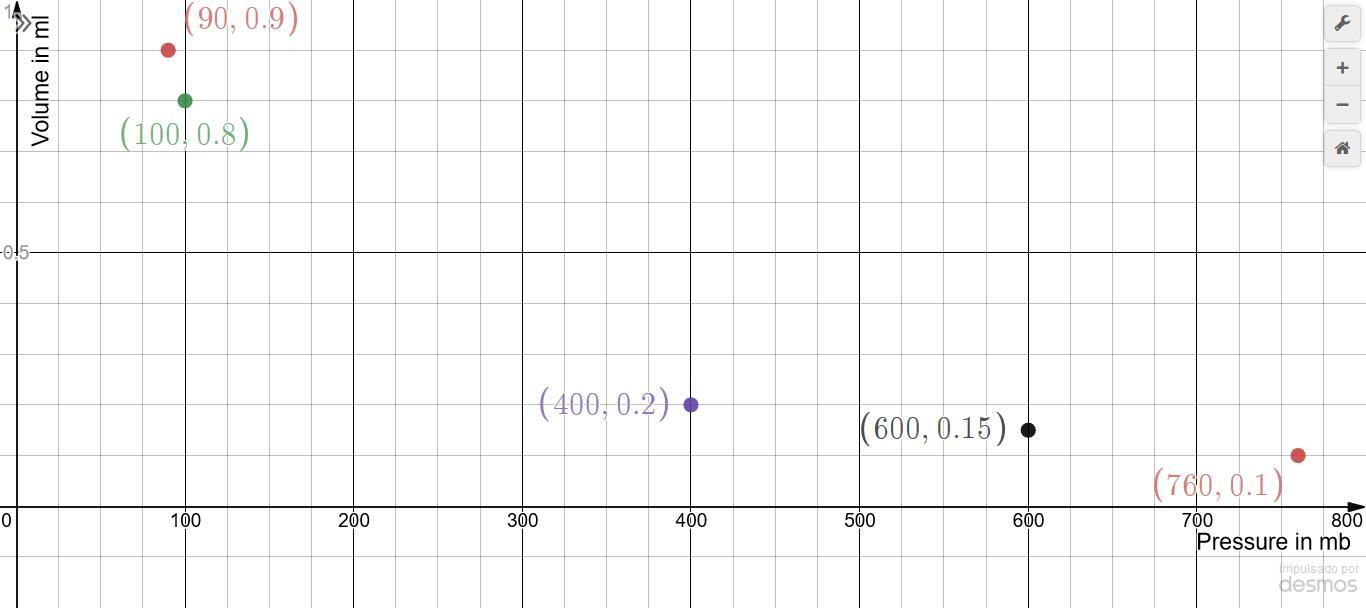
On the axes provided, label pressure on the horizontal axis from O mb to 760 mb and volume on the vertical axis from O to 1 mL.
Delicious77 [7]

Answer:

  • Please, find the graph with the labels and points located on the axes in the picture attached.

Explanation:

This is how you meet all the instructions and some important comments to understand how this kind of graphs word:

<u>1) Label pressure on the horizontal axis from O mb to 760 mb and volume on the vertical axis from O to 1 mL. </u>

The horizontal axis is used to record the independent variable and the vertical axis is used to record the dependent variable. The axes most be properly labeled with the name of the variable and the units.

In this case the origin is the point (0,0) which means that the axes cross each other, perpendicularly, at a pressure of 0 mb and a volume of 0.0 mililiters.

<u>2) Assign values to axes divisions in such a way that you occupy almost all the space on both axes. </u>

A good graph searches to occupy the whole space on both cases; to do that, find the maximum value for each variable, pressure and volume, and choose the values of the marks.

The range of the pressure (horizontal axis) is [90, 760 mb], so you should choose big divisions (marks) of 100 mb, and assign 800 mb to the right most mark on the horizontal axis. Then, you can divide each interval of 100 mb into 10 spaces, with small divisions of 10 mb (my graph uses 4 spcaes, with small divisions of 25 mb, but I recommend you use small divisions of 10 mb).

The range of the volume (vertical axis) is [0.1, 0.8], so you should choose only divisions with value of 0.1 ml.

<u>3) Now locate and label the points: </u>

  • (90, 0.9) ⇒ 90 mb, 0.9 ml
  • (100, 0.8) ⇒ 100 mb, 0.8 ml
  • (400, 0.2) ⇒ 400 mb, 0.2 ml
  • (600, 0.15) ⇒ 600 mb, 0.15 ml
  • (760, 0.1) ⇒ 760 mb, 0.1 ml

The points of the kind (x, y) are called ordered pairs, which means that the order matters, because it has a meaning: the first number represents the independent variable and the second number represents the dependent variable.

So, in the point (90, 0.9), 90 is a pressure of 90 mb and 0.9 is a volume of 0.9 ml.

To locate (600, 0.15), since the horizontal marks have value of 0.1, you must locate the second coordinate of your point between the marks 0.1 and 0.2 ml.

With that you can now locate each point on your graph.

5 0
2 years ago
Read 2 more answers
Which milligram quantity contains a total of four significant figures
denis23 [38]
D has a total of four significant figures.
7 0
2 years ago
Read 2 more answers
A ground state hydrogen atom absorbs a photon of light having a wavelength of 93.7 nm.93.7 nm. What is the final state of the hy
sammy [17]

Answer:

5

Explanation:

Given that the formula is;

1/λ= R(1/nf^2 - 1/ni^2)

λ = 93.7 nm or 93.7 * 10^-9 m

R= 1.097 * 10^7 m-1

nf = ?

ni = 1

From;

ΔE = hc/λ

ΔE = 6.63 * 10^-34 * 3* 10^8/93.7 * 10^-9

ΔE = 21 * 10^-19 J

ΔE = -2.18 * 10^-18 J (1/nf^2 - 1/ni^2)

21 * 10^-19 J = -2.18 * 10^-18 J (1/nf^2 - 1/ni^2)

21 * 10^-19/-2.18 * 10^-18 = (1/nf^2 - 1/1^2)

-0.963 = (1/nf^2 - 1)

-0.963 + 1 = 1/nf^2

0.037 = 1/nf^2

nf^2 = (0.037)^-1

nf^2 = 27

nf = 5

7 0
2 years ago
In the equilibrium system described by: PO43-(aq) + H2O(1) = HPO42-(aq) + OH-(aq) Brønsted-Lowry theory would designate: A) PO43
Kamila [148]

Answer:

The correct option is:  B) H₂0 and OH⁻ as a conjugate pair

Explanation:

According to Brønsted-Lowry theory, the<u> </u><u>acids</u><u> are the chemical substances that form a conjugate base by donating a proton</u> and <u>bases</u><u> are the chemical substances that form conjugate acid by accepting a proton.</u>

In the given chemical reaction: PO₄³⁻(aq) + H₂O(l) ⇄ HPO₄²⁻(aq) + OH⁻(aq)

<u>According to Brønsted-Lowry theory, PO₄³⁻ and OH⁻ are bases. Whereas, H₂O and HPO₄²⁻ are acids.</u>

<u>Also, PO₄³⁻ and HPO₄²⁻ are the conjugate acid-base pair; and H₂O and OH⁻ are the conjugate acid-base pair.</u>

6 0
2 years ago
Other questions:
  • The balanced equation shows how sodium chloride reacts with silver nitrate to form sodium nitrate and silver chloride. NaCl + Ag
    9·1 answer
  • Write the lewis structure for ch2clcoo−. assign a formal charge for any atom with a non-zero formal charge.
    15·1 answer
  • What volume is equivalent to 14,000 mm3?
    5·2 answers
  • Percentage of carbon in CCl^4
    7·2 answers
  • Air pressure is lower at high altitudes. An airplane cabin can adjust, but as the plane rises, passengers can experience tempora
    14·2 answers
  • Quinine, an antimalarial drug, is 8.63% nitrogen. There are two nitrogen atoms per molecule. What is the molecular weight of qui
    5·1 answer
  • If 0.15 mol of I2 vapor can effuses through an opening in a heated vessel in 36 sec, how long will it take 0.15 mol of Cl2 to ef
    5·1 answer
  • The phosphorylation of glucose to glucose 6-phosphate Group of answer choices is so strongly exergonic that it does not require
    6·1 answer
  • A sample of krypton has a volume of 6.00 L, and the pressure is 0.960 atm. If the final temperature is 55.0°C, the final volume
    11·1 answer
  • The engineers at a hydroelectric dam designed a computer program that will allow them to determine the amount of energy they can
    10·1 answer
Add answer
Login
Not registered? Fast signup
Signup
Login Signup
Ask question!