answer.
Ask question
Login Signup
Ask question
All categories
  • English
  • Mathematics
  • Social Studies
  • Business
  • History
  • Health
  • Geography
  • Biology
  • Physics
  • Chemistry
  • Computers and Technology
  • Arts
  • World Languages
  • Spanish
  • French
  • German
  • Advanced Placement (AP)
  • SAT
  • Medicine
  • Law
  • Engineering
wlad13 [49]
2 years ago
5

QUESTION 1 How are the nervous systems of a flatworm and a fish different? One responds to stimuli in the environment and the ot

her does not. One has nerve cells with axons and the other does not. One is a loose network of connected neurons without centers of integration, and one has ganglia in which integration can occur. One has a brain with a forebrain, a midbrain, and a hindbrain, and the other has ganglia in which integration can occur. 2 points QUESTION 2 Which organism has a central brain? fish flatworm sponge hydra 2 points QUESTION 3 Which organism is able to form organized patterns of behavior through the process of integration because it has ganglia? grasshopper shark mouse flatworm 2 points QUESTION 4 What moves across axons? electrons ions electrons and ions neither electrons nor axons 2 points QUESTION 5 Which of the following is part of the peripheral nervous system? spinal cord sensors brain all of the above
Chemistry
2 answers:
allsm [11]2 years ago
6 0

Answer: Q1. One has a brain with a forebrain, a midbrain, and a hindbrain, and the other has ganglia in which integration can occur.

Q2. Fish

Q3. Flatworm

Q4. Ions

Q5. Sensors

Explanation:

Q1. Flatworms

• Their nervous system is ladder like.

• At the head region, there are two simple brain like structures, which are called ganglia.

Fish has a brain, with a forebrain, a midbrain, and a hindbrain.

Q2.

Sponges are the only multicellular animals without a nervous system

The hydra has a nervous system characterized by a nerve net.

The flatworm brain contains two lobes, along with a nerve cell-containing cortex and a base of nerve fibers. This called a system of cephallization, a term used to describe the sensory network of the head and brain

Fish have extremely advanced nervous systems organized around a brain. Fish brains have rare clearly visible parts.

Q3. Only the flatworm had the ganglia.

Q4. In vertebrates, that typically conducts electrical impulses (ions) known as action potentials away from the nerve cell body. The function of the axon is to transmit information to different neurons, muscles, and glands.

Q5. The peripheral nervous system refers to parts of the nervous system outside the brain and spinal cord. It includes the cranial nerves, spinal nerves and their roots and branches, peripheral nerves, and neuromuscular junctions.


Elis [28]2 years ago
3 0
1, <span>One has a brain, with a forebrain, a midbrain, and a hindbrain, the other has ganglia which integration can occur

2, fish

3, flatworm

4, ions

5, </span><span>sensors</span>
You might be interested in
Consider NH3 and PH3. Electronegativities: P = 2.1, H = 2.1, N=3.0. Which statement is false?
NikAS [45]

Answer:

The P-H bonds are more polar than the N-H bonds.

Explanation:

Phosphine is a polar molecule with non-polar bonds. The phosphorus atom is bonded to three hydrogen atoms and the phosphorus atom has a lone pair of electrons. Since hydrogen and phosphorus are equal in electronegativity, it implies that they attract the shared pairs of electrons the same amount,hence bonding electrons are shared equally making the covalent bonds non-polar.

The lone pair of electrons on phosphorus causes the molecule to be asymmetrical with respect to charge distribution this is why the molecule is polar even though the are non-polar bonds in the molecule.

Looking at the values of electro negativity stated in the question, one can easily see that the difference in electro negativity between nitrogen and hydrogen is 0.9 while the difference in electro negativity between phosphorus and hydrogen is zero. It is clear that NH3 is naturally more polar than PH3 since each individual N-H bond in NH3 is a polar bond while the individual P-H bonds in PH3 are nonpolar.

4 0
2 years ago
Interpret the following Arterial Blood Gases 1. pH 7.33 PaCO2 60 HCO3 34 A. Normal ABG values B. Respiratory acidosis without co
kicyunya [14]

Answer: 1) C; 2)D; 3)B; 4)B; 5) A

Explanation:Interpreting the following Arterial Blood gases, we have

1. pH 7.33 PaCO2 60 HCO3  34----Respiratory acidosis with partial compensation----C

2. pH 7.48 PaCO2 42 HCO3 30------. Metabolic alkalosis without compensation----D

3. pH 7.38 PaCO2 38 HCO3 24 ----- Normal---B

4. pH 7.21 PaCO2 60 HCO3 24------ Respiratory acidosis without compensation-----B

5. pH 7.48 PaCO2 28 HCO3 20 ----Respiratory alkalosis with partial compensation

The Arterial blood gas interpretation  from analysis shows  the pH and the partial pressures of oxygen and carbon dioxide in the arterial blood of an individual which can detect how well the lungs are functioning thereby making a physician make a diagnosis, estimate  the severity of a condition and profer treatment.

4 0
2 years ago
Which procedure cannot be performed on a hot plate, requiring a Bunsen burner instead
ankoles [38]

Answer: Heating a crucible to remove water from a hydrate.

Explanation:

The options are:

a. Heating a solvent to help a solute dissolve.

b. Heating an isolated solid to dry it.

c. Heating water to boiling for a water bath.

d. Heating a crucible to remove water from a hydrate.

The procedure that can be performed on a hot plate are:

a. Heating a solvent to help a solute dissolve.

b. Heating an isolated solid to dry it.

c. Heating water to boiling for a water bath.

It should be noted that the hot plate cannot be used for heating of crucible in order to remove water from a hydrate. It is not advisable for someone to heat any silica or ceramic objects on a hot plate.

Therefore, heating a crucible to remove water from a hydrate is the correct option.

4 0
2 years ago
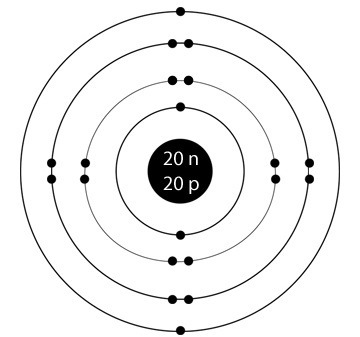
Illustrate a model of a calcium atom including the number and position of protons neutrons and electrons in the atom
andrey2020 [161]

The model would look something like the image below.

There would be a <em>central nucleus</em> containing <em>20 protons</em> and <em>20 neutrons</em>.

Surrounding the nucleus would be four concentric rings (energy levels) containing <em>20 electron</em>s.

Going out from the nucleus, the number of electrons in each ring would

be <em>2, 8, 8, 2</em>.

8 0
2 years ago
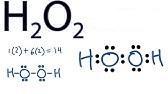
Many free radicals combine to form molecules that do not contain any unpaired electrons. The driving force for the radical–radic
Alexxandr [17]

Answer:

In the attached image the Lewis equation is shown where it is shown how two oxygens react with two hydrogens to meet the octet of the electrons.

Explanation:

Hydrogen peroxide is one of the most named chemicals since it is not only sold as "hydrogen peroxide" in pharmacies but it is also one of the great weapons of immune defense cells to defend ourselves against anaerobic bacteria.

The disadvantage of this compound is that when dividing it forms free oxygen radicals that are considered toxic or aging for our body.

4 0
2 years ago
Other questions:
  • 131i has a half-life of 8.04 days. assuming you start with a 1.53 mg sample of 131i, how many mg will remain after 13.0 days ___
    6·1 answer
  • What crossed-aldol product results when butanal is heated in the presence of excess benzaldehyde and sodium hydroxide? draw the
    10·1 answer
  • What is the best example of a cyclic event?
    7·1 answer
  • A 0.1873 g sample of a pure, solid acid, H2X (a diprotic acid) was dissolved in water and titrated with 0.1052 M NaOH solution.
    9·1 answer
  • What sample size (grams) of Na3PO4 (FW 164.00) known to be 50.00% pure should be used to consume exactly 40.00 mL of 0.1000 M HC
    6·1 answer
  • The isotope 64Cu has t1/2 of 12.7 hours. If the initial concentration of this isotope in an aqueous solution is 845 ppm, what wi
    5·1 answer
  • The pressure inside of a sealed tube if you raise the temperature go ______..
    14·2 answers
  • Consider the following chemical equation: NH4NO3(s)⟶NH+4(aq)+NO−3(aq) What is the standard change in free energy in kJmol at 298
    7·1 answer
  • At STP, a 50-gram sample of H20(I) and a 100-gram sample of H20(I) have
    15·2 answers
  • The diagram below represents a beaker of water being heated by a flame. The arrows represent heat
    14·1 answer
Add answer
Login
Not registered? Fast signup
Signup
Login Signup
Ask question!