answer.
Ask question
Login Signup
Ask question
All categories
  • English
  • Mathematics
  • Social Studies
  • Business
  • History
  • Health
  • Geography
  • Biology
  • Physics
  • Chemistry
  • Computers and Technology
  • Arts
  • World Languages
  • Spanish
  • French
  • German
  • Advanced Placement (AP)
  • SAT
  • Medicine
  • Law
  • Engineering
kogti [31]
2 years ago
4

A point charge of +7.45 pc (7.45 × 10⁻¹²

Physics
2 answers:
Rzqust [24]2 years ago
7 0

Answer:0.57\times10^{-16}N

The electric force between two charges q_1 and q_2 separated by distance rcan be defined as:

F=\frac{kq_1q_2}{r^2}

where, k =\frac{1}{4\pi \epsilon_o}=9\times10^9Nm^2/C^2

Charge of protonq_2=1.6\times10^{-19}C

Force due to charge at the origin on the proton:

F_1=\frac{9\times10^9\times 7.45\times10^{-12}\times1.6\times10^{-19}}{(9.83\times10^{-3})^2}N=1.108\times10^{-16}N

we need to calculate the distance between the charge on y-axis and the proton:

We will use the Pythagoras theorem,

Hypotenuse=\sqrt{(perpendicular)^2+(base)^2}

r=\sqrt{(9.83\times10^{-3})^2+(2.79\times10^{-3})^2}=10.21\times10^{-3}m

Force between these two charges:

F_2=\frac{9\times10^9\times -4.28\times10^{-12}\times1.6\times10^{-19}}{(10.21\times10^{-3})^2}N=-0.576\times10^{-16}N

The negative sign depicts that it is an attractive force because unlike charges attract.

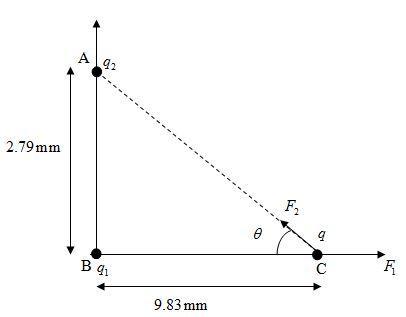
Now we need to find the net force on the proton. we cannot simply add the two forces because force is a vector quantity. so, first we need to measure the angular separation between the forces.

\theta= tan^{-1}\frac{2.79mm}{9.83mm}=tan^{-1}0.28=15.84^o

Now, we will write the forces in vector form and do vector addition.

Net force along x-axis:

F_x=F_1-F_2cos\theta=(1.108-0.576 cos15.84^o)\times10^{-16}N=0.55\times10^{-16}N

Net force along y-axis:

F_y=F_2sin\theta=0.576\times10^{-16}sin15.84^o=0.16\times10^{-16}N

Net force on proton by the two charges:

F=\sqrt{F_x^2+F_y^2}=\sqrt{(0.55\times10^{-16})^2+(0.16\times10^{-16})^2}=0.57\times10^{-16}N

Trava [24]2 years ago
6 0

The magnitude of the net electric force on the proton is \boxed{5.65 \times {10^{ - 17}}\,{\text{N}}} or \boxed{0.565\times {10^{ - 16}}\,{\text{N}}}.

Further explanation:

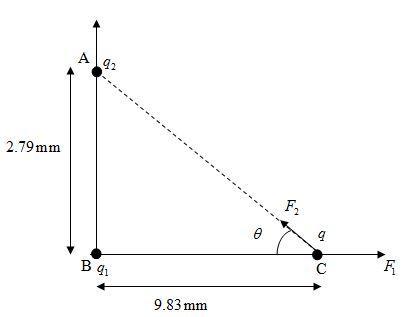
The net force on the proton placed at a point on x-axis is the resultant of the forces applied by the charge placed at origin and charge placed at the y-axis.

Given:

The positive charge which is fixed at the origin is {q_1}=+ 7.45\,{\text{pC}}.

The distance at which the negative charge fixed on the y-axis is 2.79\text{ mm}.

The negative charge which is fixed on the y-axis is {q_2}=- 4.28\,{\text{pC}}.

The distance at which the proton is placed on x-axis is 9.83\text{ mm}.

Concept:

The force between two charged particles is directly proportional to the product of both the charges and inversely proportional to the distance between them.

The force between the two charged particles is:

F=\dfrac{k{q_A}{q_B}}{r^2}                                                                 ...... (1)

In triangle ABC.

\begin{aligned}\tan \theta&=\frac{{AB}}{{BC}} \\&=\frac{{2.79\,{\text{mm}}}}{{9.83\,{\text{mm}}}} \\ \end{aligned}  

So,

\begin{aligned}\theta&={\tan ^{ - 1}}\left( {\frac{{2.79}}{{9.83}}} \right) \\&=15.85^\circ\\ \end{aligned}  

The value of the distance between charge placed on y-axis and charge placed on x-axis is:

AC=\sqrt {{{\left( {AB} \right)}^2}+{{\left( {BC} \right)}^2}}  

Substitute 2.79\text{ mm} for AB and 9.83\text{ mm} for AC in the above expression.

\begin{aligned}AC&=\sqrt {{{\left( {2.79} \right)}^2} + {{\left( {9.83} \right)}^2}}\\&=10.22\,{\text{mm}} \\ \end{aligned}

Let {F_1} is the force exerted on proton of charge q due to  the positive charge {q_1} placed at the origin.

Substitute the values in equation (1).

\begin{aligned}F_1&=\dfrac{{9\times10^9}\times{7.45\times10^{-12}}\times{1.6\times10^{-19}}}{(9.83\times10^{-3})^2}\\&=1.11\times10^{-16}\text{ N}\end{aligned}

The direction of {F_1} is away from the line joining BC as shown in the diagram.

Let {F_2} is the force exerted on proton of charge q due to negative charge q_2.

\begin{aligned}F_2&=\dfrac{{9\times10^{9}}\times{4.28\times10^{-12}}{1.6\times10^{-19}}}{(10.22\times10^{-3})^2}\\ &=5.9\times10^{-17}\text{ N}\end{aligned}

The direction of {F_2} is directed towards the line joining AC as shown in the diagram.  

Resolving {F_2} in the components along x and y direction.

The net force on proton in the x direction  is:

\begin{aligned}{F_x}&={F_1}-{F_2}\cos \theta\\&=11.1 \times {10^{ - 17}}\,{\text{N}} - 5.9 \times {10^{ - 17}}\cos \left( {15.85} \right)\,{\text{N}} \\&=5.42\times10^{-17}\text{N}\\ \end{aligned}  

The net force on proton in the y direction is:

\begin{aligned}{F_y}&={F_2}\sin \theta\\&=5.9 \times {10^{ - 17}}\sin \left( {15.85} \right)\,{\text{N}} \\&=1.61\times10^{-17}\text{ N}\\ \end{aligned}  

Magnitude of the net force is given as:

\begin{aligned}{F_{{\text{net}}}}&=\sqrt {F_x^2 + F_y^2}\\&=\sqrt {{{\left( {5.42 \times {{10}^{ - 17}}\,{\text{N}}} \right)}^2} + {{\left( {1.61 \times {{10}^{ - 17}}\,{\text{N}}} \right)}^2}}\\&=5.65 \times {10^{ - 17}}\,{\text{N}} \\\end{aligned}

Thus, the magnitude of the net electric force on the proton is \boxed{5.65 \times {10^{ - 17}}\,{\text{N}}} or \boxed{0.565\times {10^{ - 16}}\,{\text{N}}}.

Learn more:

1.  Conservation of energy brainly.com/question/3943029

2.  The motion of a body under friction brainly.com/question/4033012

3. A ball falling under the acceleration due to gravity brainly.com/question/10934170

Answer Details:

Grade: College

Subject: Physics

Chapter: Electrostatics

Keywords:  

Point charge, +7.45 pc, +7.45times10^-12 c, fixed, origin, another, charge, -4.28 pc, -4.28times10^-12 c, y axis, 2.79 mm, proton, p, x axis, 9.83 mm, 2.79times10^-3 m, 9.83times10^-3 m, magnitude, electric force, 0.57times10^-16 N, 5.65times10^-17 N, electrostatic force.
You might be interested in
an object having a core temperature of 1700 is removed from a furnace and placed in an environment having a constant temperature
IRINA_888 [86]

Answer: It will be take 2.6 hours

Explanation: Please see the attachments below

4 0
2 years ago
A roller coaster, traveling with an initial speed of 15 meters per second, decelerates uniformly at â7.0 meters per second2 to a
Harrizon [31]
<span>By algebra, d = [(v_f^2) - (v_i^2)]/2a. Thus, d = [(0^2)-(15^2)]/(2*-7) d = [0-(225)]/(-14) d = 225/14 d = 16.0714 m With 2 significant figures in the problem, the car travels 16 meters during deceleration.</span>
8 0
2 years ago
Consider the following spectrum where two colorful lines (A and B) are positioned on a dark background. The violet end of the sp
Dmitry_Shevchenko [17]

Answer:

Explanation:

a )

This type of spectrum is called line emission spectrum . Because it consists of lines . It is emission spectrum because it is due to emission of radiation from a source .

b ) The wavelength of a photon  is inversely proportional to its energy .  Photon  due to transition between n = 1 and n = 3 will have higher energy than

that due to transition between n = 2 and n = 5 . So the later photon ( B)  will have greater wavelength or photon  due to transition between n = 2 and n = 5 will have greater wavelength .

3 0
2 years ago
You are given 6 identical resistors, and allowed to combine them in any possible configuration to produce different equivalent r
tatyana61 [14]

Answer:your gay

Explanation:

gay

7 0
2 years ago
What principles of science (like facts, laws, and theories) might help explain why similar investigations conducted in many part
natulia [17]

Answer:

Reproducibility of research

Explanation:

The principle of science that explains why similar experimental investigations conducted in different parts of the world could result in the same outcome is referred to as reproducibility.

<em>A good research or experiment in science must be reproducible, otherwise, the outcome of such an experiment might become inadmissible within the scientific community. It is a core principle of the scientific method that similar results should be obtained when an experiment or observational study conducted in one place is repeated in another place with the same procedure. Hence, an experiment must be reproducible in science in order for the outcome of such an experiment to be part of the general scientific knowledge. </em>

7 0
2 years ago
Other questions:
  • Which statement best explains the relationship between the wavelengths and the frequencies of all the waves in the electromagnet
    12·1 answer
  • A rock weighing 20 n (mass = 2 kg) is swung in a horizontal circle of radius 2 m at a constant speed of 6 m/s. what is the centr
    13·2 answers
  • The air in tires can support a car because gases __________.
    5·1 answer
  • Which factors could be potential sources of error in the experiment? check all that apply.
    11·2 answers
  • A slender rod is 80.0 cm long and has mass 0.370 kg . A small 0.0200-kg sphere is welded to one end of the rod, and a small 0.05
    5·1 answer
  • A stationary 1.67-kg object is struck by a stick. The object experiences a horizontal force given by F = at - bt2, where t is th
    13·1 answer
  • a)A concentration C(mol/L) varies with time (min) according to the equation C=3.00exp(−2.00t) a) What are the implicit units of
    7·1 answer
  • Glycerin at 20 8 C fills the space between a hollow sleeve of diameter 12 cm and a fixed coaxial solid rod of diameter 11.8 cm.
    8·1 answer
  • A 1500 kg car enters a section of curved road in the horizontal plane and slows down at a uniform rate from a speed of 100 km/h
    13·1 answer
  • A ball is dropped from the top of an eleven-story building to a balcony on the ninth floor. In which case is the change in the p
    6·1 answer
Add answer
Login
Not registered? Fast signup
Signup
Login Signup
Ask question!
