answer.
Ask question
Login Signup
Ask question
All categories
  • English
  • Mathematics
  • Social Studies
  • Business
  • History
  • Health
  • Geography
  • Biology
  • Physics
  • Chemistry
  • Computers and Technology
  • Arts
  • World Languages
  • Spanish
  • French
  • German
  • Advanced Placement (AP)
  • SAT
  • Medicine
  • Law
  • Engineering
Lubov Fominskaja [6]
2 years ago
8

In ionic bond formation, the lattice energy of ions ________ as the magnitude of the ion charges _______ and the radii ________.

in ionic bond formation, the lattice energy of ions ________ as the magnitude of the ion charges _______ and the radii ________. decreases, increase, increase increases, decrease, decrease increases, increase, decrease increases, decrease, increase increases, increase, increase
Chemistry
2 answers:
Alinara [238K]2 years ago
8 0

If ion charges <u>decreases</u> then less attraction and energy <u>decreases</u>.

If radii <u>increases</u> then there is more distance , less attraction result of this energy <u>increases  </u>


so energy increases  as ion charges increases  and radii decreases

tigry1 [53]2 years ago
3 0

The most appropriate answer is:

1. Increase

2. Increases

3. Decreased

4. Increases

5. Increases

6. Decreased

<h2>Further Explanation </h2>

An ion is an atom or molecule that includes a non-zero total charge (the total number of electrons doesn't equal the whole number of protons). Cations are charged ions, while anions are charged ions. Therefore, a cation molecule includes a hydrogen proton without electrons, whereas anions have extra electrons. Because of their opposite electrical charges, cations and anions are drawn to one another and simply form ionic compounds. Ions that contain only one atom are called monatomic ions or atomic ions, while those containing two or more atoms form molecular ions or polyatomic ions. In the case of physical ionization in a medium, such as gas, an "ion pair" is created from the collision of ions, where each pair formed contains free electrons and positive ions. Ions are also created through chemical interactions, such as dissolving salts in liquids, or other ways, passing a direct current through a condensing solution that dissolves the anode through ionization.

Ion Bonding

In ionic bonds, there is an electron transfer from one atom to another. Because of the transfer of electrons, some atoms are found to have negatively charged electrons, while atoms that lose electrons will be positively charged. If an atom is added to an electron, then the atom becomes a negative ion or known as an anion. Meanwhile, if the atom loses electrons, then the atom becomes a positive ion or cation. Due to differences in charge between ions (positive ions and negative ions), the positive and negative ions will be attracted to each other by electrostatic forces. This event is the basis of ionic bonds.

Learn more

definition of An ion brainly.com/question/11574751

Ion Bonding brainly.com/question/11574751

Details

Grade: High School

Subject: Chemistry

keywords: Ion Bonding

You might be interested in
Activity 1: My Incompleteness, Complete Me. Fill in the Punnett squares with the correct genotypes based on the key pictures tha
Xelga [282]

hope you can read it. hope it's right too :).

All the best.

8 0
2 years ago
What is the maximum number of grams of ammonia, nh3, which can be obtained from the reaction of 10.0 g of h2 and 80.0 g of n2? n
Lelechka [254]

<u>Answer:</u> The mass of ammonia produced is 28.22 g

<u>Explanation:</u>

To calculate the number of moles, we use the equation:

\text{Number of moles}=\frac{\text{Given mass}}{\text{Molar mass}}     .....(1)

  • <u>For hydrogen gas:</u>

Given mass of hydrogen gas = 10.0 g

Molar mass of hydrogen gas = 2 g/mol

Putting values in equation 1, we get:

\text{Moles of hydrogen gas}=\frac{10.0g}{2g/mol}=5mol

  • <u>For nitrogen gas:</u>

Given mass of nitrogen gas = 80.0 g

Molar mass of nitrogen gas = 28 g/mol

Putting values in equation 1, we get:

\text{Moles of nitrogen gas}=\frac{80.0g}{28g/mol}=2.86mol

The given chemical equation follows:

N_2+3H_2\rightarrow 2NH_3

By Stoichiometry of the reaction:

3 moles of hydrogen gas reacts with 1 mole of nitrogen gas

So, 5 moles of hydrogen gas will react with = \frac{1}{3}\times 5=1.66mol of nitrogen gas

As, given amount of nitrogen gas is more than the required amount. So, it is considered as an excess reagent.

Thus, hydrogen gas is considered as a limiting reagent because it limits the formation of product.

By Stoichiometry of the reaction:

3 moles of hydrogen gas produces 1 mole of ammonia

So, 5 moles of hydrogen gas will produce = \frac{1}{3}\times 5=1.66moles of ammonia

Now, calculating the mass of ammonia from equation 1, we get:

Molar mass of ammonia = 17 g/mol

Moles of ammonia = 1.66 moles

Putting values in equation 1, we get:

1.66mol=\frac{\text{Mass of ammonia}}{17g/mol}\\\\\text{Mass of ammonia}=(1.66mol\times 17g/mol)=28.22g

Hence, the mass of ammonia produced is 28.22 g

4 0
2 years ago
If Co(NH3)63+ has a λmax at 440 nm, calculate ΔE for the complex. A) 2.72 x 10⁻⁴ kJ/mol B) 4.52 x 10⁻² kJ/mol C) 2.72 x 10 2 kJ/
riadik2000 [5.3K]

<u>Answer:</u> The energy of the complex is 2.72\times 10^2kJ

<u>Explanation:</u>

To calculate the energy of the complex, we use the equation given by Planck which is:

\Delta E=\frac{N_Ahc}{\lambda}

where,

\lambda = Wavelength of the complex = 440nm=4.40\times 10^{-7}m    (Conversion factor:  1m=10^9nm )

h = Planck's constant = 6.624\times 10^{-34}Js

c = speed of light = 3\times 10^8m/s

N_A = Avogadro's number = 6.022\times 10^{23}

\Delta E = energy of the complex

Putting values in above equation, we get:

\Delta E=\frac{6.022\times 10^{23}\times 6.624\times 10^{-34}\times 3\times 10^8}{4.40\times 10^{-7}}\\\\\Delta E=2.72\times 10^{5}J=2.72\times 10^2kJ

Conversion factor used:  1 kJ = 1000 J

Hence, the energy of the complex is 2.72\times 10^2kJ

5 0
2 years ago
A liquid has a volume of 34.6 ml and a mass of 46.0 g. what is the density of the liquid?
Minchanka [31]

The density of a substance can simply be calculated by dividing the mass by the volume:

density = mass / volume


Therefore calculating for the density since mass and volume are given:

density = 46.0 g / 34.6 mL

density = 1.33 g / mL

5 0
2 years ago
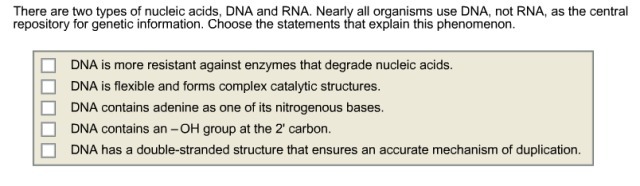
There are two types of nucleic acids, dna and rna. nearly all organisms use dna, not rna, as the central repository for genetic
Leya [2.2K]
Found the choices. Pls see attachment. 

The statements that explains this phenomenon are:
1) DNA contains adenine as one of its nitrogenous bases.
2) DNA has a double-stranded structure that ensures an accurate mechanism of duplication.

6 0
2 years ago
Other questions:
  • Caculate the mass of oxygen needed to burn 175.0grams of octane
    5·1 answer
  • Please help 30 pts!!!!! A friend needs these answers and I don't know what to say. If you don't know the answer, please ask some
    8·1 answer
  • Match each type of titration to its ph at the equivalence point for solutions at 25 ∘c. drag each item to the appropriate bin. v
    12·1 answer
  • A lithium salt used in lubricating grease has the formula LiCnH2n+1O2. The salt is soluble in water to the extent of 0.036 g per
    14·1 answer
  • Read the "Chemical Insights: Fireworks" essay within Ch 12 of the Zumdahl textbook. Which of the following substances produce br
    12·1 answer
  • A balloon filled with 1.22 L of gas at 286 K is heated until the
    10·1 answer
  • One million argon atoms is how many mol of argon atoms? (2 significant figures)
    5·1 answer
  • A 75 lb (34 kg) boy falls out of a tree from a height of 10 ft (3 m). i. What is the kinetic energy of the boy when he hits the
    6·1 answer
  • 18) Why are the large oak trees so important for storks? Where are<br> they found?<br> 1
    8·1 answer
  • Min is conducting an experiment where he compares the properties of water and lemonade. The first stage of the experiment is foc
    5·1 answer
Add answer
Login
Not registered? Fast signup
Signup
Login Signup
Ask question!