answer.
Ask question
Login Signup
Ask question
All categories
  • English
  • Mathematics
  • Social Studies
  • Business
  • History
  • Health
  • Geography
  • Biology
  • Physics
  • Chemistry
  • Computers and Technology
  • Arts
  • World Languages
  • Spanish
  • French
  • German
  • Advanced Placement (AP)
  • SAT
  • Medicine
  • Law
  • Engineering
VARVARA [1.3K]
2 years ago
13

If 0.250 mol of hydrogen gas occupies 0.333L at 20.0c what is the pressure in atmospheres?

Chemistry
1 answer:
maria [59]2 years ago
8 0

Answer: The pressure will be 18.05 atm.

Explanation: Expression for ideal gas equation is :

PV=nRT

where,

P = Pressure of the gas = ? atm

V = Volume of the gas = 0.333L

n = Number of moles of gas = 0.250 moles

R = Universal gas constant = 0.082057\text{ L atm }mol^{-1}K^{-1}

T = temperature of the gas = 20°C = (273 + 20)K = 293K

Putting values in above equation, we get:

P\times 0.333L=0.250mol\times 0.082057\text{ L atm }mol^{-1}K^{-1}\times 293K

P = 18.05 atm

You might be interested in
Nuclear power plants produce energy using fission. One common fuel, uranium-235, produces energy through the fission reaction 23
Vikentia [17]

Answer:

mass of U-235  = 15.9 g (3 sig. figures)

Explanation:

1 atom can produce -------------------------> 3.20 x 10^-11 J energy

x atoms can produce ----------------------> 1.30 x 10^12 J energy

x = 1.30 x 10^12 / 3.20 x 10^-11

x = 4.06 x 10^22 atoms

1 mol ----------------------> 6.023 x 10^23 atoms

y mol ----------------------> 4.06 x 10^22 atoms

y = 0.0675 moles

mass of U-235 = 0.0675 x 235 = 15.8625

mass of U-235  = 15.9 g (3 sig. figures)

7 0
2 years ago
Equal numbers of moles of He(g), Ar(g), and Ne(g) are placed in a glass vessel at room temperature. If the vessel has a pinhole-
mrs_skeptik [129]

Answer:

VP as function of time => VP(Ar) > VP(Ne) > VP(He).

Explanation:

Effusion rate of the lighter particles will be higher than the heavier particles. That is, the lighter particles will leave the container faster than the heavier particles. Over time, the vapor pressure of the greater number of heavier particles will be higher than the vapor pressure of the lighter particles.

=> VP as function of time => VP(Ar) > VP(Ne) > VP(He).

Review Graham's Law => Effusion Rate ∝ 1/√formula mass.

4 0
2 years ago
. Calculate the mass of O2 produced if 3.450 g potassium chlorate is completely decomposed by heating in presence of a catalyst
Vesnalui [34]
 <span>2 KClO3(s) → 3 O2(g) + 2 KCl(s) 

</span><span>Note: MnO2 (Manganese Dioxide) is not part of the reaction. A catalyst lowers the activation energy and increases both forward and reverse reactions at equal rates. 
</span>
molar mass of KClO3 = 122.5
Moles of KClO3 =  3.45 / 122.55 = 0.028

Moles of O2 produce = \frac{3}{2} \times 0.028

= 0.042 moles

molar mass of O2 = 32

so, mass of O2 = 32 x 0.042  = 1.35 g


5 0
2 years ago
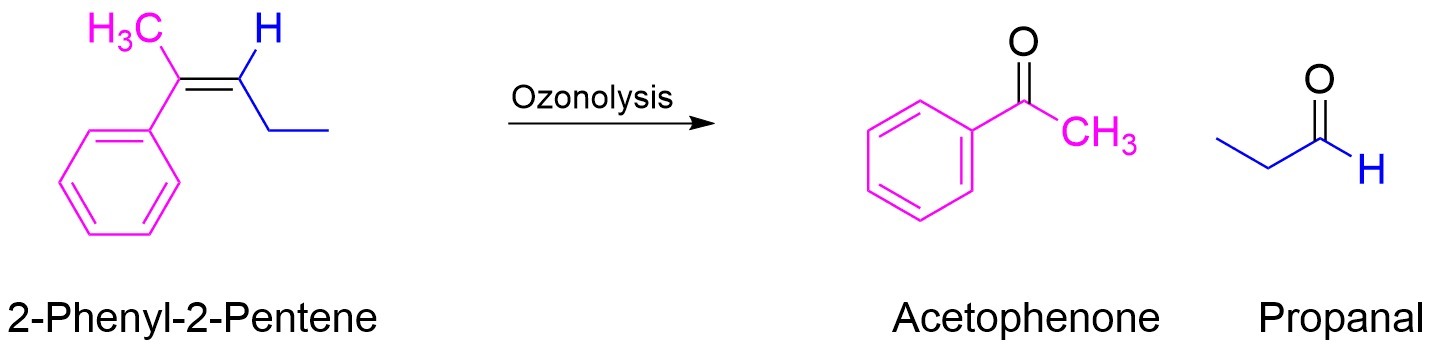
Compound a on ozonolysis yields acetophenone and propanal. what is the structure of compound a? 1-phenyl-1-hexene 1-phenyl-2-pen
astra-53 [7]
Answer:
            2-Phenyl-2-Penetene on ozonolysis <span>yields acetophenone and propanal.

Explanation:
                   The tricky way to solve such questions is to simply break the double bond in alkene and place oxygen atom at each broken half double bond making it carbonyl group. The reaction of given statement is as follow,</span>

6 0
2 years ago
How many atoms are in 80.45 g of magnesium?
KatRina [158]

Hello!

To find the amount of atoms that are in 80.45 grams of magnesium, we will need to know Avogadro's number and the mass of one mole of magnesium.

Avogadro's number is 6.02 x 10^23 atoms, and one mole of magnesium is equal to 24.31 grams.

1. Divide by one mole of magnesium

80.45 / 24.31 = 3.309 moles (rounded to the number of sigfigs)

2. Multiply moles by Avogadro's number

3.309 x (6.02 x 10^23) = 1.99 x 10^24 (rounded to the number of sigfigs)

Therefore, there are 1.99 x 10^24 atoms in 80.45 grams of magnesium.

8 0
2 years ago
Other questions:
  • Why couldn't you substitute 3m H2SO4 for concentrated HNO3 when oxidizing copper?
    14·2 answers
  • Combined gas law problem: a balloon is filled with 500.0 mL of helium at a temperature of 27 degrees Celsius and 755 mmHg. As th
    11·1 answer
  • What mass of ammonium thiocyanate (nh4scn) must be used if it is to react completely with 5.7 g barium hydroxide octahydrate?
    12·1 answer
  • In a scientific experiment, the factor that may change in response to the manipulated variable is called the ______ variable.
    9·1 answer
  • When potassium bromate (kbro3 ) is heated, it decomposes into potassium bromide and a gas that supports the combustion of a glow
    8·1 answer
  • What mass of calcium carbonate (in grams) can be dissolved by 4.0 g of hcl? (hint: begin by writing a balanced equation for the
    14·2 answers
  • A plot of velocity versus substrate concentration for a simple enzyme-catalyzed reaction produces a _____. This indicates that a
    11·1 answer
  • Density of copper is 8.96 g/cm3 and density of zinc is 7.14 g/cm3 . Brass is an alloy made of copper and zinc. You are given a s
    6·1 answer
  • If PbI2(s) is dissolved in 1.0MNaI(aq) , is the maximum possible concentration of Pb2+(aq) in the solution greater than, less th
    13·1 answer
  • Write an equation that shows the formation of a strontium ion from a neutral strontium atom
    10·1 answer
Add answer
Login
Not registered? Fast signup
Signup
Login Signup
Ask question!