answer.
Ask question
Login Signup
Ask question
All categories
  • English
  • Mathematics
  • Social Studies
  • Business
  • History
  • Health
  • Geography
  • Biology
  • Physics
  • Chemistry
  • Computers and Technology
  • Arts
  • World Languages
  • Spanish
  • French
  • German
  • Advanced Placement (AP)
  • SAT
  • Medicine
  • Law
  • Engineering
Tju [1.3M]
2 years ago
4

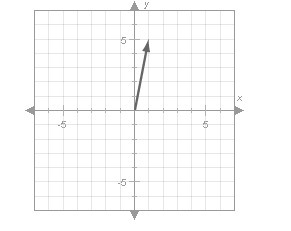
Wha is the length of the x-component of the vector plotted below?

Physics
2 answers:
mylen [45]2 years ago
6 0

B. 1

Because the x coordinate of the end point is 1 .

Point is (1,5)

so Answer is B .

Yanka [14]2 years ago
4 0

Answer:

Correct Answer is option B that is 1

Explanation:

when a vector is break into its parts, those parts are called its components.  in this question length of  vector along x-axis is 1, and length of vector along y-axis is 5. Therefore X component (also known as horizontal component) of vector is 1 and Y Component(Alson Known as Vertical component) is 5.

Hope this answer will help you

You might be interested in
A carmaker has designed a car that can reach a maximum acceleration of 12 meters/second2. The car’s mass is 1,515 kilograms. Ass
Vlada [557]
1) 15 / 12 = 1.25 ratio
2) to increase acceleration  1.25 times (with same F, or same engine) you have to lower mass 1.25 times
3) 1515/1.25 = 1212 kg

choose A

6 0
2 years ago
At the circus, a 100-kilogram clown is fired 15 meters per second from a 500-kilogram cannon. What is the recoil speed of the ca
Ahat [919]
Recoil speed= 3m/s, method shown in photo

4 0
2 years ago
A uniform cylindrical steel wire (density: 7.8 x 10³ kg/m3), 58.0 cm long and 1.34 mm in diameter, is fixed at both ends. To wha
lbvjy [14]

Answer:

T= 354.65 N

Explanation:

Given that

ρ= 7800 kg/m³

L= 58 cm

d=1.34 mm

f= 311 Hz

T= Tension

Speed of wave ,V

V = f λ      

V = f L

V= 311 x 0.58 m/s

V=180.38 m/s

Area of cross sectional

A= πr² mm²

A= 3.14 x 0.67² mm²

A=1.41 mm²

Mass = Density x Volume

m=7800\times 1.41\times 10^{-6}\ kg/m

m=0.0109 kg/m

Tension ,T

T=m V^2

T= 0.0109 x 180.38² N

T= 354.65 N


3 0
2 years ago
A 5.00-g bullet is shot through a 1.00-kg wood block suspended on a string 2.00 m long. The center of mass of the block rises a
o-na [289]

Answer:395.6 m/s

Explanation:

Given

mass of bullet m=5 gm

mass of wood block M=1 kg

Length of string L=2 m

Center of mass rises to an height of 0.38 cm

initial velocity of bullet u=450 m/s

let v_1 and v_2 be the velocity of bullet and block after collision

Conserving momentum

mu=mv_1+Mv_2 -------------1

Now after the collision block rises to an height of 0.38 cm

Conserving Energy for block

kinetic energy of block at bottom=Gain in Potential Energy

\frac{Mv_2^2}{2}=Mgh_{cm}

v_2=\sqrt{2gh_{cm}}

v_2=\sqrt{2\times 9.8\times 0.38}

v_2=0.272 m/s

substitute the value of v_2 in equation 1

5\times 450=5\times v_1+1000\times 0.272

v_1=395.6 m/s

4 0
2 years ago
Angular and Linear Quantities: A child is riding a merry-go-round that has an instantaneous angular speed of 1.25 rad/s and an a
serious [3.7K]

To solve this problem we will use the kinematic equations of angular motion in relation to those of linear / tangential motion.

We will proceed to find the centripetal acceleration (From the ratio of the radius and angular velocity to the linear velocity) and the tangential acceleration to finally find the total acceleration of the body.

Our data is given as:

\omega = 1.25 rad/s \rightarrow The angular speed

\alpha = 0.745 rad/s2 \rightarrow The angular acceleration

r = 4.65 m \rightarrow The distance

The relation between the linear velocity and angular velocity is

v = r\omega

Where,

r = Radius

\omega = Angular velocity

At the same time we have that the centripetal acceleration is

a_c = \frac{v^2}{r}

a_c = \frac{(r\omega)^2}{r}

a_c = \frac{r^2\omega^2}{r}

a_c = r \omega^2

a_c = (4.65 )(1.25 rad/s)^2

a_c = 7.265625 m/s^2

Now the tangential acceleration is given as,

a_t = \alpha r

Here,

\alpha = Angular acceleration

r = Radius

\alpha = (0.745)(4.65)

\alpha = 3.46425 m/s^2

Finally using the properties of the vectors, we will have that the resulting component of the acceleration would be

|a| = \sqrt{a_c^2+a_t^2}

|a| = \sqrt{(7.265625)^2+(3.46425)^2}

|a| = 8.049 m/s^2 \approx 8.05 m/s2

Therefore the correct answer is C.

7 0
2 years ago
Other questions:
  • What is the acceleration of a ball rolling down a ramp that starts from rest and travels 0.9 m in 3 s?
    15·1 answer
  • A rightward force is applied to a 6-kg object to move it across a rough surface at a constant velocity. The object encounters 25
    13·1 answer
  • A bookshelf is 2m long, with supports at its end (p and q). A book weighing 10N is placed in the middle of the shelf. what are t
    13·1 answer
  • A geologist is studying the shore along a river. She finds a pile of rocks at the base of a riverbank. These broken rock pieces
    14·2 answers
  • (1 point) Suppose a spring with spring constant 7 N/m is horizontal and has one end attached to a wall and the other end attache
    10·1 answer
  • Four distinguishable particles move freely in a room divided into octants (there are no actual partitions). Let the basic states
    6·1 answer
  • Two very large parallel metal plates, separated by 0.20 m, are connected across a 12-V source of potential. An electron is relea
    15·1 answer
  • Calculate the time taken by the light to pass through a nucleus of diameter 1.56 10 -16 m. (speed of light is 3 10 8 m/s)
    10·1 answer
  • The free-electron density in a copper wire is 8.5×1028 electrons/m3. The electric field in the wire is 0.0520 N/C and the temper
    11·1 answer
  • Calculate the force of gravity between two objects of masses 1300 kg and 7800 kg, which are 0.23 m apart.
    6·1 answer
Add answer
Login
Not registered? Fast signup
Signup
Login Signup
Ask question!