answer.
Ask question
Login Signup
Ask question
All categories
  • English
  • Mathematics
  • Social Studies
  • Business
  • History
  • Health
  • Geography
  • Biology
  • Physics
  • Chemistry
  • Computers and Technology
  • Arts
  • World Languages
  • Spanish
  • French
  • German
  • Advanced Placement (AP)
  • SAT
  • Medicine
  • Law
  • Engineering
PtichkaEL [24]
2 years ago
14

A fossil of a sable antelope was observed in the topmost layer of soil. A fossil of a zebra was found below it. The bottom layer

contained fossils of a blue antelope. This discovery tells us that . The sable antelope is the .
Chemistry
2 answers:
enot [183]2 years ago
7 0

Answer:

1. sable antelopes existed before blue antelopes

2. youngest fossil

Explanation:

i took the test :p

leva [86]2 years ago
6 0

Answer: According to the law of faunal succession, the fossils that are found at the bottom layer are considered to be the oldest, whereas the fossils that are present on the top layer is the youngest.

From the given question, the sable antelope is the youngest, and blue antelope is the oldest. This could suggest that the blue antelopes have undergone evolution and with time, they transformed into the horse, which were found to be present in the middle layer as an evidence. And this animal has further undergone evolution and formed the sable antelopes.

You might be interested in
What is the pOH of a 1 x 10^-8 M solution of HNO3?
Sedaia [141]

Explanation:

to find POH u need PH first

so ph=-log(h3o)

so

ph =  -  log(1 \times  {10}^{ - 8} )  \\  \\ ph = 8 \\ ph + poh =14 \\ poh = 14 - 8 \\ poh = 6

8 0
1 year ago
A scientist measures the mass of two liquids before and after combining them. The mass after combining the liquids is less then
Lelu [443]

Answer:

A chemical change occurred and a gas was produced.  

Step-by-step explanation:

If there is no chemical reaction, the <em>Law of Conservation of Mass</em> says that  

Total mass = Mass 1 + Mass 2

However, if the two liquids react and give off a gas, then

Total mass = Mass 1 + Mass 2 + Mass of gas

You are not measuring the mass of the gas, so the mass of the liquids after mixing is less than it was before mixing.

For example, if Liquid 1 was a solution of HCl and Liquid 2 was a solution of Na₂CO₃, they would give off CO₂ on mixing. but you would not be measuring the mass of the CO₂.

4 0
2 years ago
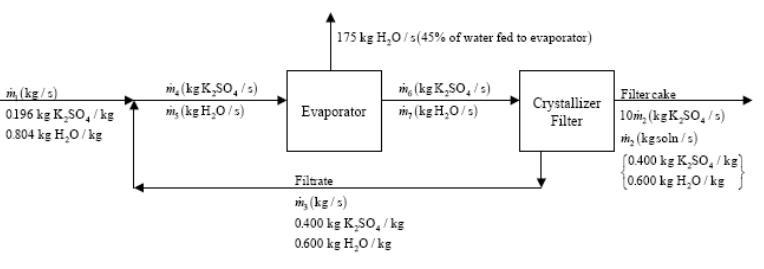
An evaporation–crystallization process of the type described in Example 4.5-2 is used to obtain solid potassium sulfate from an
timofeeve [1]

Answer:

feed = 220.77 kg/s; maximum production rate of solid crystal = 416 kg/s; the rate of supplying fresh feed to obtain the production rate = 1.6

Explanation:

Material or mass balance can be used to estimate the mass flow rates of all the streams in the diagram shown in the attached file.

Overall balance: M_{1} = 175 + 11M_{2}

Water: 0.804M_{1} = 175 + 0.6M_{2}

Using substitution method, we have:

M_{1} = 220.77 kg/s

M_{2}  = 4.16 kg/s

The maximum production rate of solid crystal is 10M_{2} = 10*4.16 = 416 kg/s

Around evaporator:

0.45M_{5} = 175

M_{5} = 175/0.45 = 389 kg/s

Around the mixing point:

M_{1} + M_{3} = M_{4} + M_{5}

Solid crystal: 0.196M_{1} + 0.4M_{3} = M_{4}

Using the last two equations, we can obtain:

0.804M_{1} + 0.6M_{3} = M_{5}

0.6M_{3} = 389 - 0.804*220.77 = 389 - 177.5 = 211.5

M_{3} = 211.5/0.6 = 352.5 kg/s

The rate of supplying fresh feed to obtain the production rate is:

\frac{M_{3}}{M_{1}} = 352.5/220.77 = 1.6

7 0
3 years ago
Anna lives in a city that experiences high precipitation, with an average annual rainfall of 524 millimeters. It is warm all yea
gavmur [86]

Anna lives in a city that is part of the tropical climate types. It has a constantly warm weather, and thus higher humidity, and according to the annual rainfall, it is most probably a rainfall that appears seasonally, not throughout the whole year.

Tim, on the other hand, lives in a city that is part of the dry climate types. It is most probably a place that is deep into the mainland, like the cold deserts of Central Asia, where the temperatures in the summer are high, and in winter are very low. Because of the distance from the sea, the rainfall doesn't reach this places, so they are very dry, and only have symbolic amount of annual rainfall.

6 0
2 years ago
Which of the following refers to a chemical property?. . a. At room temperature, mercury is a liquid, but gold is a solid.. . b.
luda_lava [24]
Out of the choices given, the answer which refers to a chemical property is going to be B. Water will not burn, but gasoline is flammable. The reason why is because burning and flammability are both chemical properties. 

6 0
2 years ago
Other questions:
  • 26 Which substance is an electrolyte?(1) C6H12O6(s) (3) NaOH(s)(2) C2H5OH(L) (4) H2(g)
    7·2 answers
  • Write a balanced half-reaction describing the reduction of aqueous chromium(IV) cations to solid chromium.
    13·1 answer
  • The highest energy occupied molecular orbital in the b−b bond of the b2 molecule is _____
    14·2 answers
  • Students working in lab accidentally spilled 17 l of 3.0 m h2so4 solution. they find a large container of acid neutralizer that
    14·1 answer
  • Nitrogen dioxide (NO2) cannot be obtained in a pure form in the gas phase because it exists as a mixture of NO2 and N2O4. At 16°
    14·1 answer
  • When an athlete gets hurt they apply sometimes an instant cold pack to the injury. The instant cold pack works by mixing two che
    13·1 answer
  • A solution that contains 55.0 g of ascorbic acid (vitamin C) in 250.0 g of water freezes at –2.34°C.
    7·1 answer
  • For each of the following substituents, indicate whether it withdraws electrons inductively, donates electrons by hyperconjugati
    9·1 answer
  • 1. How many moles of tin are needed to react with 3.5 moles of hydrogen fluoride?
    15·1 answer
  • At STP, a 50-gram sample of H20(I) and a 100-gram sample of H20(I) have
    15·2 answers
Add answer
Login
Not registered? Fast signup
Signup
Login Signup
Ask question!