answer.
Ask question
Login Signup
Ask question
All categories
  • English
  • Mathematics
  • Social Studies
  • Business
  • History
  • Health
  • Geography
  • Biology
  • Physics
  • Chemistry
  • Computers and Technology
  • Arts
  • World Languages
  • Spanish
  • French
  • German
  • Advanced Placement (AP)
  • SAT
  • Medicine
  • Law
  • Engineering
umka21 [38]
2 years ago
5

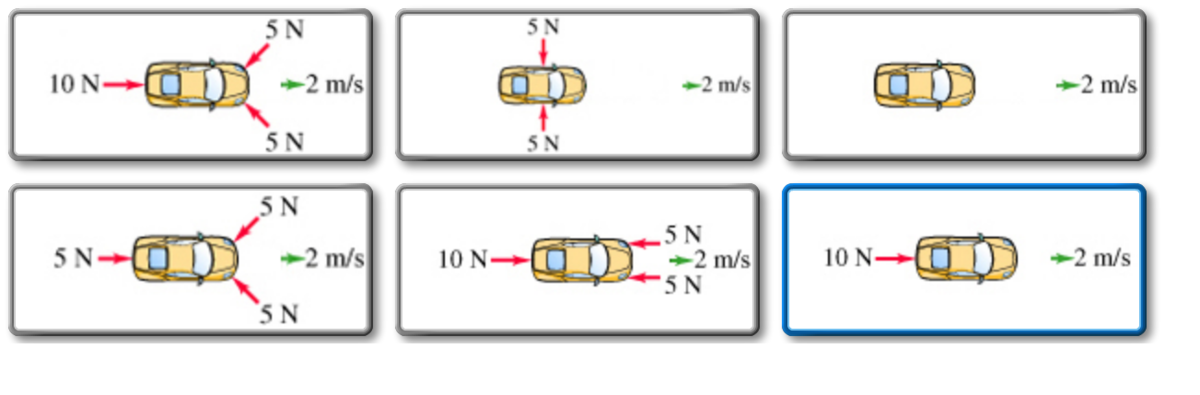
Below are birds-eye views of six identical toy cars moving to the right at 2 m/s. Various forces act on the cars with magnitudes

and directions indicated below. All forces act in the horizontal plane and are either parallel or at 45 or 90 degrees to the car's motion. Rank these cars on the basis of their speed a short time (ie. before any car's speed can reach zero) after the forces are applied. Rank from largest to smallest. To rank items as equivalent, overlap them.

Physics
1 answer:
Firdavs [7]2 years ago
3 0
All cars have the same speed before the forces are applied ( v = 2 m/s ).
After that rank is:
1. Largest: 6th car ;  Fr = 10 N,
2. 1st car ;  Fr = 2.95 N.
3. After that: 2nd, 3rd and 5th car ;  Fr = 0 N
4. Smallest : 4th car ;  Fr = - 2.04 N. 

You might be interested in
refrigerant 134a enters a compressor operating at steady state as saturated vapor at 0.12 MPa and exits at 1.2 MPa and 70 C at a
Afina-wow [57]

Answer:

the power input to the compressor is 7.19Kw

Explanation:

Hello!

To solve this problem follow the steps below.

1. We will call 1 the refrigerant state at the compressor inlet and 2 at the outlet.

2. We use thermodynamic tables to determine enthalpies in states 1 and 2.

(note: Through laboratory tests, thermodynamic tables were developed, these allow to know all the thermodynamic properties of a substance (entropy, enthalpy, pressure, specific volume, internal energy etc ..)  

through prior knowledge of two other properties such as pressure and temperature.  )

h1[quality=1, P=0.12Mpa)=237KJ/Kg

h2(P=1.2Mpa, t=70C)=300.6KJ/kg

3. uses the first law of thermodynamics in the compressor that states that the energy that enters a system is the same that must come out

Q=heat=0.32kJ/s

W=power input to the compressor

m=mass flow=0.108kg/S

m(h1)+W=Q+m(h2)

solving for W

W=Q+m(h2-h1)

W=0.32+0.108(300.6-237)=7.19Kw

the power input to the compressor is 7.19Kw
7 0
2 years ago
Two friends, barbara and neil, are out rollerblading. with respect to the ground, barbara is skating due south at a speed of 5.9
Semmy [17]
<span>As seen by Barbara, Neil is traveling at a velocity of 6.1 m/s at and angle of 76.7 degrees north from due west. Let's assume that both Barbara and Neil start out at coordinate (0,0) and skate for exactly 1 second. Where do they end up? Barbara is going due south at 5.9 m/s, so she's at (0,-5.9) Neil is going due west at 1.4 m/s, so he's at (-1.4,0) Now to see Neil's relative motion to Barbara, compute a translation that will place Barbara back at (0,0) and apply that same translation to Neil. Adding (0,5.9) to their coordinates will do this. So the translated coordinates for Neil is now (-1.4, 5.9) and Barbara is at (0,0). The magnitude of Neil's velocity as seen by Barbara is sqrt((-1.4)^2 + 5.9^2) = sqrt(1.96 + 34.81) = sqrt(36.77) = 6.1 m/s The angle of his vector relative to due west will be atan(5.9/1.4) = atan(4.214285714) = 76.7 degrees So as seen by Barbara, Neil is traveling at a velocity of 6.1 m/s at and angle of 76.7 degrees north from due west.</span>
5 0
2 years ago
Read 2 more answers
A steel aircraft carrier is 370 m long when moving through the icy North Atlantic at a temperature of 2.0 °C. By how much does t
34kurt

Answer:

The carrier lengthen is 0.08436 m.

Explanation:

Given that,

Length = 370 m

Initial temperature = 2.0°C

Final temperature = 21°C

We need to calculate the change temperature

Using formula of change of temperature

\Delta T=T_{f}-T_{i}

\Delta T=21-2.0

\Delta T=19^{\circ}C

We need to calculate the carrier lengthen

Using formula of length

\Delta L=\alpha_{steel}\times L_{0}\times\Delta T

Put the value into the formula

\Delta L=1.2\times10^{-5}\times370\times19

\Delta L=0.08436\ m

Hence, The carrier lengthen is 0.08436 m.

8 0
2 years ago
Your friend says, “chemical changes are caused by an input in energy. In physical changes, there is no transfer of energy” is yo
nalin [4]

Answer:

Ok, let's suppose the simplest of the physical changes:

We have an object that is not moving (so it is not accelerated)

and there is change, now the object moves.

Because there was a change, means that there was an acceleration, and by the second Newton's law.

Force equals mass times acceleration:

F = m*a

There must be a force.

So suppose that you pushed the object, then some energy that you had, you transferred it to the object, that now is moving and now has kinetic energy.

Now, is kinda true that in a closed system the total energy is always constant, but it depends on what is our system.

So if we think in our system as you and the object, then in the whole system the energy does not change because the energy that you lost is now on the object, but again, there was a transfer of energy.

So no, your friend is not correct.

3 0
2 years ago
What kind of deformation does a cube of Jell-O exhibit when it jiggles?
nadya68 [22]
It depends on chemistry... A physical deformation to the Jell-O.

3 0
2 years ago
Other questions:
  • The image shows an example of white light entering a prism and coming out as colors of the rainbow. How does a prism a produce t
    11·2 answers
  • A baseball bat is 32 inches (81.3 cm) long and has a mass of 0.96 kg. Its center of mass is 22 inches (55.9 cm) from the handle
    11·1 answer
  • A passenger railroad car has a total of 8 wheels. Springs on each wheel compress--slightly--when the car is loaded. Ratings for
    12·1 answer
  • A 5kg block is pulled across a table by a horizontal force of 40 N with a frictional force of 8 N opposing the motion. Draw a fo
    10·1 answer
  • A binary star system consists of two stars of masses m1 and m2. The stars, which gravitationally attract each other, revolve aro
    12·1 answer
  • The constant pressure molar heat capacity, C_{p,m}C p,m ​ , of nitrogen gas, N_2N 2 ​ , is 29.125\text{ J K}^{-1}\text{ mol}^{-1
    12·1 answer
  • 1200 N-m of torque is used to drive a gear (A) of diameter 25 cm, which in turn drives another gear (B) of diameter 52 cm. What
    11·2 answers
  • A 30-m-long rocket train car is traveling from Los Angeles to New York at 0.5c when a light at the center of the car flashes. Wh
    6·1 answer
  • A flywheel is a mechanical device used to store rotational kinetic energy for later use. Consider a flywheel in the form of a un
    8·1 answer
  • Nuclear waste disposal is one of the largest issues with nuclear power. Cesium-137 is one of the high level waste products in an
    7·1 answer
Add answer
Login
Not registered? Fast signup
Signup
Login Signup
Ask question!
