answer.
Ask question
Login Signup
Ask question
All categories
  • English
  • Mathematics
  • Social Studies
  • Business
  • History
  • Health
  • Geography
  • Biology
  • Physics
  • Chemistry
  • Computers and Technology
  • Arts
  • World Languages
  • Spanish
  • French
  • German
  • Advanced Placement (AP)
  • SAT
  • Medicine
  • Law
  • Engineering
Veronika [31]
2 years ago
6

an object of mass 6000 kg rests on the flatbed of a truck. it is held in place by metal brackets that can exert a maximum horizo

ntal force of 9000 N. when the truck is traveling 15 m/s, what is the minimum stopping distance if the load is not to slide forward into the cab?
Physics
1 answer:
Otrada [13]2 years ago
4 0

Answer:

minimum stopping distance will be d = 75 m

Explanation:

Maximum force exerted by the bracket is given as

F = 9000 N

now we know that mass of the object is

m = 6000 kg

so the maximum acceleration that truck can have is given as

F = ma

9000 = 6000 a

a = 1.5 m/s^2

now for finding minimum stopping distance of the truck

v_f^2 - v_i^2 = 2a d

0^2 - 15^2 = 2(-1.5) d

d = 75 m

You might be interested in
A source of emf is connected by wires to a resistor and electrons flow in the circuit the wire diameter is teh same throughout t
vladimir2022 [97]
I think is E
I hope that helps
3 0
2 years ago
A string is wrapped around a pulley with a radius of 2.0 cm and no appreciable friction in its axle. The pulley is initially not
stiks02 [169]

Answer:

2

Explanation:

2

5 0
2 years ago
Read 2 more answers
A particle of mass m= 2.5 kg has velocity of v = 2 i m/s, when it is at the origin (0,0). Determine the z- component of the angu
melomori [17]

Answer:

please read the answer below

Explanation:

The angular momentum is given by

|\vec{L}|=|\vec{r}\ X \ \vec{p}|=m(rvsin\theta)

By taking into account the angles between the vectors r and v in each case we obtain:

a)

v=(2,0)

r=(0,1)

angle = 90°

L=(2.5kg)(1)(2\frac{m}{s})sin90\°=5.0kg\frac{m}{s}

b)

r=(0,-1)

angle = 90°

L=(2.5kg)(1)(2\frac{m}{s})sin90\°=5.0kg\frac{m}{s}

c)

r=(1,0)

angle = 0°

r and v are parallel

L = 0kgm/s

d)

r=(-1,0)

angle = 180°

r and v are parallel

L = 0kgm/s

e)

r=(1,1)

angle = 45°

L = (2.5kg)(2\frac{m}{s})(\sqrt{2})sin45\°=5kg\frac{m}{s}

f)

r=(-1,1)

angle = 45°

the same as e):

L = 5kgm/s

g)

r=(-1,-1)

angle = 135°

L=(2.5kg)(2\frac{m}{s})(\sqrt{2})sin135\°=5kg\frac{m}{s}

h)

r=(1,-1)

angle = 135°

the same as g):

L = 5kgm/s

hope this helps!!

4 0
2 years ago
a 75 kg man is standing at rest on ice while holding a 4kg ball. if the man throws the ball at a velocity of 3.50 m/s forward, w
AysviL [449]

Answer:

His resulting velocity will be 0.187 m/s backwards.

Explanation:

Given:

Mass of the man is, M=75\ kg

Mass of the ball is, m=4\ kg

Initial velocity of the man is, u_m=0\ m/s(rest)

Initial velocity of the ball is, u_b=0\ m/s(rest)

Final velocity of the ball is, v_b=3.50\ m/s

Final velocity of the man is, v_m=?\ m/s

In order to solve this problem, we apply law of conservation of momentum.

It states that sum of initial momentum is equal to the sum of final momentum.

Momentum is the product of mass and velocity.

Initial momentum = Initial momentum of man and ball

Initial momentum = Mu_m+mu_b=75\times 0+4\times 0 =0\ Nm

Final momentum = Final momentum of man and ball

Final momentum = Mv_m+mv_b=75\times v_m+4\times 3.50 =75v_m+14

Now, initial momentum = final momentum

0=75v_m+14\\\\75v_m=-14\\\\v_m=\frac{-14}{75}\\\\v_m=-0.187\ m/s

The negative sign implies backward motion of the man.

Therefore, his resulting velocity is 0.187 m/s backwards.

3 0
2 years ago
A 1100kg car pulls a boat on a trailer. (a) what total force resists the motion of the car, boat,and trailer, if the car exerts
likoan [24]
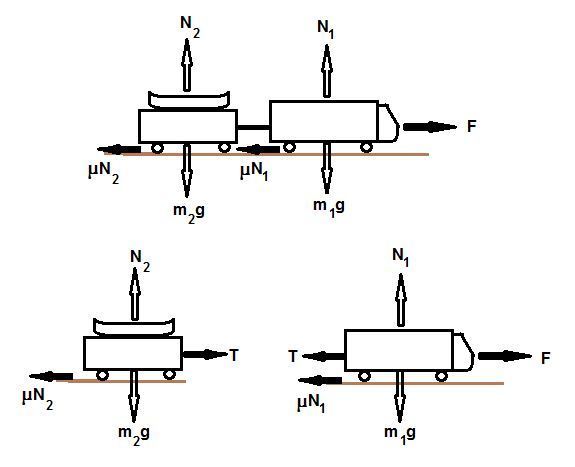
Refer to the figure shown below.

m₁ = 1100 kg, the mass of the car
m₂ = 700 kg, the mass of the trailer and boat
F = 1900 N, the driving force acting on the car
N₁ = m₁g,  the normal reaction on the car
N₂ = m₂g, the normal force on the trailer and boat
μN₁ and μN₂ are frictional forces, where  =  kinetic coefficient of friction
T = the force in the hitch between the car and trailer.

Part (a)
Let R₁ = the total force that resists the motion of the car, boat, and trailer.
Because the acceleration is 0.550m/s², therefore
(m₁ + m₂ kg)*(0.55 m/s²) = F
(1100+700 kg)*(0.55 m/s²) = (1900 - R₁) N
990 = 1900 - R
R₁ = 910 N

Answer: The resistive force is 910 N

Part (b)
80% of the resistive forces are experienced by the boat and trailer.
Let the resistive force be R₂.
Then
R₂ = 0.8*R₁ = 728 N
If the tension in the hitch between the car and the trailer is T, then
T - R₂ = m₂(0.55 m/s²)
(T - 728 N) = (700 kg)*(0.55 m/s²)
T - 728 = 385
T = 1113 N

Answer: The force in the hitch is 1113 N

3 0
2 years ago
Other questions:
  • a student drops an object from the top of a building which is 19.6 m high. How long does it take the object to fall to the groun
    13·2 answers
  • The strength of intermolecular forces between particles affects physical properties of substances such as boiling point, melting
    12·2 answers
  • Rock X is released from rest at the top of a cliff that is on Earth. A short time later, Rock Y is released from rest from the s
    5·1 answer
  • Near the surface of the moon, the distance that an object falls is a function of time. It is given by d(t) = 2.6667t2, where t i
    14·1 answer
  • Daria was swimming in a friend’s pool yesterday, when she saw that a fly had landed in the water about 5 feet away from her. She
    12·1 answer
  • For which of the following problems would a scientist most likely use carbon-14?
    7·1 answer
  • At time t=0 a proton is a distance of 0.360 m from a very large insulating sheet of charge and is moving parallel to the sheet w
    7·1 answer
  • a) Suppose that the current in the solenoid is I(t). Within the solenoid, but far from its ends, what is the magnetic field B(t)
    12·1 answer
  • A hockey puck with a mass of 0.16 kg travels at a velocity of 40 m/s toward a goalkeeper. The goalkeeper has a mass of 120 kg an
    9·1 answer
  • . A horizontal steel spring has a spring constant of 40.0 N/m. What force must be applied to the spring in order to compress it
    13·1 answer
Add answer
Login
Not registered? Fast signup
Signup
Login Signup
Ask question!