1) 
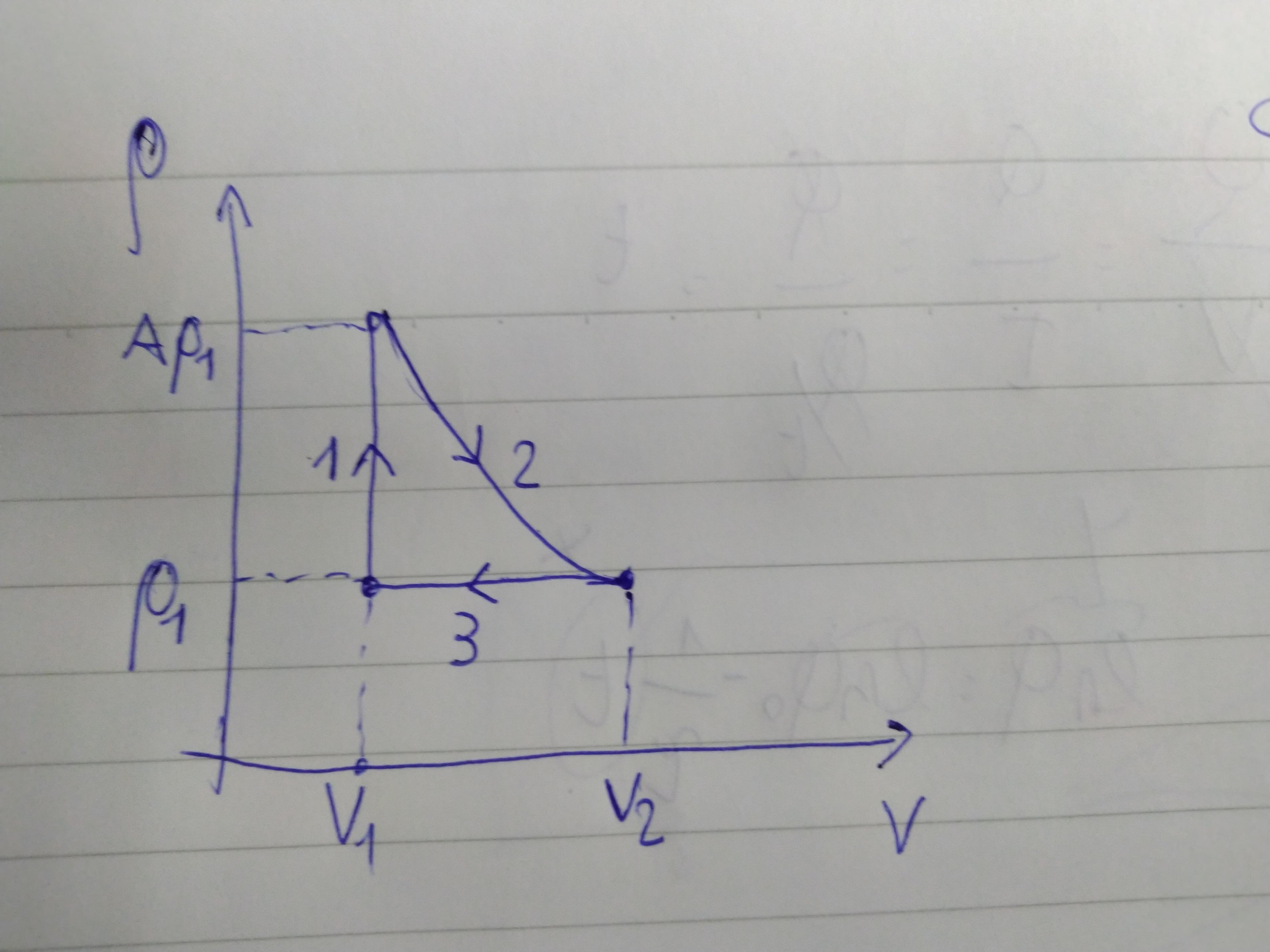
The heat absorbed by the gas can be found by using the 1st law of thermodynamics:

where
 is the change in internal energy
Q is the heat absorbed
W is the work done
Since the first process occurs at constant volume, the work done is zero:

So the equation becomes

The change in internal energy is given by
 (1)
(1)
where
n is the number of moles of the gas, which can be found by using the ideal gas law with the initial conditions of the gas:
 (2)
(2)
where R is the gas constant,
 is the specific heat at constant volume
 is the change in temperature. The temperature T2 can calculate again by using the ideal gas law at the new conditions of the gas, after its pressure has reached Ap1:
 (3)
(3)
Combining (1), (2) and (3), we find:

2) 
The work done during an isothermal process is given by:
 (4)
(4)
where in this case we have:
(number of moles)
 is the constant temperature of the process, found in the previous part
 is the final volume, which can be found again by using the ideal gas law:

 is the initial volume
Substituting all the quantities into (4), we find:

3) 
Step 3 is an isobatic process (constant pressure), so the work done can be simply calculated as

where:
 is the constant pressure of the process
 is the final volume
 is the initial volume
Substituting into the equation, and keeping in mind that

We find: