answer.
Ask question
Login Signup
Ask question
All categories
  • English
  • Mathematics
  • Social Studies
  • Business
  • History
  • Health
  • Geography
  • Biology
  • Physics
  • Chemistry
  • Computers and Technology
  • Arts
  • World Languages
  • Spanish
  • French
  • German
  • Advanced Placement (AP)
  • SAT
  • Medicine
  • Law
  • Engineering
Archy [21]
2 years ago
8

Which of the following statements describe chemical properties?

Chemistry
1 answer:
Y_Kistochka [10]2 years ago
4 0

Answer:

  • <em><u>A. Oxygen gas supports combustion.</u></em>
  • <em><u>B. Hydrofluoric acid reacts with glass.</u></em>
  • <em><u>C. Fertilizers help to increase agricultural production. </u></em>

Explanation:

<em>Chemical properties</em> can only be observed when a chemical change, i.e. a change in the chemical composition, occurs.

On the other hand,  physical properties are observed or measured without altering the composition of the substances.

Typical examples of chemical properties are reactivity, flammability, combustion, oxidation states, acidity, among others that require to carry out a chemical reaction to be observed.

Typical examples of physical properties are freezing point, melting point, boiling point, density, solubility, corrosiveness, among others.

Thus, as for the choices you have:

<em><u>A. Oxygen gas supports combustion:</u></em> the only way to observe this property is by carrying out a combustion reaction, so this describes a chemical property.

<u><em>B. Hydrofluoric acid reacts with glass:</em></u> again, only by letting hydrofluoric acid react with glass this can be observed, so this is another example of a chemical property.

<u><em>C. Fertilizers help to increase agricultural production:</em></u> fertilizers are absorbed by the plants and converted by biochemical reactions, so this also describes a chemical property.

<em><u>D. Water boils below 100°C on top of a mountain:</u></em> boiling is a change of state, the water is H₂O and continues having the same composition after boiling, so this describes a physical property.

<em><u>E. Lead is denser than aluminum: </u></em>density is measured by physical media, measuring mass and volume; so this is a physical property.

You might be interested in
During a titration the following data were collected. A 10. mL portion of an unknown monoprotic acid solution was titrated with
Liula [17]

Answer:

8.0 moles

Explanation:

Since the acid is monoprotic, 1 mole of the acid will be required to stochiometrically react with 1 mole of NaOH.

Using the formula: \frac{concentration of acid X volume of acid}{concentration of base X volume of base} = \frac{mole of acid}{mole of base}

Concentration of acid = ?

Volume of acid = 10 mL

Concentration of base = 1.0 M

Volume of base = 40 mL

mole of acid = 1

mole of base = 1

Substitute into the equation:

\frac{concentration of acid X 10}{1.0 X 40} = \frac{1}{1}

Concentration of acid = 40/10 = 4.0 M

To determine the number of moles of acid present in 2.0 liters of the unknown solution:

Number of moles = Molarity x volume

molarity = 4.0 M

Volume = 2.0 Liters

Hence,

Number of moles = 4.0 x 2.0 = 8 moles

8 0
2 years ago
If 25.0 g of NH₃ and 45.0g of O₂ react in the following reaction, what is the mass in grams of NO that will be formed? 4 NH₃ (g)
Allisa [31]

Answer:

The correct answer would be : 33.8 g

Explanation:

Molar mass of ammonia,

Molar Mass = 1* Molar Mass(N) + 3* Molar Mass (H)

= 1*14.01 + 3*1.008  = 17.034 g/mol

mass(NH3)= 25.0 g  (given)

number of mol of NH3,

n = mass of NH3/molar mass of NH3

=(25.0 g)/(17.034 g/mol)

= 1.468 mol

Now,

Molar mass of O2

= 32 g/mol

mass(O2)= 45.0 g

similar as ammonia

n (O2)=(45.0 g)/(32 g/mol)

= 1.406 mol

Balanced chemical equation is:

4 NH3 + 5 O2 ---> 4 NO + 6 H2O

1.83456 mol of O2 is required  for 1.46765 mol of NH3

by the calculation we have only 1.40625 mol of O2

Thus, the limiting agent will be - O2

now the Molar mass of NO,

= 1*14.01 + 1*16.0

= 30.01 g/mol  (similar formula used for NH3)

Balanced equation :

mol of NO formed = (4/5)* moles of O2

= (4/5)×1.40625  (from above calculation)

= 1.125 mol

mass of NO = number of moles × molar mass

= 1.125*30.01

= 33.8 g

Thus, the correct answer would be : 33.8 g

5 0
2 years ago
Which of the following statements describe chemical properties?
Y_Kistochka [10]

Answer:

  • <em><u>A. Oxygen gas supports combustion.</u></em>
  • <em><u>B. Hydrofluoric acid reacts with glass.</u></em>
  • <em><u>C. Fertilizers help to increase agricultural production. </u></em>

Explanation:

<em>Chemical properties</em> can only be observed when a chemical change, i.e. a change in the chemical composition, occurs.

On the other hand,  physical properties are observed or measured without altering the composition of the substances.

Typical examples of chemical properties are reactivity, flammability, combustion, oxidation states, acidity, among others that require to carry out a chemical reaction to be observed.

Typical examples of physical properties are freezing point, melting point, boiling point, density, solubility, corrosiveness, among others.

Thus, as for the choices you have:

<em><u>A. Oxygen gas supports combustion:</u></em> the only way to observe this property is by carrying out a combustion reaction, so this describes a chemical property.

<u><em>B. Hydrofluoric acid reacts with glass:</em></u> again, only by letting hydrofluoric acid react with glass this can be observed, so this is another example of a chemical property.

<u><em>C. Fertilizers help to increase agricultural production:</em></u> fertilizers are absorbed by the plants and converted by biochemical reactions, so this also describes a chemical property.

<em><u>D. Water boils below 100°C on top of a mountain:</u></em> boiling is a change of state, the water is H₂O and continues having the same composition after boiling, so this describes a physical property.

<em><u>E. Lead is denser than aluminum: </u></em>density is measured by physical media, measuring mass and volume; so this is a physical property.

4 0
2 years ago
A chemical reaction is done in the setup shown , resulting in a change of mass. What will happen if the same reaction is done in
irina1246 [14]
<h2>Answer:</h2>

The mass of the system will remain the same if there is no conversion of mass to energy in the reaction.

<h3>Explanation:</h3>
  • If the system is closed, then according to the law of mass conservation the mass of the reaction system will remain the same.
  • <u><em>Law of conservation of the mass: In simple words, it is described as the mass of a closed system can never be changed, it may transfer from one form to another or change into energy.</em></u>
  • But if the reaction involves energy transfer like heat or light production, in this case, the mass can be changed.
5 0
2 years ago
Read 2 more answers
A mysterious white powder could be powdered sugar (C12H22O11), cocaine (C17H21NO4), codeine (C18H21NO3), norfenefrine (C8H11NO2)
rodikova [14]

Norfenefrine (C₈H₁₁NO₂).

<h3>Further explanation</h3>

We will solve a case related to one of the colligative properties, namely freezing point depression.

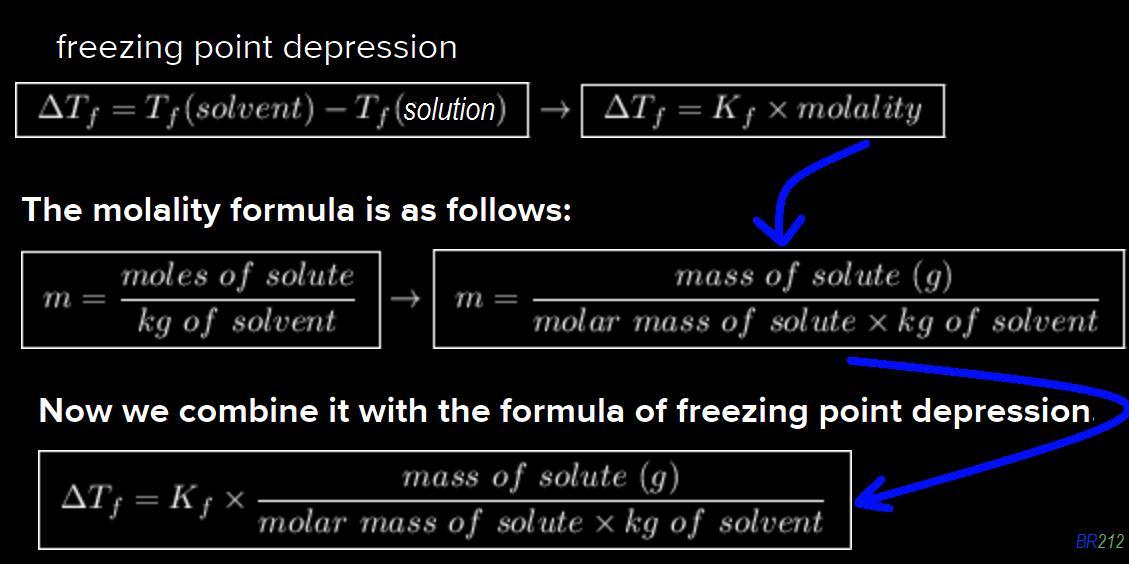
The freezing point of the solution is the temperature at which the solution begins to freeze. The difference between the freezing point of the solvent and the freezing point of the solution is called freezing point depression.

\boxed{ \ \Delta T_f = T_f(solvent) - T_f(solution) \ } \rightarrow \boxed{ \ \Delta T_f = K_f \times molality \ }

<u>Given:</u>

A mysterious white powder could be,

  • powdered sugar (C₁₂H₂₂O₁₁) with a molar mass of 342.30 g/moles,
  • cocaine (C₁₇H₂₁NO₄) with a molar mass of 303.35 g/moles,
  • codeine (C₁₈H₂₁NO₃) with a molar mass of 299.36 g/moles,
  • norfenefrine (C₈H₁₁NO₂) with a molar mass of 153.18 g/moles, or
  • fructose (C₆H₁₂O₆) with a molar mass of 180.16 g/moles.

When 82 mg of the powder is dissolved in 1.50 mL of ethanol (density = 0.789 g/cm³, normal freezing point −114.6°C, Kf = 1.99°C/m), the freezing point is lowered to −115.5°C.

<u>Question: </u>What is the identity of the white powder?

<u>The Process:</u>

Let us identify the solute, the solvent, initial, and final temperatures.

  • The solute = the powder
  • The solvent = ethanol
  • The freezing point of the solvent = −114.6°C
  • The freezing point of the solution = −115.5°C

Prepare masses of solutes and solvents.

  • Mass of solute = 82 mg = 0.082 g
  • Mass of solvent = density x volume, i.e., \boxed{ \ 0.789 \ \frac{g}{cm^3} \times 1.50 \ cm^3 = 1.1835 \ g = 0.00118 \ kg  \ }

We must prepare the solvent mass unit in kg because the unit of molality is the mole of the solute divided by the mass of the solvent in kg.

The molality formula is as follows:

\boxed{ \ m = \frac{moles \ of \ solute}{kg \ of \ solvent} \ } \rightarrow \boxed{ \ m = \frac{mass \ of \ solute \ (g)}{molar \ mass \ of \ solute \times kg \ of \ solvent} \ }

Now we combine it with the formula of freezing point depression.

\boxed{ \ \Delta T_f =  K_f \times \frac{mass \ of \ solute \ (g)}{molar \ mass \ of \ solute \times kg \ of \ solvent} \ }

It is clear that we will determine the molar mass of the solute (denoted by Mr).

We enter all data into the formula.

\boxed{ \ -114.6^0C - (-115.5^0C) = 1.99 \frac{^0C}{m} \times \frac{0.082 \ g}{Mr \times 0.00118 \ kg} \ }

\boxed{ \ 0.9 = \frac{1.99 \times 0.082}{Mr \times 0.00118} \ }

\boxed{ \ Mr = \frac{0.16318}{0.9 \times 0.00118} \ }

We get \boxed{ \ Mr = 153.65 \ }

These results are very close to the molar mass of norfenefrine which is 153.18 g/mol. Thus the white powder is norfenefrine.

<h3>Learn more</h3>
  1. The molality and mole fraction of water brainly.com/question/10861444
  2. About the mass and density of ethylene glycol as an  antifreeze brainly.com/question/4053884
  3. About the solution as a homogeneous mixture  brainly.com/question/637791

Keywords: a mysterious white powder, sugar, cocaine, codeine, norfenefrine, fructose, the solute, the solvent, dissolved, ethanol, normal freezing point, the freezing point depression, the identity


7 0
2 years ago
Read 2 more answers
Other questions:
  • What is the oxidation state of each element in FeBr2
    14·2 answers
  • The electron dot structure for CI is
    7·2 answers
  • Silver (ag) has a molar mass of 107.8682 g, nitrogen has a molar mass of 14.0067 g, and oxygen has a molar mass of 15.9994 g. wh
    13·2 answers
  • An ordered list of chemical substances is shown.
    5·1 answer
  • Select the reagent(s) that would efficiently convert the starting material to the product for the following transformations (if
    11·1 answer
  • How many iodide ions are present in 65.5ml of .210 m AlI3 solution
    7·1 answer
  • According to the following reaction, how many moles of Fe(OH)2 can form from 175.0 mL of 0.227 M LiOH solution? Assume that ther
    10·1 answer
  • Hydrazine (N2H4) and dinitrogen tetroxide (N2O4) form a self-igniting mixture that has been used as a rocket propellant. The rea
    7·1 answer
  • Write two chemical formulae showing the steps involved when a metal combined with a radical
    9·1 answer
  • Hitesh wants to learn swimming. He brought swimming costumes and a cap. What kind of material should these be made of and why?
    11·1 answer
Add answer
Login
Not registered? Fast signup
Signup
Login Signup
Ask question!