answer.
Ask question
Login Signup
Ask question
All categories
  • English
  • Mathematics
  • Social Studies
  • Business
  • History
  • Health
  • Geography
  • Biology
  • Physics
  • Chemistry
  • Computers and Technology
  • Arts
  • World Languages
  • Spanish
  • French
  • German
  • Advanced Placement (AP)
  • SAT
  • Medicine
  • Law
  • Engineering
Nezavi [6.7K]
2 years ago
14

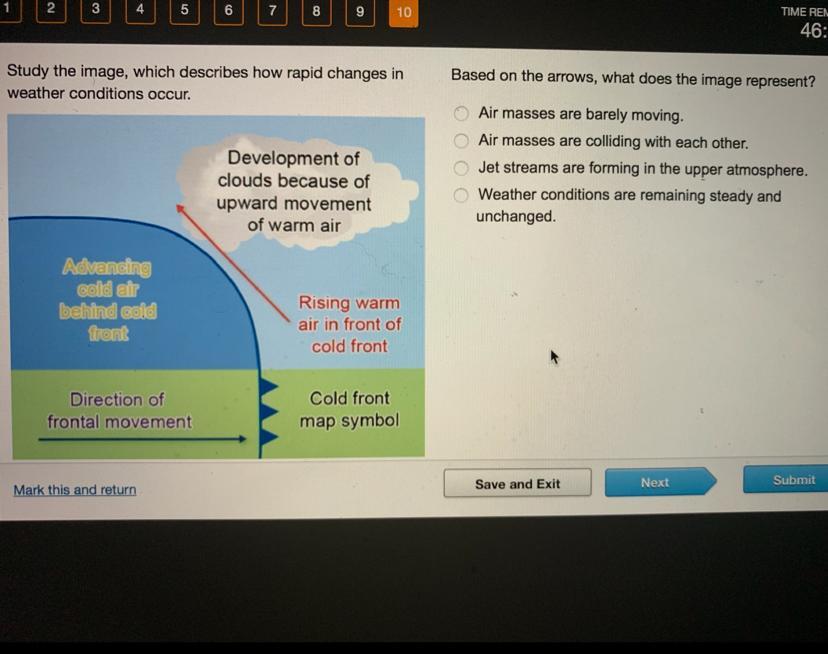
Study the image, which describes how rapid changes in weather conditions occur.

Physics
2 answers:
ladessa [460]2 years ago
8 0
2 is the answer I hope it right
svlad2 [7]2 years ago
3 0

Answer:

2- Air masses are colliding with each other.

Explanation:

  • From the image given below its clear that the warm is rising upwards and as a result of the collision from the cold winds or front from below, hence the development of clouds that make the thunderstorms appear.
  • And a result of this turbulent the rising air is pushed and the warm front cycle takes a turn and will lead to either development of cyclone or rainfall.
You might be interested in
A 4.0-mF capacitor initially charged to 50 V and a 6.0-mF capacitor charged to 30 V are connected to each other with the positiv
Juli2301 [7.4K]

Answer:

<em>The final charge on the 6.0 mF capacitor would be 12 mC</em>

Explanation:

The initial charge on 4 mF capacitor  = 4 mf  x 50 V = 200 mC

The initial Charge on 6 mF capacitor  = 6 mf x 30 V =180 mC

Since the negative ends are joined together  the total charge on both capacity would be;

q = q_{1} -q_{2}

q = 200 - 180

q = 20 mC

In order to find the final charge on the 6.0 mF capacitor we have to find the combined voltage

q = (4 x V) + (6 x V)

20 = 10 V

V = 2 V

For the final charge on 6.0 mF;

q = CV

q = 6.0 mF x 2 V

q =  12 mC

Therefore the final charge on the 6.0 mF capacitor would be 12 mC

5 0
2 years ago
Read 2 more answers
The magnitude J(r) of the current density in a certain cylindrical wire is given as a function of radial distance from the cente
kipiarov [429]

Answer:

I=68.31\times 10^{-6}\ A

Explanation:

Given that

J(r) = Br

We know that area of small element

dA = 2 π dr

I = J A

dI = J dA

Now by putting the values

dI = B r . 2 π dr

dI= 2π Br² dr

Now by integrating above equation

\int_{0}^{I}dI= \int_{r_1}^{r_2}2\pi Br^2 dr

I={2\pi B}\times \dfrac{r_2^3-r_1^3}{3}

Given that

B= 2.35 x 10⁵ A/m³

r₁ = 2 mm

r₂ = 2+ 0.0115 mm

r₂ = 2.0115 mm

I={2\pi B}\times \dfrac{r_2^3-r_1^3}{3}

By putting the values

I={2\pi \times 2.35 \times 10^5 }\times \dfrac{(2.0115\times 10^{-3})^3-(2\times 10^{-3})^3}{3}\ A

I=68.31\times 10^{-6}\ A

7 0
2 years ago
Read 2 more answers
Two 8.0 Ω lightbulbs are connected in a 12 V series circuit. What is the power of both glowing bulbs?
V125BC [204]

Answer:

18 W

Explanation:

Applying,

P = V²/R.................. Equation 1

Where P = Power of both glowing bulbs, V = Voltage, R = Combined Resistance of both bulbs

Since: It is a series circuit,

Then,

R = R1+R2............. Equation 2

Where R1= Resistance of the first bulb, R2 = Resistance of the second bulb

Given: R1 = R2 = 8 Ω

Substitute into equation 1

R = 8+8

R = 16 Ω

Also Given: V = 12 V

Substitute into equation 1

P = 12²/8

P = 144/8

P = 18 W

7 0
2 years ago
3. What conclusion can you make about the electric field strength between two parallel plates? Explain your answer referencing P
KIM [24]

Answer:

From the relation above we can conclude that the  as the distance between the two plate increases the electric field strength decreases

Explanation:

I cannot  find any attached photo, but we can proceed anyways theoretically.

The electric field strength (E) at any point in an electric field is the force experienced by a unit positive charge (Q) at that point

i.e

E=\frac{F}{Q}

But the force F

F= \frac{kQ1Q2}{r^2}

But the electric field intensity due to a point charge Q at a distance r meters away is given by

E= \frac{\frac{kQ1Q2}{r^2}}{Q} \\\\\E= \frac{Q1}{4\pi er^2 }

<em>From the relation above we can conclude that the  as the distance between the two plate increases the electric field strength decreases</em>

6 0
2 years ago
A crate slides down a ramp that makes a 20∘ angle with the ground. To keep the crate moving at a steady speed, Paige pushes back
VMariaS [17]

Answer:

Hence, work done= 287.54 J

Explanation:

Given data:

angle of ramp with the ground θ =20°

force applied = 76 N

work done on the crate to slide down 4 m down the ramp

W= F×d cosθ ( only the cos component of the force will slide the crate down)

W= 76×4×cos20= 287.54 J
4 0
2 years ago
Other questions:
  • Step 1, when solving a two dimensional, multi-charge problem, is to define the vectors. Please identify the next five steps, in
    12·2 answers
  • The three forces acting on a hot-air balloon that is moving vertically are its weight, the force due to air resistance and the u
    5·1 answer
  • a steel block has a mass of 40g.it is in the form of a cube. each edge is 1.74cm long. calculate the density
    13·1 answer
  • The first law of thermodynamics states that ___. when a process converts energy from one form to another, some energy converted
    8·2 answers
  • A straight, nonconducting plastic wire 9.50 cm long carries a charge density of 130 nC/m distributed uniformly along its length.
    5·1 answer
  • Two identical metal spheres A and B are in contact. Both are initially neutral. 1.0× 10 12 electrons are added to sphere A, then
    15·1 answer
  • What would the speed of each particle be if it had the same wavelength as a photon of yellow light (????=575.0 nm)? Proton (mass
    7·2 answers
  • You slide a coin across the floor, and observe that it slows down and eventually stops. A sensitive thermometer shows that its t
    12·1 answer
  • 17. The edges of a rectangular solid have these measures: 1.5 feet by 1½ feet by 3 inches. What is its volume in cubic inches? a
    11·1 answer
  • Consider a large truck and a small car driving up a straight, steep hill. The truck is moving at 60 miles per hour and the car a
    9·1 answer
Add answer
Login
Not registered? Fast signup
Signup
Login Signup
Ask question!
