answer.
Ask question
Login Signup
Ask question
All categories
  • English
  • Mathematics
  • Social Studies
  • Business
  • History
  • Health
  • Geography
  • Biology
  • Physics
  • Chemistry
  • Computers and Technology
  • Arts
  • World Languages
  • Spanish
  • French
  • German
  • Advanced Placement (AP)
  • SAT
  • Medicine
  • Law
  • Engineering
Ilia_Sergeevich [38]
2 years ago
4

The fastest pitched baseball was clocked at 47 m/s. Assume that the pitcher exerted his force (assumed to be horizontal and cons

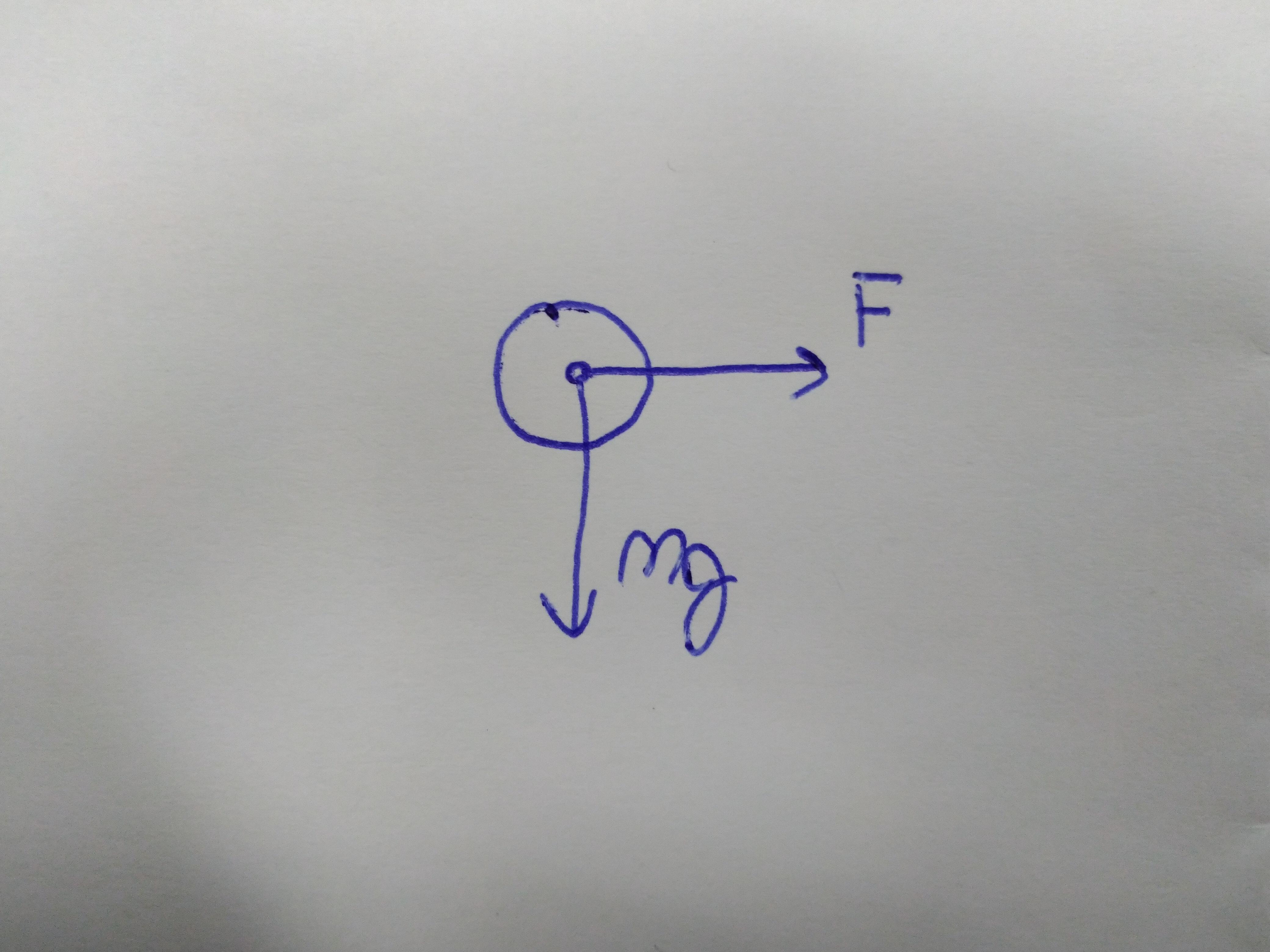
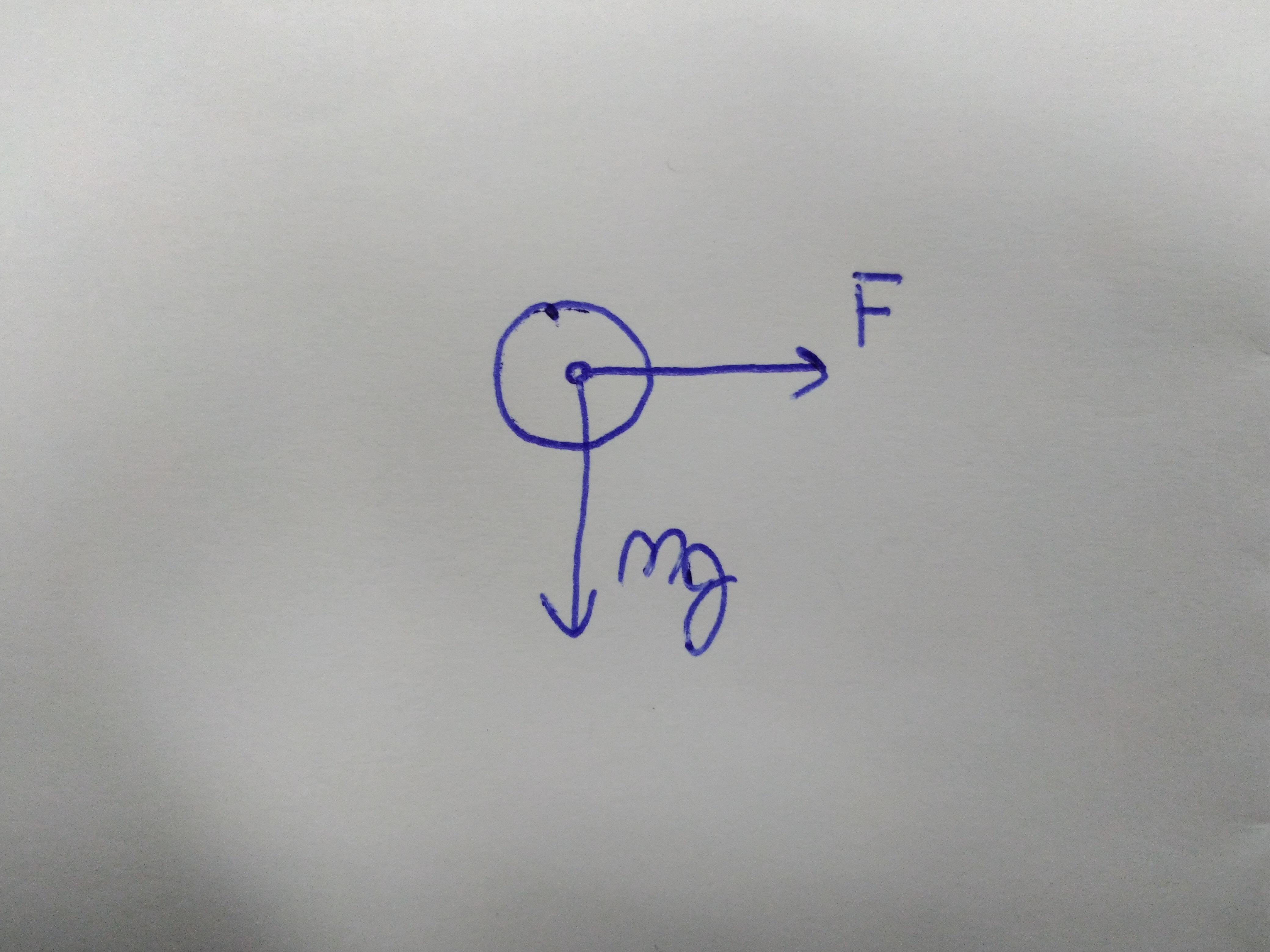
tant) over a distance of 1.0 m, and a baseball has a mass of 145 g. A) Draw a free-body diagram of the ball during the pitch. The ball is moving to the right.
B) What force did the pitcher exert on the ball during this record-setting pitch?
C) Estimate the force in Part B as a fraction of the pitcher’s weight. Assume that the pitcher has a mass of 84 kg.

Physics
1 answer:
Mars2501 [29]2 years ago
5 0

A) In attachment

Find the free-body diagram in attachment. There are only two forces acting on the ball during the pitch:

- The force applied by the pitcher, F, which acts in the horizontal direction

- The force of gravity acting on the ball, also called weight, whose magnitude is

W=mg

where m is the mass and g is the acceleration of gravity, and it acts in the downward direction.

B) 160.2 N

First of all, we need to find the acceleration of the ball. We can do it by using the SUVAT equation

v^2-u^2=2ad

where

v = 47 m/s is the final velocity of the ball

u = 0 is the initial velocity (the ball starts from rest)

a is the acceleration

d = 1.0 m is the distance covered by the ball while the force is applied

Solving for a,

a=\frac{v^2-u^2}{2d}=\frac{47^2-0}{2(1.0)}=1104.5 m/s^2

And since we know the mass of the ball,

m = 145 g = 0.145 kg

We can find the force exerted on it by using Newton's second law:

F=ma=(0.145)(1104.5)=160.2 N

C) 0.195 times the pitcher's weight

The weight of the pitcher is given by

W = mg

where

m = 84 kg is the mass of the pitcher

g = 9.8 m/s^2 is the acceleration of gravity

Solving,

W=(84)(9.8)=823.2 N

So now we can express the force found in part B) as a fraction of the pitcher's weight:

\frac{F}{W}=\frac{160.2}{823.3}=0.195

You might be interested in
Image that the radiation emitted by the nitrogen at a frequency of 8.88×10¹⁴ Hz is absorbed by an electron in a molecule of meth
kiruha [24]

Answer:

5.07\cdot 10^{-7} m (507 nm)

Explanation:

First of all let's calculate the energy of the photon absorbed by the electron, This is given by

E=hf

where

h is the Planck constant

f=8.88\cdot 10^{14} Hz is the frequency of the photon

Substituting,

E=(6.63\cdot 10^{-34}Js)(8.88\cdot 10^{14}Hz)=5.89\cdot 10^{-19} J

The energy of the second photon, the one emitted when the electron drops to the intermediate energy level, is 2/3 of this energy:

E'=\frac{2}{3}E=\frac{2}{3}(5.89\cdot 10^{-19} J)=3.92\cdot 10^{-19} J

The relationship between the energy of the photon and its wavelength \lambda is

E=\frac{hc}{\lambda}

where c is the speed of light. Solving for \lambda, we find the wavelength:

\lambda=\frac{hc}{E}=\frac{(6.63\cdot 10^{-34} Js)(3\cdot 10^8 m/s)}{3.92\cdot 10^{-19} J}=5.07\cdot 10^{-7} m

3 0
2 years ago
Read 2 more answers
What mass needs to be attached to a spring with a force constant of 7N/m in order to make a simple harmonic oscillator oscillate
Alex_Xolod [135]

Answer:

Mass will be 4.437 kg

Explanation:

We have given force constant k = 7 N/m

Time period of oscillation T = 5 sec

So angular frequency \omega =\frac{2\pi }{T}=\frac{2\times 3.14}{5}=1.256rad/sec

We know that angular frequency is given by

\omega =\sqrt{\frac{k}{m}}

1.256 =\sqrt{\frac{7}{m}}

Squaring both side

1.577 =\frac{7}{m}

m = 4.437 kg

6 0
2 years ago
A race car driver must average 200km/hr for four laps to qualify for a race. Because of engine trouble, the car averages only 17
vampirchik [111]
The average speed would have to be 260 km/hr due to the driver originally going 30 km/hr too slow the first two laps
5 0
2 years ago
Two speakers face each other, and they each emit a sound of wavelength λ. One speaker is 180∘ out of phase with respect to the o
mel-nik [20]

Answer:

a. 3/4λ

d. 1/4λ

Explanation:

When the wavelength of the sound waves is λ and the two waves are having same frequency the waves are said to be out of phase if their phase difference is in the multiples of \frac{\lambda}{2} or 180°.

When the two waves are out of phase then their opposite maxima coincide at the same time resulting in the minimum amplitude of the resulting wave throughout.

  • As we observe from the schematic that the a wave has sinusoidal pattern of variation and we get a maxima after each \frac{\lambda}{4} of the distance.
  • Here we have two speakers out of phase therefore on shifting one of the speakers by the odd multiples of \frac{\lambda}{2} we have the maxima or the extreme amplitudes.

So, we must place the microphone at  3/4λ and 1/4λ to pickup the loudest sound.

4 0
2 years ago
The headlights are shining on a truck travelling at 100 km/h. The speed of the light from the headlights relative to the road wi
jek_recluse [69]
A, the light generated from the headlights travels at a fixed speed relative to the road
3 0
2 years ago
Read 2 more answers
Other questions:
  • a driver shifts into neutral when her 1200 kg is moving at 80 km/h and finds the speed has dropped to 65 km/h 10 s later . what
    9·1 answer
  • Which elements do hydrogen fuel cells combine to produce electricity? hydrogen and oxygen hydrogen and carbon hydrogen, oxygen,
    6·2 answers
  • A metal ball with diameter of a half a centimeter and hanging from an insulating thread is charged up with 1010 excess electrons
    10·1 answer
  • A stone tumbles into a mine shaft strikes bottom after falling for 4.2 seconds. How deep is the mine shaft
    5·1 answer
  • A 0.12 kg bird is flying at a constant speed of 7.8 m/s. what is the birds conetic energy?
    13·2 answers
  • Particles in a __________ wave move in an elliptical or circular motion. question 4 options: sound longitudinal transverse surfa
    11·2 answers
  • The frequency of a wave increases. If the speed of the wave remains constant, what happens to the distance between successive cr
    6·1 answer
  • A 50-kg platform diver hits the water below with a kinetic energy of 5000 Joules. The height (relative to the water) from which
    15·1 answer
  • Express the volume expansivity and the isothermal compressibility as functions of density rho and its partial derivatives. For w
    6·1 answer
  • Devise and draw a circuit using a long, straight wire resistor, instead of a decade box, that would allow the study of the varia
    10·1 answer
Add answer
Login
Not registered? Fast signup
Signup
Login Signup
Ask question!