answer.
Ask question
Login Signup
Ask question
All categories
  • English
  • Mathematics
  • Social Studies
  • Business
  • History
  • Health
  • Geography
  • Biology
  • Physics
  • Chemistry
  • Computers and Technology
  • Arts
  • World Languages
  • Spanish
  • French
  • German
  • Advanced Placement (AP)
  • SAT
  • Medicine
  • Law
  • Engineering
tino4ka555 [31]
2 years ago
7

A parachutist weighs 1000N. when she opens her parachute, it pulls upwards on her with a force of 2000N. (a) draw a diagram to s

how forces acting on the parachutist. (b) calculate the resultant forces acting on the parachutist. (c) what effect will this force have on her ?​

Physics
1 answer:
Nataly_w [17]2 years ago
4 0

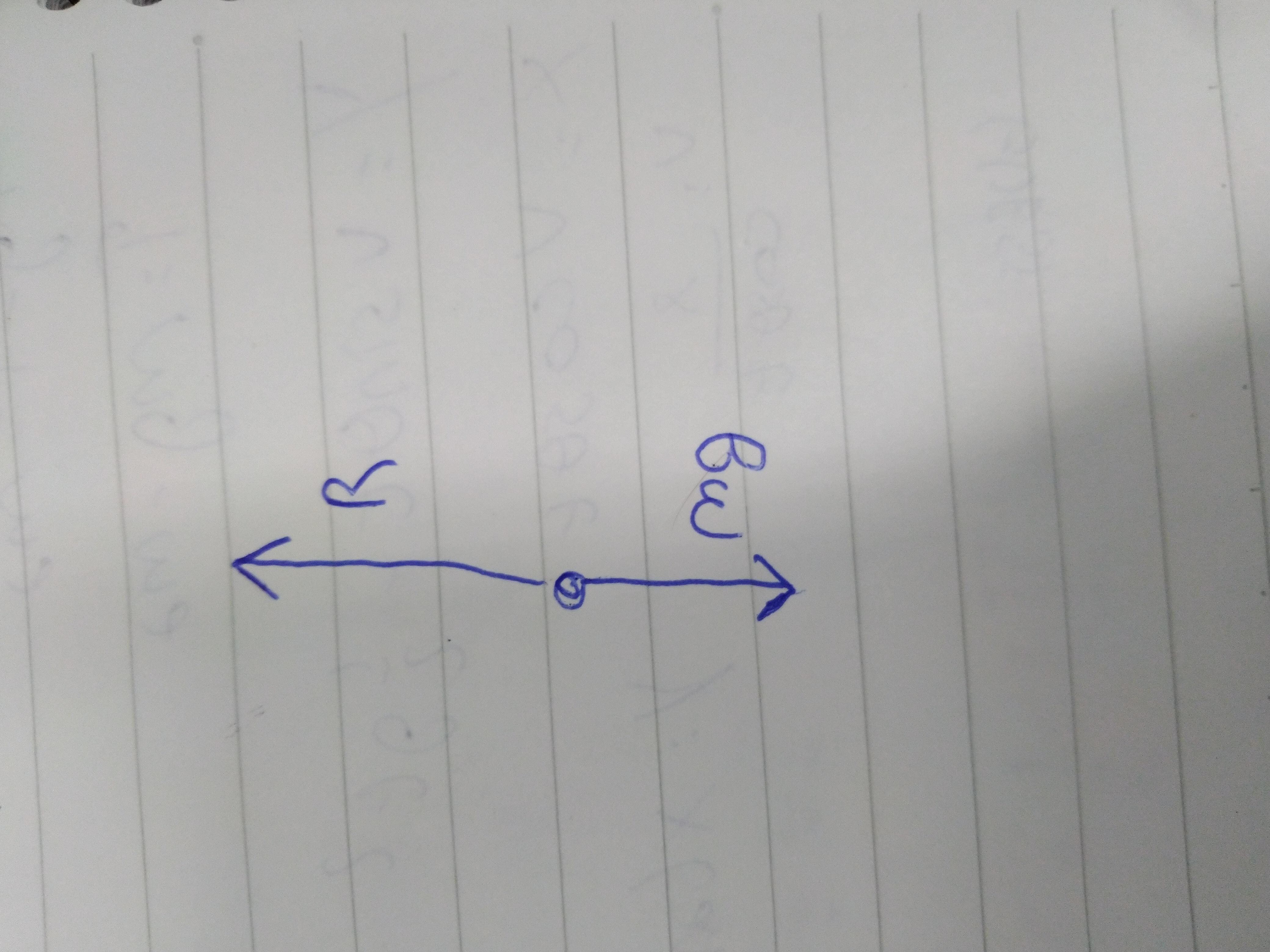
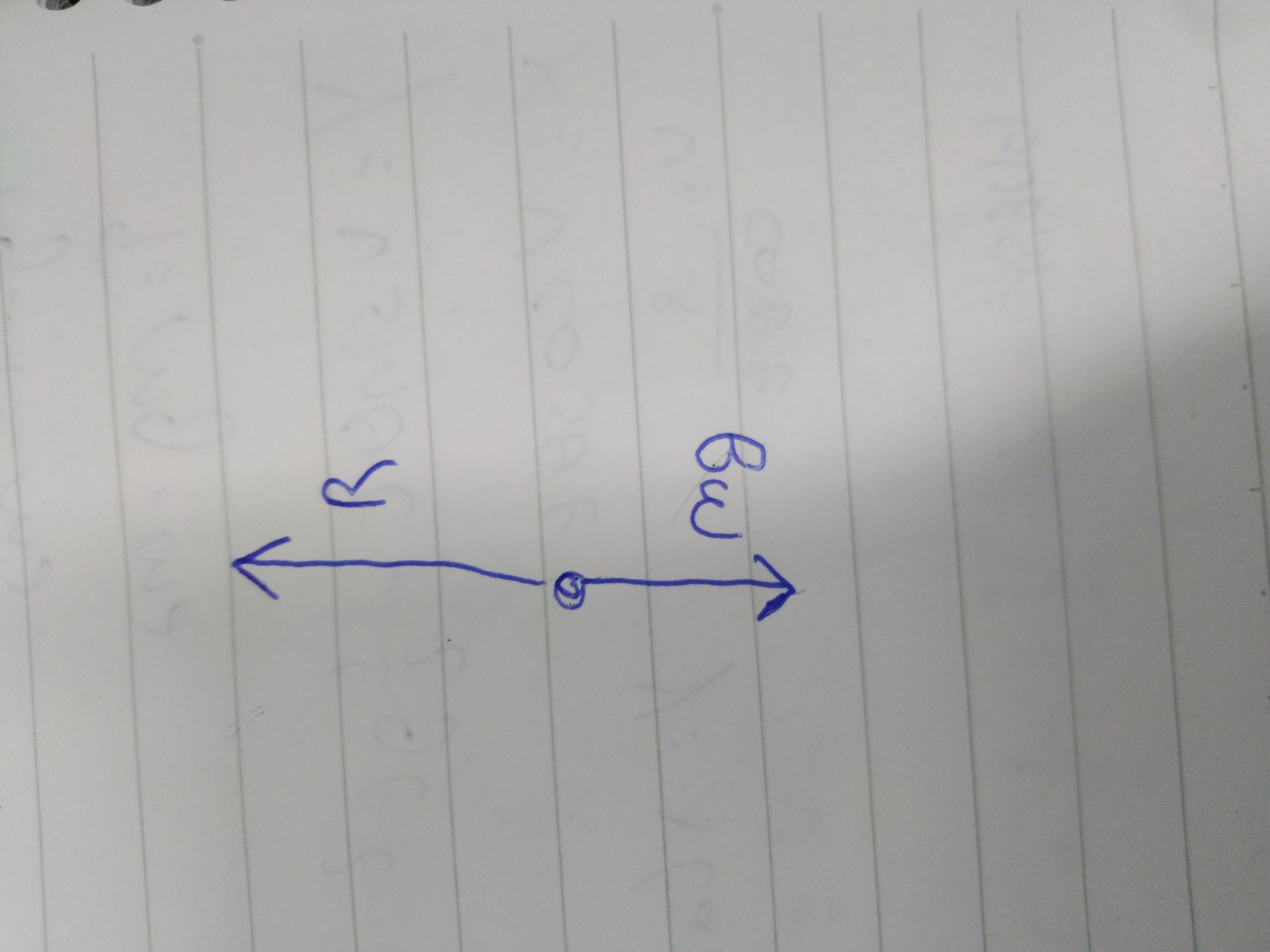
(a) Find free-body diagram in attachment (please rotate the picture, such that R points upward and mg points downward)

There are only two forces acting on the parachutist:

- Its weight, downward, of magnitude 1000 N, labelled with "mg" in the diagram (where m = mass of the parachutist, g = acceleration of gravity)

- The air resistance, upward, of magnitude 2000 N, labelled with "R" in the diagram

As the air resistance is larger than the weight, in the diagram it is represented with a longer arrow, in order to show the difference in magnitude.

(b) 1000 N, upward

By taking upward as positive direction, we can rewrite the two forces as:

R = +2000 N

mg = -1000 N

Where we have written the weight as a negative number, since its direction is downward.

Therefore, the net force on the parachutist will be

F = R + mg = +2000 + (-1000) = +1000 N

And the positive sign indicates that the resultant force is upward.

(c) The parachutist will be accelerated upward (= he/she will slow down)

We can answer this part by applying Newton's second law, which is summarized by the following:

F=ma (1)

where

F is the resultant force on the body

m is its mass

a is its acceleration

For the parachutist in this problem, the mass is

m=\frac{mg}{g}=\frac{1000 N}{9.8 N/kg}=102 kg

Therefore, using (1), we find the acceleration of the parachutist:

a=\frac{F}{m}=\frac{+1000}{102}=+9.8 m/s^2

Where the positive sign indicates that the acceleration is upward. Therefore, the parachutist will be accelerated upward, which means that he/she will slow down, since its direction of motion was downward.
You might be interested in
The Sun is the primary source of energy for ecosystems. The Sun emits . When an organism obtains nutrients by feeding on other o
Vlad1618 [11]

The scientific law of one organism feeding off to other where energy is transferred from one form to another is known as the law of conservation of energy.

Explanation-

Energy from the the highest energy source that is sun is absorbed by plants to convert it into food (i.e a form of energy). plants are the only ones that can convert sunlight into another form of energy directly.

The animals and organisms that feed off of the plants take some part of this energy for their life cycles and then the animals that feed off of these animals again take some part of this energy and carry on with their life cycle, this is how energy from sun (highest source) is transferred to different organisms by Just changing form.  

8 0
3 years ago
Read 2 more answers
What is Yusef most likely finding?
Ratling [72]

Explanation:

yusef adds all of the values in his data set and then divide by the number of values in the set. the actual density of iron is 7.874 g/ml .

4 0
2 years ago
While you are studying for an upcoming physics exam, a lightning storm is brewing outside your window. Suddenly, you see a tree
vovikov84 [41]
Blahbsnansjsjsjsisisisisiskskssk
7 0
2 years ago
How is a seismograph similar to an X-ray?
aleksklad [387]

Answer: Seismograph is an instrument that is used to measure the vibration of the earthquake. It is based on seismic waves. X ray is an electromagnetic energy wave that is used for CAT ( computerized axial tomography) scan.

Hence, both seismic wave and X ray are energy waves.

The velocity of seismic waves is different in different media. Similarly, X ray loses its amplitude depending upon the dense layer of the tissue.

5 0
2 years ago
A brick and a feather fall to the earth at their respective terminal velocities. which object experiences the greater force of a
horsena [70]
The brick, even though the brick would end up traveling faster, it most likely has a larger surface area therefore it would have more air resistance.
6 0
2 years ago
Read 2 more answers
Other questions:
  • The number that is used to show the value of one currency compared to another is called the __________. A. trade rate B. currenc
    6·1 answer
  • A 5.09 × 10¹⁴-hertz electromagnetic wave is traveling through a transparent medium. The main factor that determines the speed of
    5·1 answer
  • A 1000-kg car is slowly picking up speed as it goes around a horizontal curve whose radius is 100 m. The coefficient of static f
    13·2 answers
  • The strength of the Earth’s magnetic field B at the equator is approximately equal to 5 × 10⁻⁵ T. The force on a charge q moving
    8·1 answer
  • A typical automobile under hard braking loses speed at a rate of about 7.2 m/s2; the typical reaction time to engage the brakes
    7·1 answer
  • Part E Two forces, of magnitude 4N4N and 10N10N, are applied to an object. The relative direction of the forces is unknown. The
    5·1 answer
  • Merry-go-rounds are a common ride in park playgrounds. The ride is a horizontal disk that rotates about a vertical axis at their
    6·1 answer
  • Two identical closely spaced circular disks form a parallel-plate capacitor. Transferring 2.1×10⁹ electrons from one disk to the
    7·2 answers
  • What is the concentration of molecular oxygen (O2) in mol/L on a June day in Toronto when atmospheric pressure is 1.0 atm and th
    15·1 answer
  • You are an engineer in charge of designing a new generation of elevators for a prospective upgrade to the Empire State Building.
    5·1 answer
Add answer
Login
Not registered? Fast signup
Signup
Login Signup
Ask question!
