answer.
Ask question
Login Signup
Ask question
All categories
  • English
  • Mathematics
  • Social Studies
  • Business
  • History
  • Health
  • Geography
  • Biology
  • Physics
  • Chemistry
  • Computers and Technology
  • Arts
  • World Languages
  • Spanish
  • French
  • German
  • Advanced Placement (AP)
  • SAT
  • Medicine
  • Law
  • Engineering
morpeh [17]
2 years ago
4

Calculate the heat capacity of a gas sample from the following information: The sam- ple comes to equilibrium in a flask at 25°C

and 121.3 kPa. A stopcock is opened briefly, allowing the pressure to drop to 101.3 kPa. With the stopcock closed, the flask warms, returning to 25°C, and the pressure is measured as 104.0 kPa. Determine CP in J·mol−1·K−1 assuming the gas to be ideal and the expansion of the gas remaining in the flask to be reversible and adiabatic.
Physics
1 answer:
azamat2 years ago
5 0

Answer : The  value of c_p for reversible and adiabatic expansion is 55.04 J/mol.K

Explanation : Given,

Temperature at equilibrium = T_1=25^oC=273+25=298K

Pressure at equilibrium = P_1=121.3kPa

Temperature at adiabatic reversible expansion = T_2

Pressure at adiabatic reversible expansion = P_2=101.3kPa

Temperature at constant volume process = T_3=25^oC=273+25=298K

Pressure at constant volume process = P_3=104.0kPa

First we have to calculate the temperature at adiabatic reversible expansion.

Gay-Lussac's Law : It is defined as the pressure of the gas is directly proportional to the temperature of the gas at constant volume and number of moles.

P\propto T

or,

\frac{P_2}{T_2}=\frac{P_3}{T_3}

Now put all the given values in the above equation, we get:

\frac{101.3kPa}{T_2}=\frac{104.0kPa}{298K}

T_2=290K

Now we have to calculate the value of c_p for reversible and adiabatic.

Formula used :

T_2=T_1(\frac{P_2}{P_1})^{\frac{R}{c_p}}

Now put all the given values in the above equation, we get:

290=298\times (\frac{101.3}{121.3})^{\frac{8.314}{c_p}}

c_p=55.04J/mol.K

Therefore, the value of c_p for reversible and adiabatic expansion is 55.04 J/mol.K

You might be interested in
The resistivity of a silver wire with a radius of 5.04 × 10⁻⁴ m is 1.59 × 10⁻⁸ ω · m. if the length of the wire is 3.00 m, what
Alexxx [7]
<span>5.98 x 10^-2 ohms. Resistance is defined as: R = rl/A where R = resistance in ohms r = resistivity (given as 1.59x10^-8) l = length of wire. A = Cross sectional area of wire. So plugging into the formula, the known values, including the area of a circle being pi*r^2, gives: R = 1.59x10^-8 * 3.00 / (pi * (5.04 x 10^-4)^2) R = (4.77 x 10^-8) / (pi * 2.54016 x 10 ^-7) R = (4.77 x 10^-8) / (7.98015 x 10^-7) R = 5.98 x 10^-2 ohms So that wire has a resistance of 5.98 x 10^-2 ohms.</span>
4 0
2 years ago
Voices of swimmers at a pool travel 400 m/s through the air and 1,600 m/s underwater. The wavelength changes from 2 m in the air
frosja888 [35]

The frequency of the wave has not changed.

In fact, the frequency of a wave is given by:

f=\frac{v}{\lambda}

where v is the wave's speed and \lambda is the wavelength.

Applying the formula:

- In air, the frequency of the wave is:

f=\frac{400 m/s}{2 m}=200 Hz

- underwater, the frequency of the wave is:

f=\frac{1600 m/s}{8 m}=200 Hz

So, the frequency has not changed.

3 0
2 years ago
Read 2 more answers
Whipple is confused about the connection between the velocity and acceleration of the tennis ball. he decides to compare the vel
tamaranim1 [39]

The speed of the ball is always zero and the acceleration is always -g when it reaches the top of its motion. This is because when the ball is free, only gravity acts on it which is always downwards, hence g is the net acceleration and it is always negative. However the velocity does not direction change instantly, negative acceleration first slows down the ball with a positive velocity, until that point the ball keeps moving up, then the ball velocity becomes zero just before changing direction and becoming negative after which the ball will now go down along gravity. Hence the ball velocity is zero at the top (neither going up nor down). Mathematically this can be seen as velocity is the integration of acceleration.

7 0
2 years ago
What is the net force required to give an automobile with a mass of 1,600 kg an acceleration of 4.5 m/s2
Paladinen [302]

Answer:

Fnet=7200 N

Explanation:

Fnet=mass x acceleration

mass= 1600kg acceleration=4.5m/s^2

8 0
2 years ago
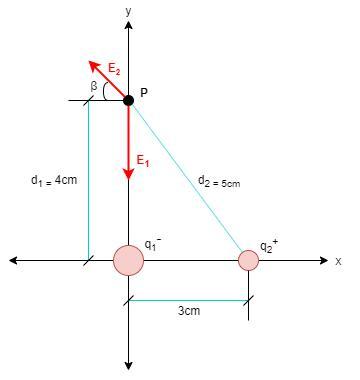
Fields of Point Charges Two point charges are fixed in the x-y plane. At the origin is q1 = -6.00 nC . and at a point on the x-a
My name is Ann [436]

Answer:

Part A) Electric fields at the point due to q₁ and q₂:

E₁ = 33.75*10³ N/C (-j) , E₂= ( 6.48 (-i) + 8.64 (+j) )*10³ N/C

Part B) Net electric field at P (Ep)

Ep=   (6.48*10³ (-i)+25.11 10³ (-j) )N/C

Explanation:

Conceptual analysis

The electric field at a point P due to a point charge is calculated as follows:

E = k*q/d²

E: Electric field in N/C

q: charge in Newtons (N)

k: electric constant in N*m²/C²

d: distance from charge q to point P in meters (m)

Equivalence

1nC= 10⁻⁹C

1cm= 10⁻²m

Data

k= 9*10⁹ N*m²/C²

q₁ = -6.00 nC = -6 *10⁻⁹C

q₂ = +3.00 nC = +3*10⁻⁹C

d₁ = 4cm = 4 *10⁻²m

d_{2} =\sqrt{(4*10^{-2})^{2}+((3*10^{-2})^{2} }

d₂ = 5 *10⁻²m

Part A) Calculation of the electric fields at the point due to q₁ and q₂

Look at the attached graphic:

E₁: Electric Field at point  P(0,4) cm due to charge q₁. As the charge q₁ is negative (q₁-), the field enters the charge

E₂: Electric Field at point  P(0,4) cm  due to charge q₂. As the charge q₂ is positive (q₂+) ,the field leaves the charge

E₁ = k*q₁/d₁² = 9*10⁹ *6 *10⁻⁹/ (4 *10⁻²)² = 33.75*10³ N/C

E₂ = k*q₂/d₂²= 9*10⁹ *3*10⁻⁹/(5 *10⁻²)² =  10.8*10³ N/C

E₁ = 33.75*10³ N/C (-j)

E₂x=E₂cosβ = 10.8*(3/5) = 6.48*10³ N/C

E₂y=E₂sinβ = 10.8*(4/5) =  8.64*10³ N/C

E₂= ( 6.48 (-i) + 8.64 (+j) )*10³ N/C

Part B) Calculation of the net electric field at P (Ep)

The electric field at a point P due to several point charges is the vector sum of the electric field due to individual charges.

Ep=Epx (i) + Epy (j)

Epx= E₂x= 6.48*10³ N/C (-i)

Epy= E₁y+E₂y= (33.75*10³ (-j) + 8.64*10³ (+j) ) N/C=25.11 10³ (-j) N/C

Ep=   (6.48*10³ (-i)+25.11 10³ (-j) )N/C

Ep=   (6.48*10³ (-i)+25.11 10³ (-j) )N/C

3 0
2 years ago
Other questions:
  • What is the standard metric unit of power
    11·1 answer
  • The square loop shown in the figure moves into a 0.80T magnetic field at a constant speed of 10m/s. The loop has a resistance of
    15·2 answers
  • The speed of a bus increases uniformly from 15 ms per second to 60 ms per second in 20 seconds. calculate 1. the average speed 2
    10·2 answers
  • A standard 1 kilogram weight is a cylinder 51.0 mm in height and 42.0 mm in diameter. Determine the density of the material
    6·1 answer
  • Urban cities like Atlanta have to contend with a serious problem like pollution. Drivers in California are testing out a car tha
    7·1 answer
  • An experiment is conducted in which red light is diffracted through a single slit. Listed below are alterations made, one at a t
    6·1 answer
  • What mass needs to be attached to a spring with a force constant of 7N/m in order to make a simple harmonic oscillator oscillate
    9·1 answer
  • Tech A says that tires are marked with a date code listing the date the tires should be discarded. Tech B says that any tires wi
    11·1 answer
  • A boy and a girl are resting on separate rafts 14 m apart in calm water when the girl notices a small beach toy floating midway
    10·1 answer
  • A student sorted mineral samples into two groups: dull and shiny. Which of the following properties did the student use to sort
    6·2 answers
Add answer
Login
Not registered? Fast signup
Signup
Login Signup
Ask question!