answer.
Ask question
Login Signup
Ask question
All categories
  • English
  • Mathematics
  • Social Studies
  • Business
  • History
  • Health
  • Geography
  • Biology
  • Physics
  • Chemistry
  • Computers and Technology
  • Arts
  • World Languages
  • Spanish
  • French
  • German
  • Advanced Placement (AP)
  • SAT
  • Medicine
  • Law
  • Engineering
ra1l [238]
2 years ago
15

"An empty cylindrical barrel is open at one end and rolls without slipping straight down a hill. The barrel has a mass of 19.0 k

g,19.0 kg, a radius of 0.260 m,0.260 m, and a length of 0.650 m.0.650 m. The mass of the end of the barrel equals a fifth of the mass of its side, and the thickness of the barrel is negligible. The acceleration due to gravity is ????
Physics
1 answer:
Sophie [7]2 years ago
5 0

Answer:

the acceleration due to gravity, g of the cylinder is 9.81m/s2

Explanation:

since the cylinder is rolling down from a hill, the acceleration due to gravity of any object coming down from the atmosphere is always constant which is g=9.8m/s2 or approximately 10m/s2

You might be interested in
In a series circuit, a generator (1300 Hz, 12.0 V) is connected to a 14.0- resistor, a 4.40-μF capacitor, and a 6.00-mH inductor
klemol [59]

Answer:

(a) 2.8 V

(b) 5.6 V

(c) 9.8 V

Explanation:

Given:

Frequency of the generator (f) = 1300 Hz)

Terminal voltage (V) =12.0 V

Resistance of resistor (R) = 14.0 Ω

Capacitance of capacitor (C) = 4.40 μF = 4.40 × 10⁻⁶ F

Inductance of the inductor (L) = 6.00 mH = 6.00 × 10⁻³ H

In order to find the voltages across each, we first need to find the reactance and impedance.

Reactance of the inductor is given as:

X_L=2\pi f L\\\\X_L=2\times 3.14\times 1300\times 6.00\times 10^{-3}\\\\X_L=49\ \Omega

Reactance of the capacitor is given as:

X_C=\frac{1}{2\pi fC}\\\\X_C=\frac{1}{2\times 3.14\times 1300\times 4.40\times 10^{-6}}\\\\X_C =28\ \Omega

Now, impedance is given as:

Z=\sqrt{X_L^2+X_C^2}\\\\Z=\sqrt{(49)^2+(28)^2}\\\\Z=\sqrt{3185}=56.4\ \Omega

Current across the circuit is given as:

I=\frac{V}{Z}\\\\I=\frac{12}{56.4}=0.2\ A

As resistor, capacitor and inductor are connected in series, the current across each of them is same and equal to total current in the circuit.

(a)

Voltage across the resistor is given as:

V_R=IR\\\\V_R=0.2\times 14=2.8\ V

Therefore, the voltage across resistor is 2.8 V.

(b)

Voltage across the capacitor is given as:

V_C=IX_C\\\\V_C=0.2\times 28=5.6\ V

Therefore, the voltage across the capacitor is 5.6 V.

(c)

Voltage across the inductor is given as:

V_L=IX_L\\\\V_L=0.2\times 49=9.8\ V

Therefore, the voltage across the inductor is 9.8 V.

6 0
2 years ago
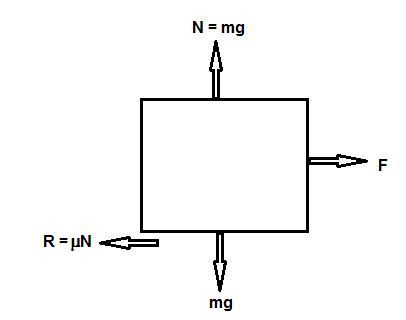
An object has a mass of 15 kg and is accelerating to the right at 16.3 m/s2. The free-body diagram shows the horizontal forces a
marshall27 [118]
Refer to the free body diagram shown melow.

F =  applied force
R =  frictional force
m = 15 kg, the mass of the object

The acceleration (to the right) is 16.3 m/s², therefore
F - R = (15 kg)*(16.3 m/s²) = 244.5 N

The normal reaction is
N = mg = (15 kg)*(9.8 m/s²)  = 147 N
The frictional force is
R = μN = 147μ N,  where μ =  coefficient of kinetic friction.

Let us check possible answers:
If R = 5.5 N, then μ = 5.5/147 = 0.0374 (very likely)
If R = 15 N, then μ = 15/147 = 0.102 (possible)
If R = 244.5 N,   (Highly unlikely, exceed mg)
If R = 494.5 N, (highly unlikely, exceeds mg)

Answer:
The most reasonable answer is R = 5.5 N

8 0
2 years ago
Read 2 more answers
An electron moves through a uniform electric field vector E = (2.80î + 5.20ĵ) V/m and a uniform magnetic field vector B = 0.400k
alina1380 [7]

Answer:

1.758820×10^11(-2.5i-0.8j) m/s^2

Explanation:

From the question, the parameters given are; E=(2.80i+ 5.20j) v/m, a uniform magnetic field,B= 0.400K T, acceleration, a= ??? and velocity vector, v= 11.0i metre per seconds (m/s)...

We can solve this problem using the formula below;

Ma= q[E+V × B] ---------------(1).

Note: q is negative, m= mass of electron.

Making acceleration,a the subject of the formula and substituting the parameters into equation (1);

a= -e/m × (2.5i + 5.2j +11.0i × 0.400K)

a= -e/m × (2.5i+5.2j-4.4j)

a= e/m × (-2.5i - 0.8j)

e/m= 1.758820×10^11 c/kg

Therefore, slotting in the value of charge to mass(e/m) ratio;

a= 1.7588×10^11×(-2.5i-0.8j) m/s^2

7 0
2 years ago
In this problem you will consider the balance of thermal energy radiated and absorbed by a person.Assume that the person is wear
Ivahew [28]

Answer:P=14.6 W

Explanation:

According to the Stefan-Boltzmann law for real radiating bodies:

P=\sigma A \epsilon T^{4} (1)

Where:

P is the energy radiated (in Watts)

\sigma=5.67(10)^{-8}\frac{W}{m^{2} K^{4}} is the Stefan-Boltzmann's constant.  

A is the Surface area of the body  

T=30\°C + 273.15= 303.15 K is the effective temperature of the body (its surface absolute temperature) in Kelvin

\epsilon=0.6 is the body's emissivity

On the other hand, we are told the human body is roughly approximated to a cylinder of length L=2.0m and circumference C=0.8m.

The circumference of a circle is:C=0.8m=2 \pi r where r is the radius. Hence r=\frac{0.8m}{2 \pi}=0.1273 m.

Now we have to input this value for r  in the Area of a cylinder formula:

A=\pi r^{2}L

A=\pi (0.1273 m)^{2}(2 m)

A=0.0509 m^{2} (2)

Substituting (2) in (1):

P=(5.67(10)^{-8}\frac{W}{m^{2} K^{4}}) (0.0509 m^{2}) (0.6) (303.15 K)^{4} (3)

Finally:

P=14.62 W \approx 14.6 W

7 0
2 years ago
An electromagnetic wave is traveling through vacuum in the positive x direction. Its electric field vector is given by E⃗ =E0sin
fgiga [73]

Given that,

The electric field is given by,

\vec{E}=E_{0}\sin(kx-\omega t)\hat{j}

Suppose, B is the amplitude of magnetic field vector.

We need to find the complete expression for the magnetic field vector of the wave

Using formula of magnetic field

Direction of (\vec{E}\times\vec{B}) vector is the direction of propagation of the wave .

Direction of magnetic field = \hat{j}

B=B_{0}\sin(kx-\omega t)\hat{k}

We need to calculate the poynting vector

Using formula of poynting

\vec{S}=\dfrac{E\times B}{\mu_{0}}

Put the value into the formula

\vec{S}=\dfrac{E_{0}\sin(kx-\omega t)\hat{j}\timesB_{0}\sin(kx-\omega t)\hat{k}}{\mu_{0}}

\vec{S}=\dfrac{E_{0}B_{0}}{\mu_{0}}(\sin^2(kx-\omega t))\hat{i}

Hence, The poynting vector is \dfrac{E_{0}B_{0}}{\mu_{0}}(\sin^2(kx-\omega t))\hat{i}

7 0
2 years ago
Other questions:
  • A spring with a spring constant of 2500 n/m. is stretched 4.00 cm. what is the work required to stretch the spring?
    13·2 answers
  • If the loss of 3500 kcal is equal to a loss of 1.0 lb, how many days will it take charles to lose 5.0 lb
    13·1 answer
  • D=? V=100mL M=1.5kg=___g
    11·1 answer
  • Explain why it takes more energy to remove the second electron from a lithium atom than it does to remove the fourth electron fr
    13·2 answers
  • Two infinite parallel surfaces carry uniform charge densities of 0.20 nC/m2 and -0.60 nC/m2. What is the magnitude of the electr
    6·1 answer
  • Steam at 0.6 MPa, 200 oC, enters an insulated nozzle with a velocity of 50 m/s. It leaves at a pressure of 0.15 MPa and a veloci
    12·1 answer
  • What factors affect the ability of a substance to transfer thermal energy to heat or be heated by it's surroundings?
    15·1 answer
  • The figure above represents a stick of uniform density that is attached to a pivot at the right end and has equally spaced marks
    13·1 answer
  • Modifiable strength improvement factors include all of the following except...??
    12·1 answer
  • A kinesin that is transporting a secretory vesicle uses approximately 80 ATP molecules/s. Each ATP provides a kinesin molecule w
    7·1 answer
Add answer
Login
Not registered? Fast signup
Signup
Login Signup
Ask question!