answer.
Ask question
Login Signup
Ask question
All categories
  • English
  • Mathematics
  • Social Studies
  • Business
  • History
  • Health
  • Geography
  • Biology
  • Physics
  • Chemistry
  • Computers and Technology
  • Arts
  • World Languages
  • Spanish
  • French
  • German
  • Advanced Placement (AP)
  • SAT
  • Medicine
  • Law
  • Engineering
Lorico [155]
2 years ago
14

A 15.0-Ω resistor and a coil are connected in series with a 6.30-V battery with negligible internal resistance and a closed swit

ch.
(a) At 2.00 ms after the switch is opened the current has decayed to 0.210 A. Calculate the inductance of the coil.

(b) Calculate the time constant of the circuit.

(c) How long after the switch is opened will the current reach 1.00% of its original value?
Physics
1 answer:
Aloiza [94]2 years ago
7 0

Answer:

0.04328 H

0.00288 seconds

0.01326 seconds

Explanation:

V = Voltage = 6.3 V

R = Resistance = 15 Ω

L = Inductance

I = Decayed current = 0.21 A

t = Time to decay = 2 ms

Maximum Current is given by

I_0=\frac{V}{R}\\\Rightarrow I_0=\frac{6.3}{15}\\\Rightarrow I_0=0.42\ A

Current in the circuit is given by

I=I_0exp\frac{-Rt}{L}\\\Rightarrow ln\frac{I_0}{I}=\frac{Rt}{L}\\\Rightarrow L=\frac{Rt}{ln\frac{I_0}{I}}\\\Rightarrow L=\frac{15\times 2\times 10^{-3}}{ln\frac{0.42}{0.21}}\\\Rightarrow L=0.04328\ H

The inductance is 0.04328 H

Time constant is given by

\tau=\frac{L}{R}\\\Rightarrow \tau=\frac{0.04328}{15}\\\Rightarrow \tau=0.00288\ s

Time constant is 0.00288 seconds

Time required is given by

t=\tau ln\frac{I_0}{I}\\\Rightarrow t=0.00288\times ln\frac{I_0}{0.01I_0}\\\Rightarrow t=0.01326\ s

The time to reach 1% of its original value is 0.01326 seconds

You might be interested in
A fellow student of mathematical bent tells you that the wave function of a traveling wave on a thin rope is y(x,t)=2.30mmcos[(6
Shalnov [3]

Answer:

a. y(x,t)= 2.05 mm cos[( 6.98 rad/m)x + (744 rad/s).

b. third harmonic

c. to calculate frequency , we compare with general wave equation

y(x,t)=Acos(kx+ωt)

from ωt=742t

ω=742

ω=2*pi*f

742/2*pi

f=118.09Hz

Explanation:

A fellow student of mathematical bent tells you that the wave function of a traveling wave on a thin rope is y(x,t)=2.30mmcos[(6.98rad/m)x+(742rad/s)t]. Being more practical-minded, you measure the rope to have a length of 1.35 m and a mass of 3.38 grams. Assume that the ends of the rope are held fixed and that there is both this traveling wave and the reflected wave traveling in the opposite direction.

A) What is the wavefunction y(x,t) for the standing wave that is produced?

B) In which harmonic is the standing wave oscillating?

C) What is the frequency of the fundamental oscillation?

a. y(x,t)= 2.05 mm cos[( 6.98 rad/m)x + (744 rad/s).

b. lambda=2L/n

when comparing the wave equation with the general wave equation , we get the wavelength to be

2*pi*x/lambda=6.98x

lambda=0.9m

we use the equation

lambda=2L/n

n=number of harmonics

L=length of string

0.9=2(1.35)/n

n=2.7/0.9

n=3

third harmonic

c. to calculate frequency , we compare with general wave equation

y(x,t)=Acos(kx+ωt)

from ωt=742t

ω=742

ω=2*pi*f

742/2*pi

f=118.09Hz

8 0
2 years ago
You need to design a clock that will oscillate at 10 MHz and will spend 75% of each cycle in the high state. You will be using a
Svetllana [295]

Answer:

Hello your question has some missing parts and the required diagram attached below is the missing part and the diagram

Digital circuits require actions to take place at precise times, so they are controlled by a clock that generates a steady sequence of rectangular voltage pulses. One of the most widely

used integrated circuits for creating clock pulses is called a 555 timer.  shows how the timer’s output pulses, oscillating between 0 V and 5 V, are controlled with two resistors and a capacitor. The circuit manufacturer tells users that TH, the time the clock output spends in the high (5V) state, is TH =(R1 + R2)*C*ln(2). Similarly, the time spent in the low (0 V) state is TL = R2*C*ln(2). Design a clock that will oscillate at 10 MHz and will spend 75% of each cycle in the high state. You will be using a 500 pF capacitor. What values do you need to specify for R1 and R2?

ANSWER : R1 = 144.3Ω,   R2 =  72.2 Ω

Explanation:

Frequency = 10 MHz

Time period = 1 / F =  0.1 <em>u </em>s

Duty cycle = 75% = 0.75

Duty cycle can be represented as :   Ton / T

Also: Ton = Th = 0.75 * 0.1 <em>u </em>s  = 75 <em>n</em> s

TL = T - Th = 100 <em>n</em>s - 75 <em>n</em> s = 25 <em>n</em> s

To find the value of R2 we use the equation for  time spent in the low (0 V) state

TL = R2*C*ln(2)

hence R2 = TL / ( C * In 2 )

c = 500 pF

Hence R2 = 25 / ( 500 pF * 0.693 )  = 72.2 Ω

To find the value of R1 we use the equation for the time the clock output spends in the high (5V) state,

Th = (R1 + R2)*C*ln(2)

  from the equation make R1 the subject of the formula

R1 =  (Th - ( R2 * C * In2 )) / (C * In 2)

R1 = ( 75 ns - ( 72.2 * 500 pF * 0.693)) / ( 500 pF * 0.693 )

R1 = ( 75 ns  - ( 25 ns ) / 500 pf * 0.693

     = 144.3Ω

8 0
2 years ago
a batter hits a homerun in which the ball travels 110m horizontally with no appreciable air resistance. If the ball left the bat
e-lub [12.9K]

If you know the formula for horizontal range, then finding the solution is immediate:

r=\dfrac{{v_0}^2\sin2\theta}g

110\,\mathrm m=\dfrac{{v_0}^2\sin100^\circ}{9.8\,\frac{\mathrm m}{\mathrm s^2}}\implies v_0\approx33\,\dfrac{\mathrm m}{\mathrm s}

7 0
2 years ago
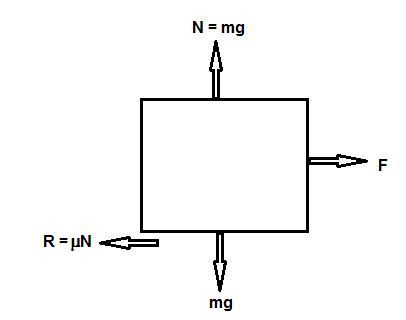
An object has a mass of 15 kg and is accelerating to the right at 16.3 m/s2. The free-body diagram shows the horizontal forces a
marshall27 [118]
Refer to the free body diagram shown melow.

F =  applied force
R =  frictional force
m = 15 kg, the mass of the object

The acceleration (to the right) is 16.3 m/s², therefore
F - R = (15 kg)*(16.3 m/s²) = 244.5 N

The normal reaction is
N = mg = (15 kg)*(9.8 m/s²)  = 147 N
The frictional force is
R = μN = 147μ N,  where μ =  coefficient of kinetic friction.

Let us check possible answers:
If R = 5.5 N, then μ = 5.5/147 = 0.0374 (very likely)
If R = 15 N, then μ = 15/147 = 0.102 (possible)
If R = 244.5 N,   (Highly unlikely, exceed mg)
If R = 494.5 N, (highly unlikely, exceeds mg)

Answer:
The most reasonable answer is R = 5.5 N

8 0
2 years ago
Read 2 more answers
A box of mass 3.1kg slides down a rough vertical wall. The gravitational force on the box is 30N . When the box reaches a speed
Nostrana [21]

Answer:

Explanation:

a) The net force on the box in vertical direction:

Fnet=Fg−f−Fp  *sin45  °

 here Fg is the  gravitational force .f is the force of friction and , Fp is the pushing force.

Fnet=ma

ma=Fg−f−Fp  *sin45  °

​a=\frac{30-13-23*sin(45)}{3.1}

 =0.24 m/s²  

Vf =Vi +at

     =0.48+0.24*2

Vf=2.98 m/s

b)

                                Fnet=Fg−f−Fp  *sin45  °

                                        =Fg−0.516Fp−Fp  *sin45  °

                                        =30-1.273Fp

                                Fnet=0               (Because speed is constant)

                                Fp=30/1.273

                                      =23.56 N

5 0
2 years ago
Read 2 more answers
Other questions:
  • Bjorn is holding a tennis ball outside a second floor window (3.5 meters from the ground) and billie jean is holding one outside
    15·1 answer
  • The pencil rotates about an axis perpendicular to the plane of the figure. which of the labeled points is the point that the axi
    9·2 answers
  •  If the gauge pressure of a gas is 114 kPa, what is the absolute pressure?
    13·2 answers
  • Q 32.35: The isotope 235U decays by alpha emission with a half-life of 7.0 x 10⁸ y. It also decays (rarely) by spontaneous fissi
    6·1 answer
  • Which, if any, of the following statements concerning the work done by a conservative force is NOT true? All of these statements
    8·1 answer
  • a child hits a ball with a force of 350 N. (a) If the ball and bat are in contact for 0.12 is, what impulse does the ball receiv
    15·1 answer
  • For a particular type of motion, the velocity is zero but the speed is a nonzero quantity. Which statement can you make about th
    5·1 answer
  • Four rods that obey Hooke's law are each put under tension. (a) A rod 50.0 cm50.0 cm long with cross-sectional area 1.00 mm21.00
    5·1 answer
  • A construction worker accidentally drops a brick from a high scaffold. a. What is the brick's velocity after 4.0 s? b. How far d
    15·1 answer
  • What voltage is required to move 6A through 20?<br><br>​
    6·1 answer
Add answer
Login
Not registered? Fast signup
Signup
Login Signup
Ask question!