answer.
Ask question
Login Signup
Ask question
All categories
  • English
  • Mathematics
  • Social Studies
  • Business
  • History
  • Health
  • Geography
  • Biology
  • Physics
  • Chemistry
  • Computers and Technology
  • Arts
  • World Languages
  • Spanish
  • French
  • German
  • Advanced Placement (AP)
  • SAT
  • Medicine
  • Law
  • Engineering
Alja [10]
2 years ago
4

The dipole moment (μ) of HBr (a polar covalent molecule) is 0.851D (debye), and its percent ionic character is 12.6 % . Estimate

the bond length of the H−Br bond in picometers. Note that 1 D=3.34×10⁻³⁰ C⋅m and
Chemistry
1 answer:
Sati [7]2 years ago
8 0

Answer:

Bond length of HBr = 141 pm

Explanation:

\% \ ionic\ character=\frac{measured\ dipole\ moment}{dipole\ moment\ of\ 100\% ionic\ compound(\mu_(ionic))} \times 100 \%

measured dipole moment of HBr = 0.851 D

1D=3.34\times 10_^{-30}C.m

therefore,

dipole moment of HBr in C.m is,

0.851D\times (\frac{3.34\times 10^{-30}C.m}{1D} )=2.84 \times 10^{-30} C.m

dipole moment is related with charge and bond length as follows:

\mu_{ionic}=Q\times r

Here Q is charge and r is interatomic distance or bond length

In case of HBr, Q is 1.6×10^-19 C.

Calculate diople moment HBr, \mu_(ionic) as follows:

12.6=\frac{2.84\times 10^{-30}C.m}{\mu_{ionic}}\times 100 \\\mu_{ionic}=\frac{2.84\times 10^{-30}C.m}{12.6}\times 100\\\mu_{ionic}=Q\times r\\2.25 \times 10^{-29}C.m=1.6 \times 10^{-19}C \times r\\r=1.41\times 10^{-10}m\\=141pm

Bond length of HBr is 141 pm

You might be interested in
A 0.89% (w/v) sodium chloride solution is referred to as physiological saline solution because it has the same concentration of
maks197457 [2]
1) 0.89% m/v = 0.89 grams of NaCl / 100 ml of solution

=> 8.9 grams of NaCl in 1000 ml of solution = 8.9 grams of NaCl in 1 liter of solution

2) Molarity = M = number of moles of solute / liters of solution

=> calculate the number of moles of 8.9 grams of NaCl

3) molar mass of NaCl = 23.0 g /mol + 35.5 g/mol = 58.5 g / mol

4) number of moles of NaCl = mass / molar mass = 8.9 g / 58.5 g / mol = 0.152 mol

5) M = 0.152 mol NaCl / 1 liter solution = 0.152 M

Answer: 0.152 M
4 0
2 years ago
Two different compounds are obtained by combining nitrogen with oxygen. The first compound results from combining 46.7 gg of NN
mina [271]

Answer:

4.02

Explanation:

The mass ratios will be given by dividing the mass of O₂ into the mass of N₂.

So lets do our calculations:

First Compound:

53.3 g O₂ / 46.7 g N₂ =  1.14

Second Compound:

82.0 g O₂ / 17.9 g N₂ = 4.58

Ratio = 4.58 / 1.14 =  4.02

This result for all practical purposes is a whole number, and it is telling us that there are 4 times as many oxygen atoms in the second coumpound as in the first compound. This is so because the ratio we just calculated is also the ratio in mol atoms:

Ratio = [ mass O₂ / MW O2/ mass N₂/ MW N₂] 2nd compound  /   [mass O₂ / MW O2/ mass N₂/ MW N₂  !st compound]

and the molecular weights cancel each other.

The only N and O compounds that follow this ratio are N₂O₄ and N₂O, and this question could be made in a multiple choice to match  formulas.

3 0
2 years ago
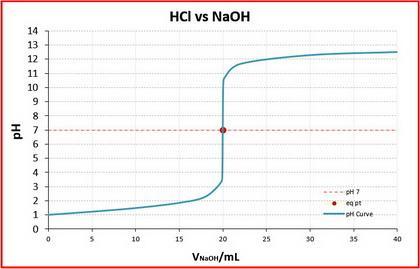
(g) On the graph in part (d) , carefully draw a curve that shows the results of the second titration, in which the student titra
atroni [7]

Answer:

Here's what I get  

Explanation:

(g) Titration curves

I can't draw two curves on the same graph, but I can draw two separate curves for you.  

The graph in part (d) had an equivalence point at 20 mL.

In the second titration, the NaOH was twice as concentrated, so the volume to equivalence point would be half as much — 10 mL.

The two titration curves are below.

(h) Evidence of reaction

HCl and NaOH are both colourless.

They don't  evolve a gas or form a precipitate when they react.

The student probably noticed that the Erlenmeyer flask warmed up — a sign of a chemical change.

4 0
2 years ago
According to the octet rule, atoms tend to gain, lose, or share electrons until they are surrounded by ________ valence electron
Mazyrski [523]
According to the octet rule, atoms tend to gain, lose, or share electrons until they are surrounded by__8__ valence electrons.
6 0
2 years ago
A student dissolved 4.00 g of Co(NO3)2 in enough water to make 100. mL of stock solution. He took 4.00 mL of the stock solution
mihalych1998 [28]

Answer:

0.08097 grams of nitrate ions are there in the final solution.

Explanation:

Moles of cobalt(II) nitrate ,n= \frac{4.00 g}{245 g/mol}=0.01633 mol

Volume of the cobalt(II) nitrate solution, V = 100.0 mL = 0.1 L

Molarity=\frac{n}{V(L)}

Let the molarity of the solution be M_1

M_1=\frac{0.01633 mol}{0.1 L}=0.1633 M

A students then takes 4 .00 mL of M_1 solution and dilute it to 275 ml.

M_1=0.1633 M

V_1=4.00 mL

M_2=? (molarity after dilution)

V_2=275 mL (after dilution)

M_1V1=M-2V_2

M_2=\frac{M_1V_1}{V_2}=\frac{0.1633 M\times 4.00 mL}{275 mL}=0.002375 M

Molarity of the of solution after dilution is 0.002375 M.

Co(NO_3)_2(aq)\rightarrow Co^{2+}(aq)+2NO_3^{-}(aq)

1 mol of cobalt(II) nitrate gives 2 moles of nitrate ions. Then 0.002375 M solution of cobalt (II) nitrate will give:

[NO_3^{-}]=\frac{2}{1}\times 0.002375 M=0.004750 M

Moles of nitrate ions = n

Volume of the solution = 275 mL = 0.275 L

Molarity of the nitrate ions = [NO_3^{-}]=0.004750 M

[NO_3^{-}]=\frac{n}{0.275 L}

n = 0.001306 mol

Mass of 0.001306 moles of nitrate ions:

0.001306 mol × 62 g/mol= 0.08097 g

0.08097  grams of nitrate ions are there in the final solution.

4 0
2 years ago
Other questions:
  • Complete combustion of a 0.600-g sample of a compound in a bomb calorimeter releases 24.0 kJ of heat. The bomb calorimeter has a
    10·2 answers
  • What is the number of moles of <br> 0.0960g of H2SO4
    10·1 answer
  • You are performing an experiment in your lab. To compare with other experiments you need your results to be in moles. During you
    12·2 answers
  • Aluminum–lithium (Al–Li) alloys have been developed by the aircraft industry to reduce the weight and improve the performance of
    8·1 answer
  • Industrial production of nitric acid, which is used in many products including fertilizers and explosives, approaches 10 billion
    9·1 answer
  • A mixture of three gases has a total pressure at 298 K of 1560 mm Hg. the mixture is analyzed and is found to contain 1.50 mol N
    10·1 answer
  • For a hydrogen atom, which electronic transition would result in the emission of a photon with the highest energy?
    11·1 answer
  • Match the specific enzyme to its class. A. oxidoreductase B. hydrolase C. transferase D. ligase E. lyase aminase
    8·1 answer
  • Naturally occurring iodine has an atomic mass of 126.9045 amu. A 12.3849-g sample of iodine is accidentally contaminated with 1.
    13·1 answer
  • Combustion analysis of a 13.42-g sample of the unknown organic compound (which contains only carbon, hydrogen, and oxygen) produ
    7·1 answer
Add answer
Login
Not registered? Fast signup
Signup
Login Signup
Ask question!