answer.
Ask question
Login Signup
Ask question
All categories
  • English
  • Mathematics
  • Social Studies
  • Business
  • History
  • Health
  • Geography
  • Biology
  • Physics
  • Chemistry
  • Computers and Technology
  • Arts
  • World Languages
  • Spanish
  • French
  • German
  • Advanced Placement (AP)
  • SAT
  • Medicine
  • Law
  • Engineering
Montano1993 [528]
2 years ago
16

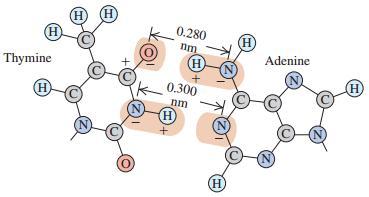
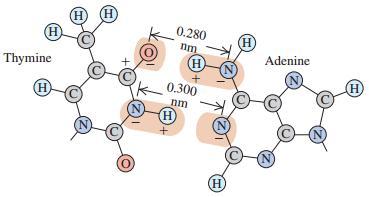
The two sides of the DNA double helix are connected by pairs of bases (adenine, thymine, cytosine, and guanine). Because of the

geometric shape of these molecules, adenine bonds with thymine and cytosine bonds with guanine. The figure (Figure 1) shows the thymine-adenine bond. Each charge shown is ±e, and the H−N distance is 0.110 nm.
A) Calculate the net force that thymine exerts on adenine. To keep the calculations fairly simple, yet reasonable, consider only the forces due to the O−H−N and the N−H−N combinations, assuming that these two combinations are parallel to each other. Remember, however, that in the O−H−N set, the O− exerts a force on both the H+ and the N−, and likewise along the N−H−N set.

B) Is the net force attractive or repulsive?

C) Calculate the force on the electron in the hydrogen atom, which is 5.29×10⁻² nm from the proton.

D) Compare the strength of the bonding force of the electron in hydrogen with the bonding force of the adenine-thymine molecules.

Physics
1 answer:
VikaD [51]2 years ago
5 0

Answer:

Explanation:

Attached is an image of the bond from search.

Take the force that diected towards thymine as negative

For the combination O-H-N:

The net force for this combination is,

F=-F_{OH}+F_{ON}\\\\=\frac{Ke^2}{r^2}+\frac{Ke^2}{r'^2}\\\\=Ke^2(\frac{-1}{r^2}+\frac{1}{r'^2})\\\\=(9.0\times 10^9Nm^2/kg^2)(1.6\times 10^{-19}C)^2[\frac{1}{[(0.280-0.110)\times 10^{-9}m]^2}+\frac{1}{0.280\times 10^{-9}m)^2}]\\\\=-5.03354\times 10^{-9}N

For the combination N-H-N:

The net force for this combination is,

F'=F_{NN}-F_{HN}\\\\=\frac{Ke^2}{r^2}-\frac{Ke^2}{r'^2}\\\\=Ke^2(\frac{-1}{r^2}+\frac{1}{r'^2})\\\\=(9.0\times 10^9Nm^2/kg^2)(1.6\times 10^{-19}C)^2[\frac{1}{[0.300\times 10^{-9}m]^2}-\frac{1}{((0300-0..110)\times 10^{-9})m)^2}]\\\\=-3.822\times 10^{-9}N

The net force that exerted by the thymine on the Adenine is,

F_{net}=F+F'\\\\=-5.03354\times 10^{-9}N-3.822\times 10^{-9}N\\\\=-8.8558\times 10^{-9}N

In three significant figures, the net force is 8.86\times 10^{-9}N

b)

The negative sign indicates that the force is attractive since it acts towards the thyme.

c)

The force o electron due to the proton is,

F=\frac{Ke^2}{r^2}\\\\=\frac{(9.0\times 10^9Nm^2/C^2)(1.6\times 10^{-9}C)^2}{(5.29\times 10^{-11}m)^2}\\\\=8.233\times 10^{-8}N

Since the electron and proton are oppositely charged, the force acting on the electron is directed towards the proton.

d)

Take the ratio of the above forces:

\frac{F}{F_{net}}=\frac{8.233\times 10^{-8}N}{8.233\times 10^{-8}N}\\\\=9.3

Thus, the bonding strength of the electron in hydroen atom is 9.3 times to the bonding force of the adenine thymine molecules.
You might be interested in
Keisha looks out the window from a tall building at her friend Monique standing on the ground, 8.3 m away from the side of the b
Salsk061 [2.6K]

Answer:

Explanation:

GIVEN DATA:

Distance between keisha and her friend 8.3 m

angle made by keisha toside building 30 degree

height of her friend monique is 1.5 m

from the figure

\Delta ACB

tan 30 = \frac{8.3}{h}

h= \frac{8.3}{tan 30} = 14.376 m

therefore

height of keisha is = h  + 1.5 m

                               = 14.376 + 1.5

= 15.876 \simeq 16 m

therefore option c is correct

5 0
2 years ago
Any ferrous metal object within or near the mri magnet has the potential of becoming a projectile. this is commonly referred to
PtichkaEL [24]
This phenomena is referred to as metal projectile injury/effect. MRI stands for magnetic resonance imaging. As expected, your body is subjected to a magnetic field. This is a technique to look inside your body without cutting it open. Metals should not be placed anywhere near an MRI because it will cause the metals to follow the direction of the magnetic field. 
4 0
2 years ago
A straight wire carries a current of 3 A which is in the plane of this page, pointed toward the top of the page. A particle of c
Ilia_Sergeevich [38]

Answer:

The magnitude of the magnetic force exerted on the moving charge by the current in the wire is 2.18 x 10^{-8} N

The direction of the magnetic force exerted on the moving charge by the current in the wire is radially inward

Explanation:

given information:

current, I = 3 A

q_{0} = +6.5 x 10^{-6} C

r = 0.05 m

v = 280 m/s

and direction of the magnetic force exerted on the moving charge by the current in the wire, we can use the following formula:

F = qvB sin θ

where

F = magnetic force (N)

q = electric charge (C)

v = velocity (m/s)

θ = the angle between the velocity and magnetic field

to find B we use

B = μ_{0}I/2πr

μ_{0} = 4π x 10^{-7} or 1.26 x 10^{-6} N/A^{2} , thus

B = 4π x 10^{-7} x 3 / 2π(0.05)

  = 1.2  x  10^{-5} T

Now, we can calculate the magnitude force

F = qvB sin θ

θ = 90°, because the speed and magnetic are perpendicular

F = 6.5 x 10^{-6} x 280  x 1.2 x  10^{-5} sin 90°

  = 2.18 x 10^{-8} N

Using the hand law, the magnetic direction is radially inward

8 0
2 years ago
A basketball player is running at a constant speed of 2.5 m/s when he tosses a basketball upward with a speed of 6.0 m/s. How fa
Strike441 [17]

Answer:

distance=6.11m

Explanation:

A basketball player is running at a constant speed of 2.5 m/s when he tosses a basketball upward with a speed of 6.0 m/s. How far does the player run before he catches the ball? Ignore air resistance. I got stuck because I wasn't sure which formula to use when approaching this problem. Does it involve an angle at all?

first of all we get the time it takes to reach the maximum height

then twice of the time it takes to reach maximum height will be the time of flight

from newtons equation of motion

v=u+at

v=0

u=6m/s

0=6-9.81t

t=.61s

the time of flight will be 1.22secs

how far it travels will then be d, the basketball player moves with a horizontal speed 2.5m/s towards the ball

distance=speed*time

distance=2.5m/s*1.22

distance=6.11m

3 0
2 years ago
A pulley 12 cm in diameter is free to rotate about a horizontal axle. A 220-g mass and a 470-g mass are tied to either end of a
Aleks [24]

Answer:0.147 N-m

Explanation:

Given

Diameter of Pulley d=12 cm

radius r=6 cm

mass of first object m_1=220 gm

mass of second object m_2=470 gm

Now both masses will exert a torque a on Pulley

Torque due to first Pulley T_1=m_1g\cdot r

T_1=0.22\times 9.8\times 0.06=0.129 N-m

Torque due to second mass on Pulley T_2=m_2g\cdot r

T_2=0.276 N-m

Total Torque by masses T_{net}=T_2-T_1

T_{net}=0.276-0.129=0.147 N-m

so we need to apply a torque of magnitude 0.147 N-m opposite to the direction of T_{net}  

3 0
2 years ago
Other questions:
  • A projectile follows a straight-line path instead of a parabolic trajectory. Which could be the launch angle? would it be 90 or
    9·2 answers
  • A 1.0-kg block and a 2.0-kg block are pressed together on a horizontal frictionless surface with a compressed very light spring
    13·2 answers
  • Which voice can produce a pitch that has a speed of 343 m/s and a wavelength of 0.68 m? Check all that apply.
    12·2 answers
  • An amusement park ride raises people high into the air, suspends them for a moment, and then drops them at a rate of free-fall a
    13·2 answers
  • the coefficient of static friction between a 40 kg picnic table and the ground below is .43. what is the greatest horizontal for
    14·2 answers
  • Which statements describe the characteristics of asteroids? Check all that apply. formed 4.6 billion years ago orbit the Sun bey
    7·2 answers
  • Two infinite parallel surfaces carry uniform charge densities of 0.20 nC/m2 and -0.60 nC/m2. What is the magnitude of the electr
    6·1 answer
  • A cyclist moving towards right with an acceleration of 4m/s² at t = 0 he has travelled 5 m moving towards the right at 15 m/s wh
    7·1 answer
  • Suppose a ray of light traveling in a material with an index of refraction n a reaches an interface with a material having an in
    12·1 answer
  • Calculate the time taken by the light to pass through a nucleus of diameter 1.56 10 -16 m. (speed of light is 3 10 8 m/s)
    10·1 answer
Add answer
Login
Not registered? Fast signup
Signup
Login Signup
Ask question!
