answer.
Ask question
Login Signup
Ask question
All categories
  • English
  • Mathematics
  • Social Studies
  • Business
  • History
  • Health
  • Geography
  • Biology
  • Physics
  • Chemistry
  • Computers and Technology
  • Arts
  • World Languages
  • Spanish
  • French
  • German
  • Advanced Placement (AP)
  • SAT
  • Medicine
  • Law
  • Engineering
mina [271]
2 years ago
10

Observe the reactions given below. Classify the reactants based on whether they are oxidized or reduced. Zn(s)+Cu2+(aq)→Zn2+(aq)

+Cu(s) 3Fe(s)+4H2O(g)→Fe2O3(s)+4H2(g) Drag the appropriate items to their respective bins. View Available Hint(s)
Chemistry
1 answer:
Natalija [7]2 years ago
7 0

Answer:

1. Zn is oxidize.

Cu is reduced.

2. Fe is oxidize.

H2 is reduced.

Explanation:

1. Zn(s)+Cu2+(aq)→Zn2+(aq)+Cu(s)

From the equation,

Zn changes oxidation number from 0 to +2. Therefore Zn is oxidized.

Cu2+ changes oxidation number from +2 to 0. Therefore, Cu2+ is reduced

2. 3Fe(s)+4H2O(g)→Fe2O3(s)+4H2(g)

From the equation,

Fe changes oxidation number from 0 to +3. Therefore, Fe is oxidized.

H changes oxidation number from +1 to 0. Therefore, H is reduced

You might be interested in
The pKs of succinic acid are 4.21 and 5.64. How many grams of monosodium succinate (FW = 140 g/mol) and disodium succinate (FW =
Varvara68 [4.7K]

Answer:

9.744g of monosodium succinate.

4.925g of disodium succinate.

Explanation:

To find pH of the buffer produced by the mixture of monosodium succinate-Disodium succinate is obtained from H-H equation:

pH = pKa + log ([Na₂Suc] / [NaHSuc])

As you want a pH of 5.28 and pKa is 5.64:

5.28 = 5.64 + log ([Na₂Suc] / [NaHSuc])

-0.36 = log ([Na₂Suc] / [NaHSuc])

0.4365 = ([Na₂Suc] / [NaHSuc]) <em>(1)</em>

<em />

As total concentration of the buffer is 100mM = 0.100M:

0.100M = [Na₂Suc] + [NaHSuc] <em>(2)</em>

Replacing (2) in (1):

0.4365 = (0.100M - [NaHSuc] / [NaHSuc])

0.4365 = (0.100M - [NaHSuc] / [NaHSuc])

0.4365 [NaHSuc] = 0.100M - [NaHSuc]

1.4365 [NaHSuc] = 0.100M

[NaHSuc] = 0.0696M

And:

[Na₂Suc] = 0.0304M

As volume of the buffer is 1L:

[NaHSuc] = 0.0696 moles

[Na₂Suc] = 0.0304 moles

Using molar mass of both substances:

Mass of monosodium succinate:

0.0696moles * (140g / 1mol) =<em> 9.744g of monosodium succinate.</em>

Mass of disodium succinate:

0.0304moles * (162g / 1mol) =<em> 4.925g of disodium succinate.</em>

<em></em>

5 0
2 years ago
For no2−, write an equation that shows how the anion acts as a base. express your answer as a chemical equation. identify all of
katrin [286]
Hello!

Bases are defined by Arrhenius as substances which release OH⁻ ions when dissolved in water. NO₂⁻ complies with this definition by the chemical reaction that is shown below:

 NO₂⁻(aq) + H₂O (l) HNO₂ (aq) + OH⁻(aq)

Have a nice day!
5 0
2 years ago
Read 2 more answers
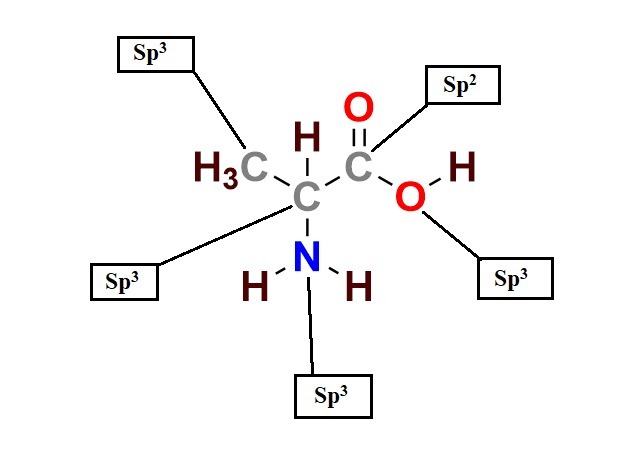
Consider the structure of the amino acid alanine. indicate the hybridization about each interior atom.
OLEGan [10]
The structure of Alanine is shown below,
Except the carbon atom of carbonyl group which is Sp² Hybridized, all remaining atoms are Sp³ Hybridized. The hybridization of each element is depicted in a box below,

5 0
2 years ago
Read 2 more answers
Which of the following shows a Bronsted-Lowry acid reacting?
7nadin3 [17]
<h3>Answer:</h3>

         Option-C:  HCl + H₂O  →   H₃O⁺ + Cl⁻

Explanation:

       Bronsted-Lowery concept of Acid and Base defines Acid as that specie which tends to donate H⁺ (Hydrogen Ion) and bases are those species which accepts H⁺ from Acids.

In selected option, HCl is reacting as Acid as it donates H⁺ to water (lowery bronsted base).

Also, the correspong acid is converted into conjugate base (i.e. Cl⁻) and base is converted into conjugate acid (i.e. H₃O⁺)

8 0
2 years ago
Read 2 more answers
Groups of atoms that are added to carbon backbones and give them unique properties are known as
Irina-Kira [14]

Answer:

             Groups of atoms that are added to carbon backbones and give them unique properties are known as <u>Functional Groups</u>.

Explanation:

                   In organic chemistry they are called as Functional Group because they are the active part of a molecule. These groups give a unique characteristic to molecule both chemically and physically. Also, each functional group represent a different class of compounds.

Examples:

S No.                          Functional Group                                 Name

1                                   R--X                                             Alkyl Halides

2                                   R--OH                                          Alcohols

3                                  R--NH₂                                         Amines

4                                  R--O--R                                         Ethers

5                                   R--CO--R                                      Ketones

6                                   R--CO--H                                     Aldehydes

7                                  R--CO--OH                                  Carboxylic acids

8                                   R--CO--X                                     Acid Halides

10                                R--CO--NR₂                                 Acid Amides

11                                 R--CO-OR'                                  Esters

3 0
2 years ago
Other questions:
  • How many grams are in 3.3 moles of potassium sulfide , k2s
    15·1 answer
  • If a certain gas occupies a volume of 13 L when the applied pressure is 6.5 atm , find the pressure when the gas occupies a volu
    11·2 answers
  • You are performing a simple distillation of roughly 50:50 liquid solution containing two components, hexane and nonane You place
    14·1 answer
  • What is the simplest formula of a compound if a sample of the compound contains 0.221 mol X, 0.442 mol Y, and 0.884 mol Z? chemP
    9·2 answers
  • Chlorine gas can be made from the reaction of manganese dioxide with hydrochloric acid. MnO2(s) + 4HCl(aq) → MnCl2(aq) + 2H2O(l)
    12·1 answer
  • A phosphorus atom with 4 bonds has a charge of ___.
    6·1 answer
  • (g) On the graph in part (d) , carefully draw a curve that shows the results of the second titration, in which the student titra
    14·1 answer
  • The equilibrium reaction below has the Kc = 4.00 at 25°C. If the temperature of the system at equilibrium is increased to 100°C,
    11·1 answer
  • What information about a chemical solution can be inferred from knowing its pH value?
    10·1 answer
  • The planet Venus is surrounded by a thick layer of gases. In fact, the atmospheric pressure on Venus is over 90 times greater th
    11·1 answer
Add answer
Login
Not registered? Fast signup
Signup
Login Signup
Ask question!