answer.
Ask question
Login Signup
Ask question
All categories
  • English
  • Mathematics
  • Social Studies
  • Business
  • History
  • Health
  • Geography
  • Biology
  • Physics
  • Chemistry
  • Computers and Technology
  • Arts
  • World Languages
  • Spanish
  • French
  • German
  • Advanced Placement (AP)
  • SAT
  • Medicine
  • Law
  • Engineering
AleksandrR [38]
2 years ago
6

A 10-kg sled carrying a 30-kg child glides on a horizontal, frictionless surface at a speed of 6.0 m/s toward the east. The chil

d jumps off the back of the sled, propelling it forward at 20 m/s. What was the child’s velocity in the horizontal direction relative to the ground at the instant she left the sled?

Physics
1 answer:
raketka [301]2 years ago
3 0

Answer:

- 1.33m/s

Explanation:

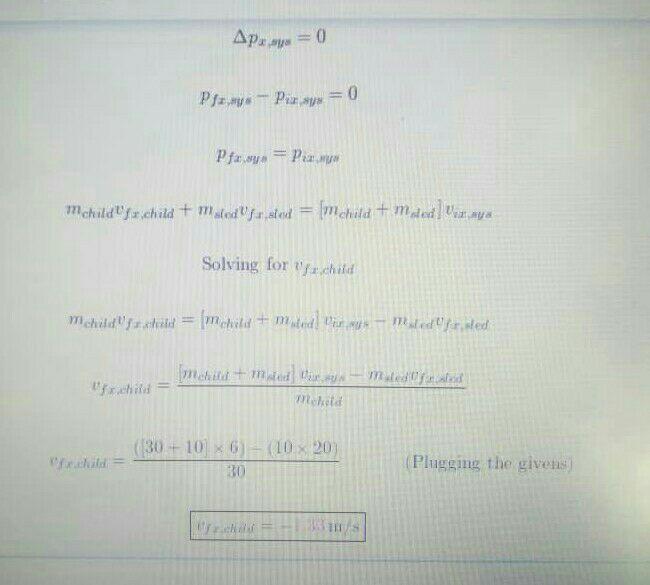
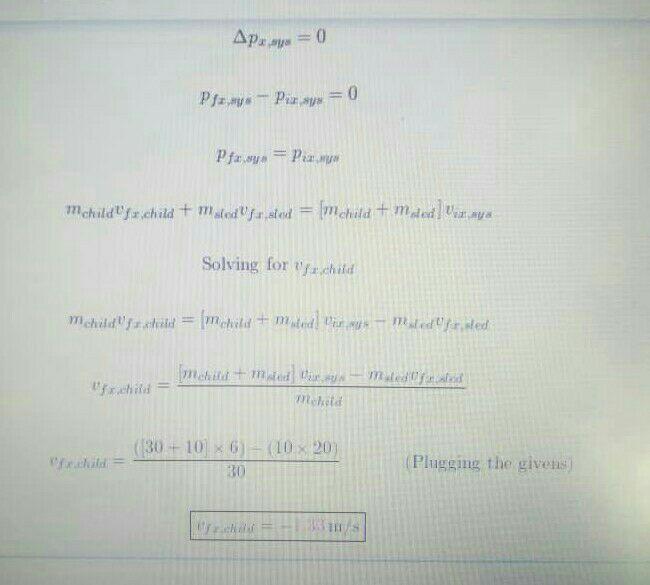
We choose the system to be the child and the sled. The surface is friction less, which means that there are no forces exerted on the system horizontally. This means that the horizontal momentum component of the system is constant and conserved.

So we can use the conservation momentum principle to find the velocity of the child just after he leaves the sled.

This is shown in the attached file.

You might be interested in
A projectile of mass M, initially at rest, is acted upon by a net force [including gravity] that increases quadratically with ti
Elden [556K]

Answer:

maximum height is y = b²/18g √ (12L/b)³

Explanation:

Let's analyze the situation first we have a projectile subjected to an acceleration depends on time, so we must use the definition of acceleration to find the speed when it is at distance L, then we will use the projectile launch equations

Acceleration dependent on t

     a = dv / dt

     dv = adt

     ∫dv =∫ (b t²) dt

     v = b t³ / 3

The initial speed is zero for zero time


we use the definition of speed

     v = dy / dt

     dy = v dt

     ∫dy = ∫b t³ / 3 dt

     y = b/3   t⁴ / 4

     y = b/12 t⁴

we evaluate from the initial point where the height is zero for the zero time

Let's calculate the time to travel the length (y = L) of the canyon

     t = (12 y / b) ¼

     t = (12 L / b) ¼

Taking the time, we can calculate the projectile's output speed

     v = b/3  ( (12 L / b)^{3/4}


This is the speed of the body, which is the initial speed for the projectile launch movement. Let's calculate the highest point where the zero speed

      Vy² = v₀² - 2 g y

       0 = Vo² - 2 g y

      2 g y = v₀²

      y =  v₀²/ 2g

      y = 1/2g    [b/3 (12L / b^{3/4}) ] 2

      y = 1 / 2g [b²/9  (12L/b)^{3/2}]

      y = b²/18g √ (12L/b)³

7 0
2 years ago
Cassidy Carver's family child care center has an activities table with four chairs an easel that can accommodate a child on each
Akimi4 [234]

Answer:4

Explanation:

6 0
2 years ago
A uniformly accelerated car passes three equally spaced traffic signs. The signs are separated by a distance d = 25 m. The car p
DedPeter [7]

Answer:

a) v_{1}=\frac{x_{2}-x_{1}  }{t_{2}-t_{1}  }=\frac{(2(\frac{25}{3})-\frac{25}{3} )m}{3.9s-1.3s}  =3.2051 \frac{m}{s}

b) v_{2}=\frac{x_{3}-x_{2}  }{t_{3}-t_{2}  }=\frac{(25-2(\frac{25}{3}) )m}{5.5s-3.9s}  =5.2083 \frac{m}{s}

c) a=\frac{v_{2}-v_{1}  }{t_{2}-t_{1}  } =\frac{5.2083m/s-3.2051m/s}{5.5s-3.9s} =1.252 \frac{m}{s^{2} }

Explanation:

<em><u>The knowable variables are </u></em>

d_{t}=25m

t_{1}=1.3 s

t_{2}=3.9 s

t_{3}=5.5 s

Since the three traffic signs are <u>equally spaced</u>, the <u>distance between each sign is \frac{25}{3} m</u>

a) v_{1}=\frac{x_{2}-x_{1}  }{t_{2}-t_{1}  }=\frac{(2(\frac{25}{3})-\frac{25}{3} )m}{3.9s-1.3s}  =3.2051 \frac{m}{s}

b) v_{2}=\frac{x_{3}-x_{2}  }{t_{3}-t_{2}  }=\frac{(25-2(\frac{25}{3}) )m}{5.5s-3.9s}  =5.2083 \frac{m}{s}

Since we know the velocity in two points and the time the car takes to pass the traffic signs

c) a=\frac{v_{2}-v_{1}  }{t_{2}-t_{1}  } =\frac{5.2083m/s-3.2051m/s}{5.5s-3.9s} =1.252 \frac{m}{s^{2} }

6 0
2 years ago
A pendulum is used in a large clock. The pendulum has a mass of 2kg. If the pendulum is moving at a speed of 2.9 m/s when it rea
Vanyuwa [196]
You first us 1/2(mv^2) to solve for the potential energy and then put that in to PE=m*g*h and solve for hight

3 0
2 years ago
Read 2 more answers
A merry-go-round with a a radius of R = 1.63 m and moment of inertia I = 196 kg-m2 is spinning with an initial angular speed of
kondor19780726 [428]

Answer:

1) L = 299.88 kg-m²/s

2) L = 613.2 kg-m²/s

3) L = 499.758 kg-m²/s

4) ω₁ = 0.769 rad/s

5) Fc = 70.3686 N

6) v = 1.2535 m/s

7) ω₀ = 1.53 rad/s

Explanation:

Given

R = 1.63 m

I₀ = 196 kg-m²

ω₀ = 1.53 rad/s

m = 73 kg

v = 4.2 m/s

1) What is the magnitude of the initial angular momentum of the merry-go-round?

We use the equation

L = I₀*ω₀ = 196 kg-m²*1.53 rad/s = 299.88 kg-m²/s

2) What is the magnitude of the angular momentum of the person 2 meters before she jumps on the merry-go-round?

We use the equation

L = m*v*Rp = 73 kg*4.2 m/s*2.00 m = 613.2 kg-m²/s

3) What is the magnitude of the angular momentum of the person just before she jumps on to the merry-go-round?

We use the equation

L = m*v*R = 73 kg*4.2 m/s*1.63 m = 499.758 kg-m²/s

4) What is the angular speed of the merry-go-round after the person jumps on?

We can apply The Principle of Conservation of Angular Momentum

L in = L fin

⇒ I₀*ω₀ = I₁*ω₁

where

I₁ = I₀ + m*R²

⇒  I₀*ω₀ = (I₀ + m*R²)*ω₁

Now, we can get ω₁

⇒  ω₁ = I₀*ω₀ / (I₀ + m*R²)

⇒  ω₁ = 196 kg-m²*1.53 rad/s / (196 kg-m² + 73 kg*(1.63 m)²)

⇒  ω₁ = 0.769 rad/s

5) Once the merry-go-round travels at this new angular speed, with what force does the person need to hold on?

We have to get the centripetal force as follows

Fc = m*ω²*R  

⇒  Fc = 73 kg*(0.769 rad/s)²*1.63 m = 70.3686 N

6) Once the person gets half way around, they decide to simply let go of the merry-go-round to exit the ride.

What is the linear velocity of the person right as they leave the merry-go-round?

we can use the equation

v = ω₁*R = 0.769 rad/s*1.63 m = 1.2535 m/s

7) What is the angular speed of the merry-go-round after the person lets go?

ω₀ = 1.53 rad/s

It comes back to its initial angular speed
8 0
2 years ago
Other questions:
  • Roseanne heated a solution in a beaker as part of a laboratory experiment on energy transfer. After a while, she noticed the liq
    5·1 answer
  • The buoyant force on an object fully submerged in a liquid depends on (select all that apply)
    13·1 answer
  • What is the final speed if the displacement is increased by a factor of 4?
    12·1 answer
  • Estimate how long it would take one person to mow a football field using an ordinary home lawn mower. suppose that the mower mov
    5·1 answer
  • The speed of light of a ray of light traveling through a distance having an absolute index of refraction of 1.1 is?
    7·1 answer
  • Your friend states in a report that the average time required to circle a 1.5-mi track was 65.414 s. This was measured by timing
    15·1 answer
  • A diode vacuum tube consists of a cathode and an anode spaced 5-mm apart. If 300 V are applied across the plates. What is the ve
    13·1 answer
  • A large crate with mass m rests on a horizontal floor. The static and kinetic coefficients of friction between the crate and the
    5·2 answers
  • The natural direction of heat flow between two reservoirs depends on ....​
    11·1 answer
  • A helicopter pulls upward by means of a rope on a 250 kg crate to lift it UNIFORMLY. What is the net force on the crate?
    7·1 answer
Add answer
Login
Not registered? Fast signup
Signup
Login Signup
Ask question!