answer.
Ask question
Login Signup
Ask question
All categories
  • English
  • Mathematics
  • Social Studies
  • Business
  • History
  • Health
  • Geography
  • Biology
  • Physics
  • Chemistry
  • Computers and Technology
  • Arts
  • World Languages
  • Spanish
  • French
  • German
  • Advanced Placement (AP)
  • SAT
  • Medicine
  • Law
  • Engineering
GaryK [48]
2 years ago
3

The drive wheel of an engine is 13 inches in diameter, and the pulley on the rotary pump is 5 inches in diameter. If the shafts

of the drive wheel and the pulley are 2 feet apart, what length of belt is required to join them?

Physics
1 answer:
Ket [755]2 years ago
4 0

Answer: 23.66 in

Explanation:

Drive wheel of engine is larger than pulley of rotary pump

Drive wheel diameter = 13 in

Since radius = diameter / 2

drive wheel radius = 6.5 in

Pulley diameter = 5in

Pulley radius = 2.5 in

Horizontal Distance between pulleys = 2ft

Note : 1 foot = 12 inches

Converting distance to inches ;

Horizontal Distance between pulleys = 2×12 = 24 inches

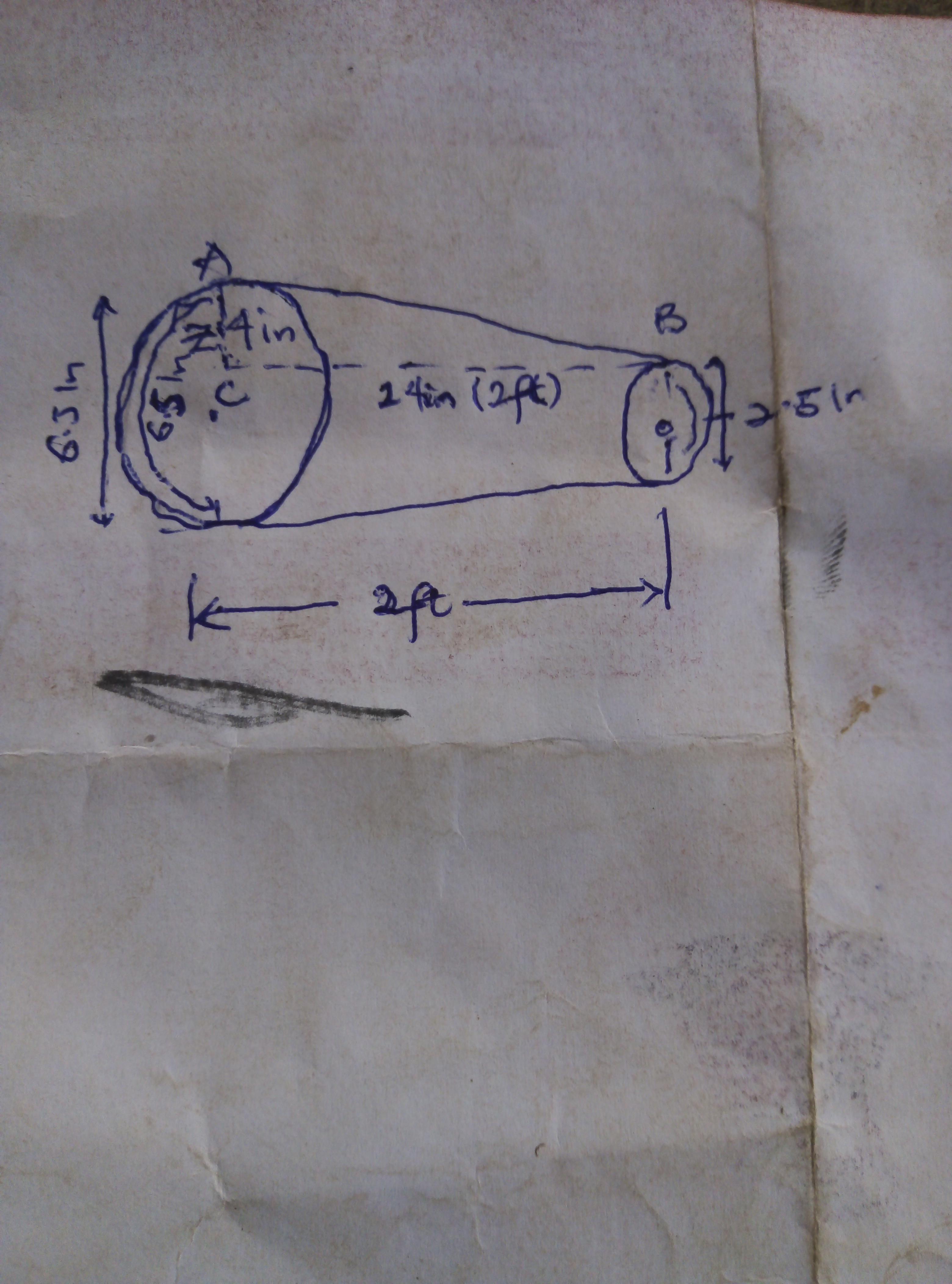
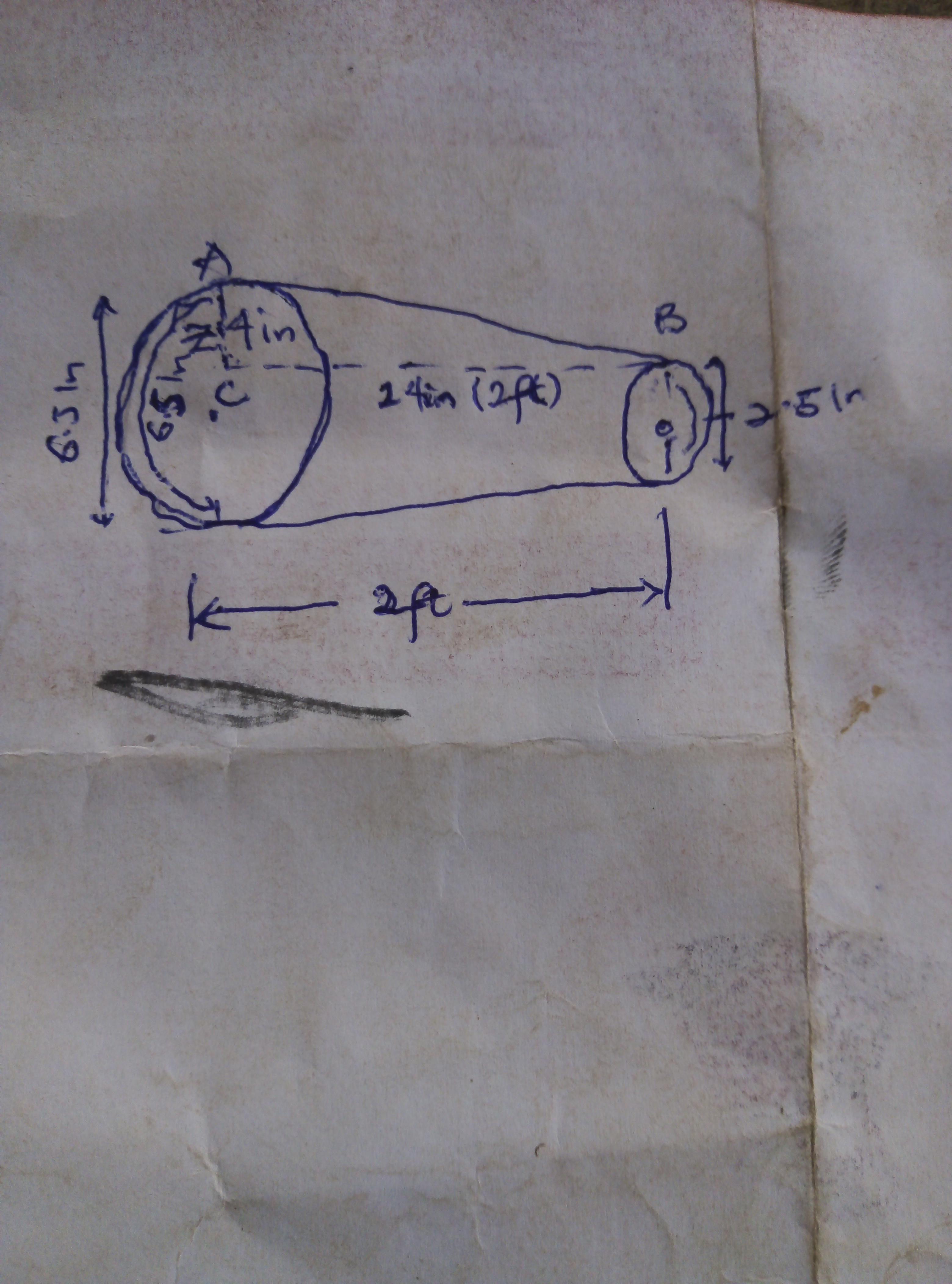
Difference in height of pulleys = radius 1st pulley - radius of second pulley ;

Height difference = 6.5 - 2.5 = 4 in

From the diagram attached ;

AB = sqrt(BC^2 - AC^2)

Length of belt (AB) = sqrt( 24^2 - 4^2)

Length of belt = sqrt(576 - 16)

Length of belt = sqrt(560)

Length of belt = 23.66 in
You might be interested in
A machine is currently set to a feed rate of 5.921 inches per minute (IPM). Te machinist changes this setting to 6.088 IPM. By h
lukranit [14]

Answer:

By 16.7% or 0.167 IPM

Explanation:

Substracting the final IPM (6.088) to the initial IPM (5.921) gives us the net difference, which is how much did it increase in IPM. Multiplying this number by 100 gives us the percentual increase in the feed rate.

4 0
2 years ago
Read 2 more answers
Which statement best explains the relationship between the wavelengths and the frequencies of all the waves in the electromagnet
sukhopar [10]
Which statement best explains the relationship between the wavelength and the frequencies of all the waves in the electromagnetic spectrum? 
B. <span>The higher the frequency of the waves, the lower their wavelength is.</span>
4 0
2 years ago
Cylinder A is moving downward with a velocity of 3 m/s when the brake is suddenly applied to the drum. Knowing that the cylinder
Xelga [282]

Answer:

Incomplete question

Check attachment for the given diagram

Explanation:

Given that,

Initial Velocity of drum

u=3m/s

Distance travelled before coming to rest is 6m

Since it comes to rest, then, the final velocity is 0m/s

v=3m/s

Using equation of motion to calculate the linear acceleration or tangential acceleration

v²=u²+2as

0²=3²+2×a×6

0=9+12a

12a=-9

Then, a=-9/12

a=-0.75m/s²

The negative sign shows that the cylinder is decelerating.

Then, a=0.75m/s²

So, using the relationship between linear acceleration and angular acceleration.

a=αr

Where

a is linear acceleration

α is angular acceleration

And r is radius

α=a/r

From the diagram r=250mm=0.25m

Then,

α=0.75/0.25

α =3rad/sec²

The angular acceleration is =3rad/s²

b. Time take to come to rest

Using equation of motion

v=u+at

0=3-0.75t

0.75t=3

Then, t=3/0.75

t=4 secs

The time take to come to rest is 4s

7 0
2 years ago
Physics professor Antonia Moreno is pushed up a ramp inclined upward at an angle 31.0 ∘ above the horizontal as she sits in her
DerKrebs [107]

Answer:

The answer is below

Explanation:

Given that:

mass (m) = 86 kg, distance (L) = 2.75 m, θ = 31°, force (F) = 595 N, initial velocity (v_i) = 2.4 m/s, g = acceleration due to gravity = 9.8 m/s²

The net work can be gotten from the equation:

W_{net}=Fcos(\theta)L-mgsin(\theta)L\\\\W_{net}=595*cos(31)*2.75-[86*9.81*sin(31)*2.75)\\\\W_{net}=1402.54-1194.92\\\\W_{net}=207.62

From the work-energy theorem equation, we can get her speed at the top of the ramp (v_f)

Hence:

W_{net}=change\ in\ kinetic\ energy\\\\W_{net}=\frac{1}{2}m(v_f^2-v_i^2 )\\\\2W_{net}=m(v_f^2-v_i^2 )\\\\v_i=\sqrt{ v_i^2+\frac{2W_{net}}{m}} \\\\v_f=\sqrt{ 2.4^2+\frac{2*207.62}{86}}}\\\\v_f=3.25\ m/s

8 0
2 years ago
The gas tank of Dave’s car has a capacity of 12 gallons. The tank was 38 full before Dave filled it to capacity. It cost him $2.
m_a_m_a [10]

Answer:

$ 18.75            

Explanation:

given,                                              

capacity of the Dave’s car = 12 gallons

Assuming that the tank is 3/8 full before

Cost of gas per gallon =  $2.50 per gallon of gas

Volume Dave have to fill                      

       =1 - \dfrac{3}{8}                          

       =\dfrac{5}{8} of full tank              

       =\dfrac{5}{8}\times 12              

volume Dave have to fill = 7.5 gallons          

total money Dave spent                  

     = 7.5 gallons x $2.50                

     = $ 18.75                                            

Dave have to spend $ 18.75 to fill tank to it capacity.

5 0
2 years ago
Read 2 more answers
Other questions:
  • What differentiates baseline activities from health-enhancing activities?
    15·2 answers
  • If the frequencies of two component waves are 24 Hz and 20 Hz, they should produce _______ beats per second.
    10·2 answers
  • What is needed to give a large boulder a large acceleration?
    14·2 answers
  • A student holds one end of a thread, which is wrapped around a cylindrical spool, as shown above. The student then drops the spo
    8·1 answer
  • What affects the way a projectile performs when it is shot from a firearm?
    10·2 answers
  • A foam ball of mass 0.150 g carries a charge of -2.00 nC. The ball is placed inside a uniform electric field, and is suspended a
    5·1 answer
  • A new technology company is marketing drones for residential use. The bar graph shows the relation between number of sales and t
    12·1 answer
  • On average, both arms and hands together account for 13% of a person's mass, while the head is 7.0% and the trunk and legs accou
    8·1 answer
  • If the ac peak voltage across a 100-ohm resistor is 120 V, then the average power dissipated by the resistor is ________
    12·1 answer
  • the container is filled with liquid. the depth of liquid is 60 cm. if it is exerting the pressure of 2000pa. calculate the densi
    11·1 answer
Add answer
Login
Not registered? Fast signup
Signup
Login Signup
Ask question!